

SFP Modules
-
Product
range - Guide
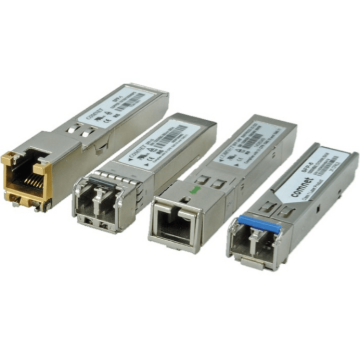

GUIDE
The SFP Module and Its Applications
The abbreviation SFP comes from English and stands for "Small Form-factor Pluggable," which roughly means "small form-factor pluggable."
An SFP module is a standardized so-called transceiver module (learn here what a transceiver module is), which is used in networking for high data rates and speeds in the gigabit range (Gbit/s), e.g., to enable "real-time network connections." Thanks to the SFP module's ability to transmit as well as to receive data, these modules are able to establish a bidirectional (two-way) connection between two network points (e.g., IP camera in building A and control center in building B). The use of SFP modules is especially recommended for transmitting very large amounts of data.
Frequently Asked Questions (FAQ)
What is an SFP?
SFP stands for "Small Form-factor Pluggable," which roughly means "small form-factor pluggable." It is a hot-plug module (it can be plugged in and unplugged during operation without restarting the system) that is inserted into a network device such as a switch. SFP modules, also called SFP transceivers, are used in networking to achieve fast communication with large amounts of data over longer distances. With an SFP, data transmission usually takes place via LWL (fiber-optic cable), also called fiber optics.
What is an SFP and SFP+?
SFP (Small Form-factor Pluggable) is a communication module that is plugged into a switch to achieve fast communication with large amounts of data over longer distances via fiber optics. An SFP enables transmission over one lane with a data rate of up to 4 Gbit/s.
The SFP+ (Enhanced Small Form-factor Pluggable) is a further development of the SFP, which likewise transmits data over only one lane, but with a data rate of up to 16 Gbit/s. The SFP+ is mostly used to build a 10 Gigabit network.
What types of SFP are there?
- SFP (Small Form-factor Pluggable) are modules, also called transceivers, that enable data transmission over one lane (channel) with a data rate of up to 4 gigabits per second (Gbit/s).
- SFP+ (Enhanced Small Form-factor Pluggable) is an enhanced version of the standard SFP that likewise enables data transmission over only one lane, but with a data rate of up to 16 gigabits per second (Gbit/s).
SFP+ modules or transceivers are mostly used for fast 10 Gigabit networks. - SFP28 (Small Form-factor Pluggable 28) ensures data transmission over 4 different lanes (channels) with a data rate of up to 28 Gbit/s per lane. Accordingly, the SFP28 module makes it possible to convert a 100Gbit/s port into 4X 25Gbit/s.
- QSFP (Quad Small Form-factor Pluggable) ensures data transmission in quad (four-fold) over 4 different lanes (channels) with a data rate of 1.25 Gbit/s per channel and a total transmission rate of up to 4 Gbit/s
- QSFP+ (Enhanced Quad Small Form Factor Pluggable+) A transceiver likewise allows quadruple transmission through quad, but with a data volume of 10 Gbit/s per channel and thus a total data volume of 40 Gbit/s.
- QSFP28 (Quad Small Form-Factor Pluggable 28) Modules or transceivers are suitable for 100G network applications and ensure a data rate of up to 28 Gbit/s per channel through quad transmission, as well as a 2x 50G breakout connection with a transfer rate of up to 100 Gbit/s.
- QSFP-DD, also called QSFP56-DD (Quad Small Form-factor Pluggable – Double Density) modules or transceivers are, thanks to their capability of eightfold data transmission over 8 channels with a data rate of 400 Gbit/s to 800 Gbit/s, the most powerful among the SFP.
How fast is SFP?
Standard SFP modules or transceivers offer a transmission speed over just one lane (channel) of up to 4 Gbit/s (gigabits per second).
Which fiber optic cable for SFP?
Depending on the application, multimode as well as singlemode fiber optic cables can be connected in conjunction with an SFP module or transceiver. As a rule, singlemode fiber optic cables are used to provide longer transmission distances with fast data transmission. Multimode fiber optic cables are best suited for shorter transmission distances with high data volumes.
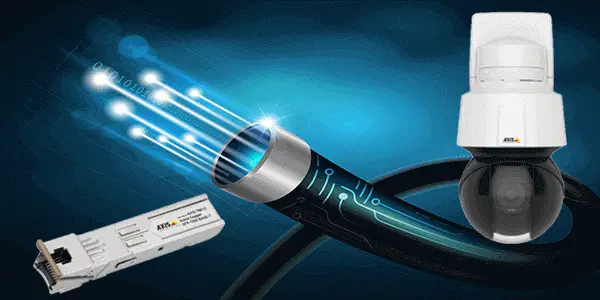
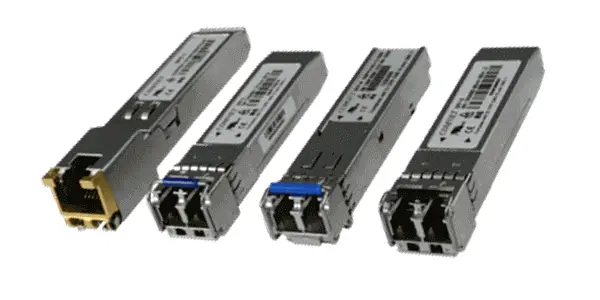
SFP modules are most often used as connecting elements for Fibre Channels (fiberglass cables, also called LWL fiber optic cables), which allows a fiber optic line to be connected to, for example, a switch. Depending on the application, singlemode as well as multimode fiber optic cables can be connected to the switch. Basically, in the field of video surveillance, singlemode fiber optic cables are used for longer distances with a fast data rate, such as for a far-away surveillance camera. Multimode fiber optic cables, on the other hand, are suitable for shorter distances with high data volumes, for example to connect a switch that controls several high-resolution IP cameras with a NAS (Network Attached Storage).
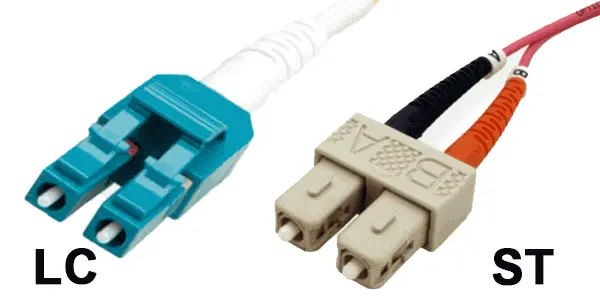
Regardless of singlemode or multimode, the most common fiber optic cables use so-called LC connectors or SC connectors (Figure 3) to connect to the SFP module. The counterpart of the SFP module, into which it is plugged in the respective device, is a so-called SFP port (Figure 4). SFP ports are “hot-swappable” capable, which means they allow the SFP module to be inserted and removed during operation (hot swap) without the switch or NVR (network video recorder) having to be shut down.
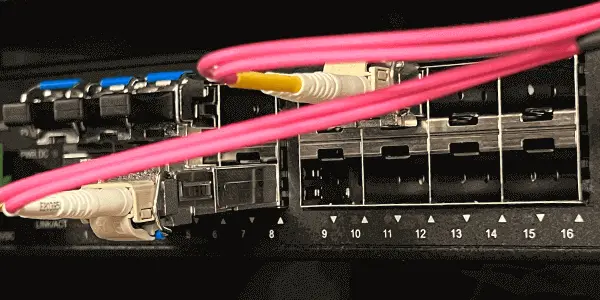
What types of SFP modules are there?
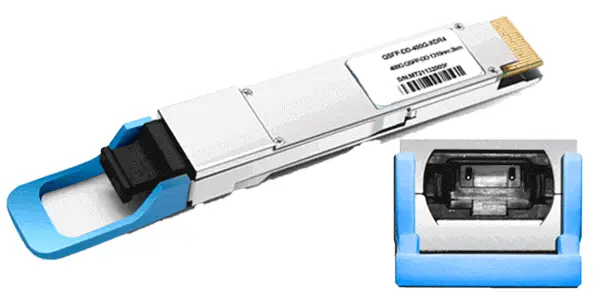
Our networking range includes various types of SFP modules, such as SFP, SFP+, SFP28 (Figure 5) as well as QSFP, QSFP+, QSP28 and QSFP-DD (Figure 6). They differ from one another in data rate, measured in Gbits/s (gigabits per second), and in transmission technology through so-called lanes (tracks or channels), depending on the model, as follows:
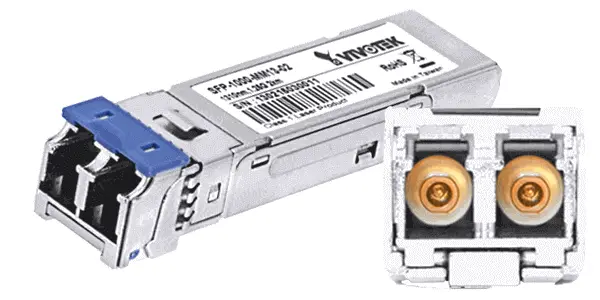
- SFP (Small Form-factor Pluggable) enables transmission over one lane with a data rate of up to 4 Gbit/s.
- SFP+ (Enhanced Small Form-factor Pluggable) is a further development of SFP and likewise enables transmission over only one lane, but with a data rate of up to 16 Gbit/s. SFP+ modules are mostly used to implement 10 Gigabit Ethernet.
- SFP28 (Small Form-factor Pluggable 28) is capable of transmitting over 4 different lanes with a data rate of up to 28 Gbit/s per lane. Accordingly, the SFP28 module can convert a 100Gbit/s port into 4x 25Gbit/s.
- QSFP (Quad Small Form-factor Pluggable) enables quad (fourfold) transmission over 4 lanes (channels), each with a data rate of 1.25 Gbit/s per lane and a total throughput of up to 4 Gbit/s.
- QSFP+ (Enhanced Quad Small Form Factor Pluggable+) also enables fourfold transmission via quad, but with a data rate of 10 Gbit/s per lane and a total throughput of 40 Gbit/s.
- QSFP28 (Quad Small Form-Factor Pluggable 28) is designed for 100G applications and, through quad transmission, enables a data rate of up to 28Gbit/s per lane as well as a 2x 50G breakout connection with a total throughput of up to 100 Gbit/s.
- QSFP-DD also called QSFP56-DD (Quad Small Form-factor Pluggable – Double Density) is the most powerful of the SFP modules and enables eightfold transmission over 8 lanes with a data rate of 400 Gbit/s to 800 Gbit/s.
Which SFP modules are compatible with which SFP ports?
SFP modules and SFP+ modules have the same dimensions but are in some cases different. For example, an SFP+ port can support an SFP module depending on the type, but not the other way round. However, please note that not all SFP+ ports offer this support.
SFP+ modules can also be operated with an SFP28 port, but the data rate at the port must be reduced to 10 Gbit/s.
QSFP ports are generally compatible with all QSFP modules, but a QSFP module only supports its own data rate.
Due to their dimensions, SFP modules are not compatible with QSFP ports, and vice versa.
Dimensions of SFP modules:
| SFP | 8.5mm height x 13.4mm width x 56.5mm length |
| SFP+ | 8.5mm height x 13.4mm width x 56.5mm length |
| SFP28 | 8.5mm height x 13.4mm width x 56.5mm length |
| QSFP | 8.5mm height x 18.35mm width x 72mm length |
| QSFP+ | 8.5mm height x 18.35mm width x 72mm length |
| QSFP28 | 8.5mm height x 18.35mm width x 72mm length |
| QSFP-DD | 8.5mm height x 18.35mm width x 72mm length |
Our Expert Tip: To prevent bottlenecks in the network architecture, we recommend using the same SFP modules for video surveillance that are also suitable for the SFP ports of the switch.
Applications of SFP Modules
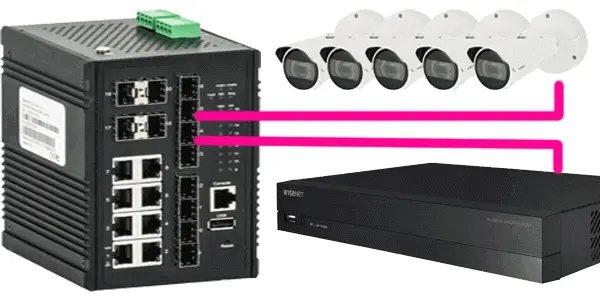
In the field of video surveillance, SFP modules are used to network the switches and the associated surveillance cameras with one another (Figure 7), which enables communication between several decentralized locations on one site. A typical application of such video surveillance (Figure 8) would be, for example, when several buildings on one site must each be monitored independently but all come together in a video surveillance system in a control center or surveillance room.

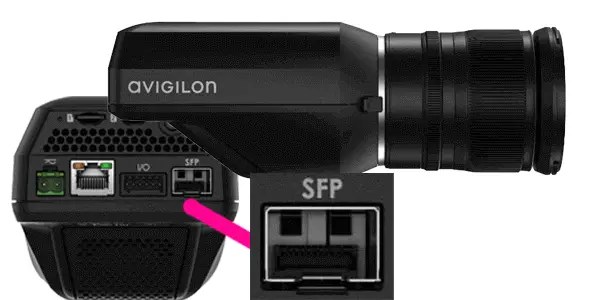
IP cameras with a very high resolution of, for example, 32 megapixels can also be connected directly to an NVR (network video recorder) via fiber optic cable using an SFP module, so that the high data volume of the IP camera can be transmitted at full FPS (frame rate) without latency (image delay). These are usually IP cameras with multiple lenses, such as a panoramic camera (Figure 9), or a surveillance camera that has only one lens (Figure 10) but offers an extremely high resolution of 40 MP.

Especially in video surveillance applications such as street surveillance, highway surveillance (Figure 11), city surveillance, or airport surveillance (Figure 12), where the surveillance cameras are located far away and the surveillance images must be transmitted over long distances, data transmission via fiber optic cable is very effective. Without this type of transmission, the surveillance images would certainly reach the dispatch center with a far greater delay, making real-time surveillance impossible. Video surveillance in real time is an important factor in accidents for the response time of the police and rescue services, helping to ensure the safety of citizens.


Our online shop offers a wide range of SFP modules from various manufacturers, such as Axis, Barox, Commnet, Hikvision, Vivotek, Roline, Eneo, IFS and AMG, which are suitable for network applications in the field of video surveillance.
To help you choose the right SFP module for your video surveillance, our network technology expert team is happy to advise you.