

PoE Repeaters and Extenders
-
Product
range - Guide
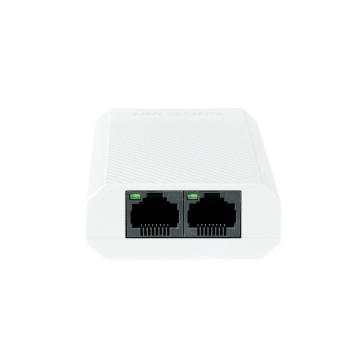

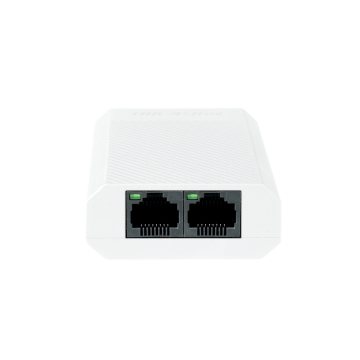
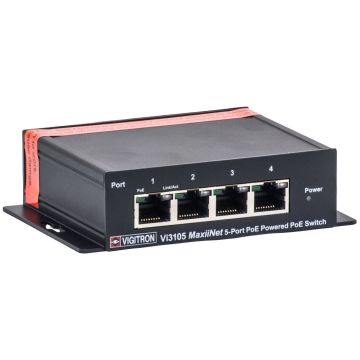

BUYER'S GUIDE
PoE Extenders and PoE Repeaters in Network Technology
In network technology for video surveillance, in addition to PoE injectors, there are further components for powering an IP camera, such as the PoE extender and the PoE repeater. Both terms come from English: "extender" means "Erweiterer" (expander), and "repeater" means "Wiederholer" (repeater). Technically, there is no difference between a PoE repeater and a PoE extender, since both components are responsible for extending the power supply over a PoE (Power over Ethernet) link and therefore serve the same purpose. The only difference lies in the names or designations, which depend on the manufacturer.
Frequently Asked Questions (FAQ)
What is a PoE extender?
PoE extenders, also called PoE repeaters, extend the power supply (PoE - Power over Ethernet) of a PoE-capable end device, such as an IP camera, beyond the 100-meter cable length limit. The cable connection is usually a network cable such as CAT5, CAT6, or CAT7. However, special PoE extenders can also transmit power over coaxial cable or two-wire cable.
How does a PoE extender or PoE repeater work?
PoE extenders or PoE repeaters forward data and power, which they receive from a PoE injector or PoE switch, to an end device such as a surveillance camera, thereby increasing the transmission range of the network connection. Depending on the type and manufacturer, PoE extenders and PoE repeaters draw between 4 and 5 watts from the total power received (PoE budget) for their own power supply, so a power outlet at the extender is not necessary. Example: a PoE extender receives 30 watts from a PoE+ injector according to IEEE 802.3af, of which it draws 5 watts for its own supply and therefore forwards only 25 watts of PoE to the network device.
Regarding data throughput, depending on the manufacturer and model, PoE extenders and PoE repeaters can receive and forward up to 1 gigabit per second (Gbit/s).
What types of PoE extenders or PoE repeaters are there?
The most widespread are PoE extenders and PoE repeaters for transmissions over a network cable (CAT5 - Cat7). Another type is the PoC (Power over Coax) extender and repeater, which can transmit power and data over a coaxial cable (antenna cable). For applications such as intercom or door intercom systems, "two-wire" extenders and repeaters are often used, which can forward data and power over ordinary power and telephone lines.
What is the difference between a PoE injector and a PoE extender or repeater?
A PoE injector is generally connected to a power outlet for its own power supply and can supply a network device with power and data over a CAT cable at a maximum distance of up to 100 meters. From a cable length of 100 meters, a PoE extender or repeater is required to ensure further power supply and data communication. The PoE extender or repeater receives the voltage it needs for its own operation from the PoE injector.
What is passive PoE?
Passive Power over Ethernet does not conform to any IEEE standard. Because there is no “handshake procedure” (negotiation and communication process) by which network devices are protected against overvoltage, as is the case with the IEEE 802.3af or IEEE 802.3at PoE standards, passive PoE always supplies the maximum voltage.
Transmission methods of extenders and repeaters
Since various cable media such as network cable, coaxial cable and two-wire cable are available for surveillance cameras in the field of video surveillance, network technology provides suitable extenders or repeaters for the respective transmission method or power supply. The extenders or repeaters (Figure 1) designated PoC (Power over Coax) differ from conventional PoE extenders and PoE repeaters (Figure 2) in the type of cabling, as they transmit the required voltage via coaxial cable (antenna cable). Depending on their equipment, PoC extenders and PoC repeaters can be used to supply power to an IP camera as well as to an analog HD surveillance camera.
Extenders or repeaters suitable for transmission over two-wire cable are used more in security technology applications, such as door intercom systems, than in video surveillance.


How PoE extenders and PoE repeaters work
In principle, powering an IP camera via a PoE injector or PoE switch over a CAT cable is possible up to a maximum cable length of 100 meters. If this cable length is exceeded, an extender or repeater is required beyond 100 meters (Figure 3) to maintain PoE power supply to the surveillance camera over the same cable. Accordingly, a new PoE extender or PoE repeater must be used every 100 meters of cable length (Figure 4) to achieve power supply over several hundred meters.


In this setup, the PoE extenders and PoE repeaters are themselves powered via the CAT cable with PoE and require no additional power input from an electrical outlet. Power over Ethernet (PoE) extenders and repeaters usually receive both data and the required power from a PoE injector or PoE switch. Since they themselves require 4 to 5 watts for their own operation, this amount must be deducted from the total input power of the available PoE budget for optimal power supply to the end device, the IP camera.
A simple calculation example: A PoE input power of 30 watts to the extender or repeater from a PoE injector or switch results in a PoE output power from the extender or repeater to the surveillance camera of only 25 watts.
Depending on the cable length, multiple extenders or repeaters can be used within one network connection in a so-called cascading method to power the IP camera over several hundred meters. However, the total available PoE budget is reduced accordingly the more extenders or repeaters are used. The following table (Figure 5) shows the effect of the number of PoE extenders or repeaters used on the available PoE power.
|
Number of extenders |
Cable length |
Input power from PoE injector/ switch |
Output power from extender/ repeater to IP camera |
|
1 |
200 m |
25 W |
20 W |
|
2 |
300 m |
20 W |
15 W |
|
3 |
400 m |
15 W |
10 W |
|
4 |
500 m |
10 W |
5 W |
Important factors for extending the PoE connection with PoE extenders and PoE repeaters
The extension range of the PoE connection from a switch or PoE injector to the IP camera using PoE extenders or PoE repeaters depends on several factors.
- One of the most important factors for ensuring a suitable power supply through an extender or repeater is first determining the maximum power required by the IP camera (including infrared illuminators, heating, ventilation, etc.). The performance of the PoE extender or repeater depends on this. This information can usually be found in the IP camera's data sheet.
- Not all PoE extenders or repeaters can be connected in series (cascading method) to extend the PoE connection multiple times over a single CAT cable. It is therefore important to follow the manufacturer's product description or seek technical advice.
- PoE+ extenders and repeaters are limited to a maximum power of up to 30 watts, while Ultra PoE extenders can handle and deliver power levels of 60 to 90 watts. To supply power to a long cable run with PoE through cascaded extenders and repeaters, the rule applies: "the higher the input power, the greater the distance of the PoE supply"
Our Expert Tip
To ensure optimal expansion of the power supply for an IP camera, we recommend allowing enough headroom between the input power and output power of the PoE extender or PoE repeater. For example, if the surveillance camera requires a maximum output of 20 watts, an input power of 30 watts is definitely recommended. Especially in winter at lower temperatures, when the IP camera must be continuously heated, an adequate reserve of PoE budget effectively contributes to the reliability of video surveillance. Therefore, it is better to have more power available and not need it than to need it and not have it. The total power consumption of the surveillance camera over the entire year does not change at all. Thanks to the "handshake procedure" of PoE transmission, voltage is only drawn when it is actually needed.
Our online shop for professional video surveillance offers a wide range of extenders and repeaters from renowned manufacturers such as Axis, Hikvision, Hanwha Techwin, Bosch, Vivotek, Comnet, Nitek, Seeeyes, Veracity and Dahua. To help you confidently make the right choice of a suitable extender or repeater for your video surveillance from the start, our expert team is happy to provide advice.