

Surveillance Cameras - Online Shop and Buying Guide
Our current offers on popular IP cameras and Wi-Fi cameras for July 2026. Buy your surveillance camera from the specialist, with guaranteed free customer support:
Surveillance Cameras - Online Shop and Buying Guide
Our current offers on popular IP cameras and Wi-Fi cameras for July 2026! Buy your surveillance camera from the specialist, with guaranteed free customer support:

German Protect Surveillance Camera Buying Guide
Video Surveillance with Audio: Is It Allowed?

German Protect Knowledge: Everything You Need to Know About Installing a Surveillance Camera
Which Surveillance Camera Does the Police Recommend?
Surveillance Camera Guide: Everything About Choosing the Right Camera, Features, Costs and the Best Manufacturers
Surveillance Camera Guide:
Everything About Choosing the Right Camera, Features, Costs and the Best Manufacturers
The Essentials in Brief
The Essentials in Brief
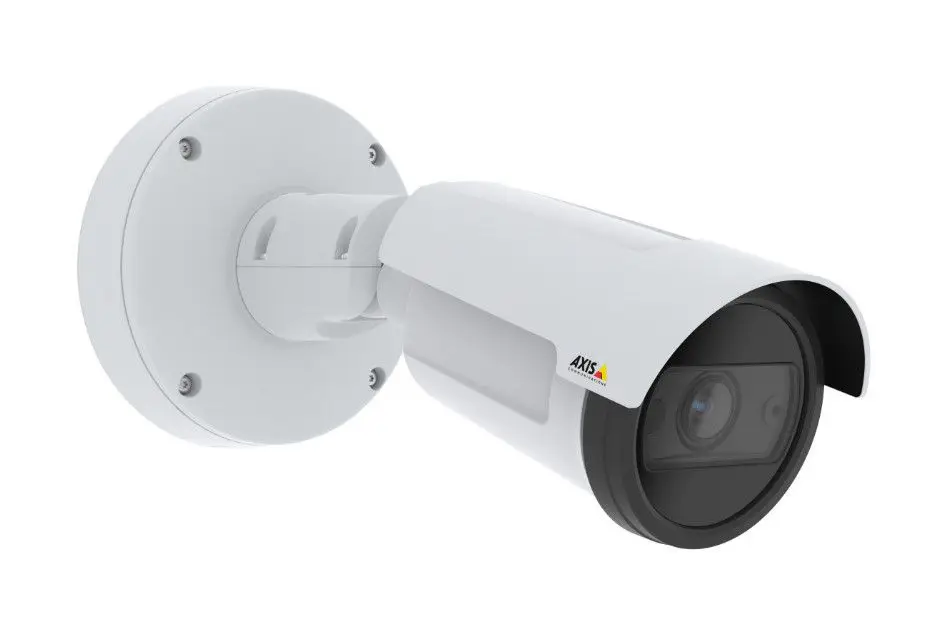 German Protect offers you a large selection of over 3,000 surveillance cameras in a wide range of price segments, designs and popular brands. As a multiple award-winning and certified online specialist retailer, we offer you everything you need for the right video surveillance in the private, commercial, public and government sectors.
- Surveillance cameras protect every type of building, such as apartments, houses, and commercial or industrial properties, against intruders and vandalism, and contribute to a sense of security and, accordingly, a good quality of life.
- The market and technology for IP cameras are developing at a rapid pace, but there are also major differences in consistent reliability between systems and manufacturers. In our guide, we therefore give you an overview of the most important factors when buying a reliable and affordable camera.
- The rapid development in the field of video surveillance now provides private and commercial users with a broad range of features for increasingly demanding applications and requirements. As specialist installers, we work with our trained customer support team to find the right solution for your application - we are happy to advise you.
The Essentials at a Glance
- German Protect offers you a wide selection of more than 3,000 surveillance cameras in a variety of price ranges, designs and popular brands. As a multiple award-winning and certified online specialist retailer, we offer you everything you need for the right video surveillance in the private, commercial, public and government sectors.
- Surveillance cameras protect every type of building, such as apartments, houses, and commercial or industrial properties, against intruders and vandalism, and contribute to a sense of security and, accordingly, a good quality of life.
- The market and technology for IP cameras are developing at a rapid pace, but there are also big differences in quality when it comes to consistent reliability between systems and manufacturers. In our buying guide, we therefore give you an overview of the most important factors when buying a reliable and affordable camera.
- The rapid development in the field of video surveillance now provides both private and commercial users with a broad range of functions for increasingly demanding applications and requirements. As specialist dealers, together with our trained customer support team, we will find the right solution for your application – we are happy to advise you.
Frequently Asked Questions from Our Customers (FAQ)
What should you look for when buying your IP surveillance camera?
With the rapid advancement of technology, there are hardly any limits left for the IP surveillance camera. Because of the complexity of the areas of application of today's highly sophisticated surveillance cameras, manufacturers have focused especially on network surveillance camera technology in recent years and have developed it meticulously.
Analog technology, on the other hand, has hardly been considered in development by many manufacturers and will soon be a thing of the past. Seen this way, IP cameras are technically far superior to analog cameras and are always the technology preferred and recommended by experts.
It is therefore important, before buying an IP surveillance camera, to be sure which areas of application you want to use it for and what results you want to achieve with it. You can only be sure if you not only understand how an IP surveillance camera works, but also which hardware components and software contribute to its reliable functionality. With our guide, we as a specialist security retailer want to give our customers the opportunity to form an informed opinion before buying, with the help of experts, about the IP surveillance camera and what matters when choosing one. Of course, our technicians are also happy to assist you with detailed advice.
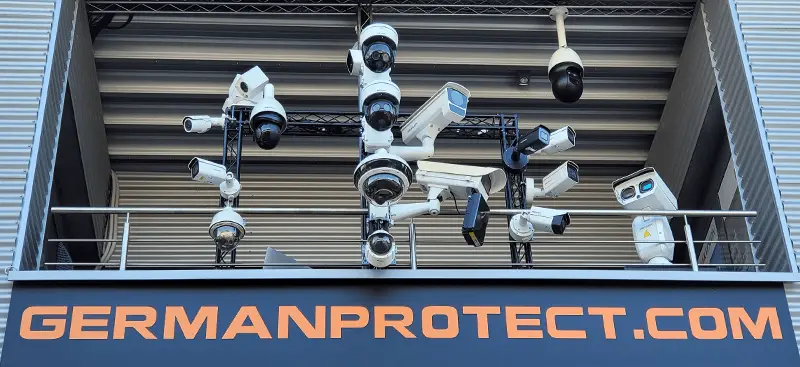
How are network cameras constructed and how do they work?
For image capture, an IP camera uses the same technology as analog systems: light passes through the usually interchangeable lens onto a light-sensitive CCD or CMOS chip. Every IP camera contains an integrated digital signal processor. Its task is to convert the images into a digital format and compress them. The resolution is camera-specific and can therefore be freely selected by the user across a wide range. Common resolutions range from 1920x1080 to 3840x2160 (this corresponds to Full HD or 4K UHD in TV technology). Top-of-the-line models work with 33 megapixels at 7680x4320 and more, though at a reduced frame rate.
At the output of an IP security camera, the data is available in digitized form so that it can be fed into a network. This can be done with wired LAN technology, but also over a Wi-Fi network. HD or 4K monitors can serve as receivers of the image signals for direct monitoring of the recorded images. The data is preferably archived on fast hard drives of sufficiently large capacity in a network video recorder. Integration into a network is what makes it possible to control all camera functions from a central location. With the appropriate configuration, it is even possible to control the IP camera from any location via app or client access and to retrieve the images it delivers in real time.
What are the advantages and disadvantages of IP surveillance cameras?
A high-quality IP camera for professional security technology delivers high-resolution images that reveal even the finest details.
Since the images are in digital form, they can be conveniently stored on a hard drive .
The lower prices for large hard drives therefore have a positive effect on archiving costs. Additional IP cameras can be connected at any time and integrated into the system.
If a network already exists, every IP security camera can be integrated into it using the existing cabling. This cabling is less susceptible to interference from external influences.
The IP camera's encryption software also enables data transmission that meets security requirements. The main advantage of IP video surveillance is remote access from virtually any computer via the internet and data exchange within the network with defined access rights.
The disadvantages include the fact that very high resolutions are sometimes accompanied by a reduction in frame rate . Due to the high data rates, incorrectly configured systems or hardware deficiencies can cause choppy images and delays (latency) when control commands are sent to the IP camera. This problem usually occurs when the hardware components are not matched to one another or designed for the respective performance required for smooth interoperation.
What connection types does a surveillance camera offer for transmitting video footage?
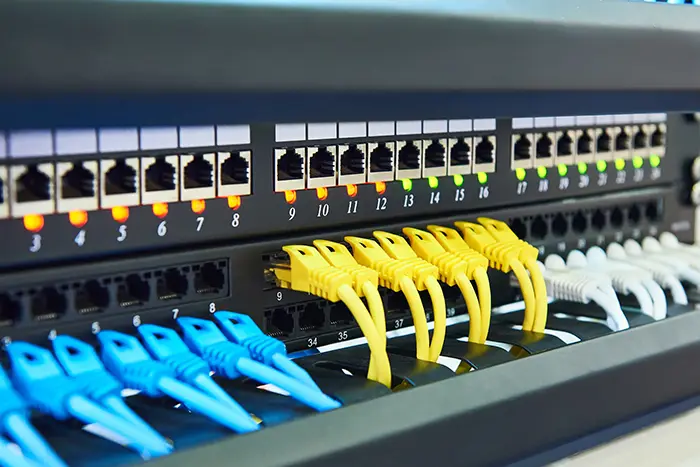 The footage captured by surveillance cameras must be transmitted to a central location for viewing or storage. Transmission can be wired or wireless. Wired IP cameras use LAN cabling. If the IP surveillance camera supports Power over Ethernet (PoE), it can be supplied via the network cable with the electrical power required for operation at the same time. Wired transmission has the advantage of being very secure and less susceptible to interference. Wi-Fi is generally used for wireless video transmission. Wireless surveillance cameras can be used very flexibly in a wide variety of locations.

Some analog or digital surveillance cameras transmit their images via coaxial cable. Typical digital standards for these devices are HDTVI, HDCVI, AHD and SDI. The advantage of this type of image transmission over coaxial cable is that the coaxial cabling already in place on site can be used to implement digitization in the multi-megapixel range.
What recording options are there for video surveillance technology?
So that security camera footage can be used not only for live monitoring but also accessed later, it has to be stored. Before deciding on a recording system, you should be aware that it is a security-relevant component and must therefore be secure and reliable.

Cloud: For security reasons, we do not recommend recording to a cloud. You never know who has access to the data or where the data is stored in the first place.

PC: We do not recommend continuous recording to a PC. The power consumption and the required system specifications are not cost-effective. Other data is constantly being stored on a PC as well, which often leads to system overload from live streams in the multi-megapixel range.

NAS: Storing to a NAS (Network Attached Storage) is only conditionally recommended, since the NAS must come from the video surveillance field. Today's cameras have their own built-in intelligence, which mass storage devices often cannot process. In addition, with a NAS you are tied to the manufacturers and camera types listed in the NAS compatibility list. If a camera is not listed, even though the manufacturer is on the list, implementation and above all correct functioning of the camera becomes a matter of luck. We very often get calls from customers after the NAS has performed an update, asking why the camera suddenly no longer works.

NVR: We generally recommend NVRs (Network Video Recorders) or DVRs (Digital Video Recorders) , as they are the easiest and most efficient for the user to operate. The variety of configuration options in programming is far greater than with other devices. An NVR is solely responsible for managing the video surveillance cameras.

Video servers: So-called video servers are an indispensable component in professional video surveillance and in connection with VMS (Video Management Software). With various VMS, it is possible to control and visualize multiple NVRs/DVRs and NAS devices from different locations on a single platform.
Deploying a video server on an intranet as well as on the internet allows multiple simultaneous client accesses in real time, regardless of their locations. Thanks to the high processing power of a video server, specialized analysis software, notification mechanisms and, ultimately, response mechanisms can be used and coordinated simultaneously.
What should be considered with video surveillance in commercial and private settings?
Video technology is increasingly being used in commercial and private settings as well. Easy handling, digital transmission paths, networked technology, affordable prices and monthly service flat rates make purchasing a video recording system or an alarm system as a security system equally attractive for businesses and private households.
All installations must comply with legal requirements. Especially with DIY installations of video technology or alarm systems, mistakes can occur that do not comply with the legal basis of German legislation. For every installation, you must consider where the IP surveillance camera can be mounted so that no unauthorized areas are within its field of view, such as a neighbor's property or a public street. Audio recording is also generally not permitted and is prohibited.
Buildings or properties that are privately owned are not clearly addressed by the GDPR. Accordingly, one might assume that owners can do as they please on their own private property and may therefore install and operate surveillance systems as they see fit.
Nevertheless, a private area is not always a law-free zone. Private individuals who, for example, use a camera system to secretly monitor the babysitter or to record unauthorized entry in order to protect themselves against burglars must also make this clearly visible. For example, by means of one or more signs in a visible area indicating that unauthorized entry onto the property or premises is prohibited and that the grounds/premises are protected electronically by permanent video surveillance. By visible area, we mean at eye level, so that before entering the grounds/premises, a person can decide whether or not they want to be recorded. On the other hand, placing a notice in the lower corner of a door would not be suitable.
Proper placement of the security notice sign (clearly visible to everyone) is of the utmost legal importance.
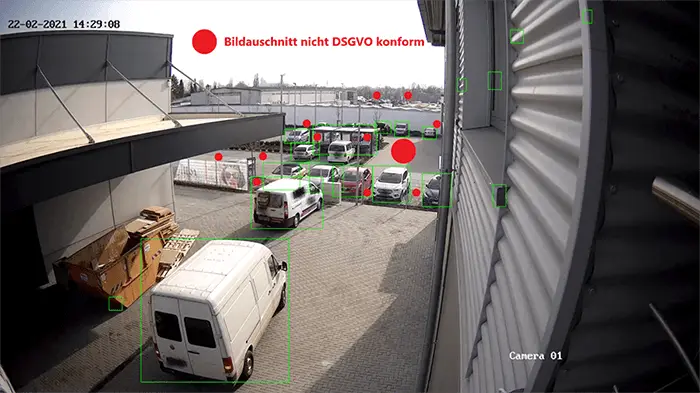
Audio recording on private property is generally only permitted if you can absolutely rule out that audio is recorded of anyone other than your family members and that the recording does not extend beyond your private property. Audio recordings of neighbors or neighboring properties, as well as of passersby on an adjacent street, are not permitted.
Please note that such violations can result in very high fines. Likewise, video surveillance of the hallway, the main entrance door or other shared areas in a multi-tenant apartment building is generally prohibited and violates general personality rights. These areas are accessible to all tenants and do not fall under the sole sovereign domain of one tenant or their exclusive domestic authority. Please note that such violations can result in very high fines.
Which image sensor size is right for my IP surveillance camera?
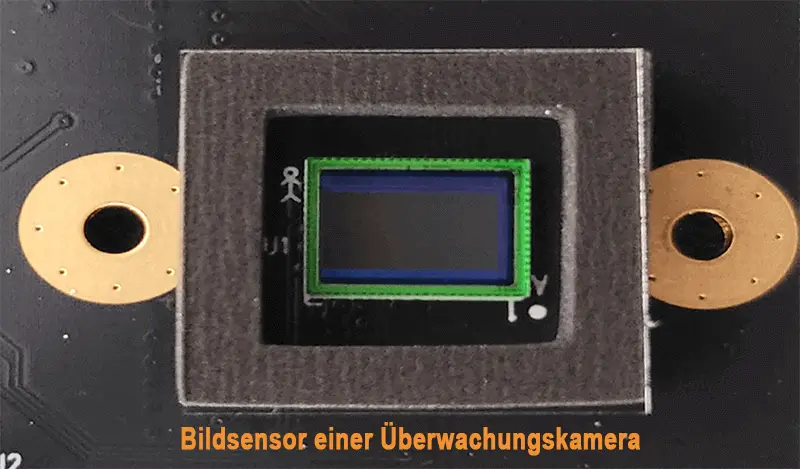
Many surveillance cameras in the low price segment, below the 150 euro mark, usually have very small image sensors installed. As a result, despite their high resolution, these surveillance cameras do not deliver the desired results at night, for example. For a reliably functioning surveillance camera, we recommend an image sensor size of 1/1.8 inch or larger.
Video surveillance at night poses special challenges for surveillance cameras. Because the image sensor's surface area is too small, and there are correspondingly too few pixels for the light to fall on, the surveillance camera is less light-sensitive at night. This results in heavy noise in the image, and dark areas are barely visible.
Even with the important WDR function (Wide Dynamic Range) switched on, the frame rate of the surveillance camera is suddenly reduced drastically, causing latency (image transmission delays).
This latency means that one or more frame sequences are missing from the video recordings. With fast movements such as running, a complete frame sequence in the video stream is very important so that the video recordings are more accurate.
Interested in more details? Learn more about this topic in our encyclopedia article: Image Sensors and Image Sensor Sizes >>
What resolutions are available for IP surveillance cameras?
Depending on the model, the resolution of an IP surveillance camera ranges from under one megapixel to 4K Ultra HD, 8K Ultra HD, and up to 32MP Full Resolution. The higher the resolution of an IP surveillance camera, the more details can be seen in the image, and the larger the field of view becomes. The resolution you choose depends on various factors such as the object distance, the size of the image area, and the details that need to be identified. A Full HD IP surveillance camera with 1920 x 1080 pixels, for example, makes it possible to create identification-quality images of people at distances of up to ten meters. License plates can even be recognized at up to 20 meters. For large image areas such as 180- or 360-degree panoramas and a high required level of detail, multi-sensor cameras with resolutions of 10, 20 or 32 megapixels are available. If only objects or people at a short distance and in a small area need to be captured, an IP camera with a low resolution in the lower megapixel range is sufficient.
The resolution of an IP surveillance camera indicates the number of visible pixels. The following resolutions are of particular importance in the field of video surveillance:
- 720p
- 1080p
- 4 megapixels
- 5 megapixels
- 6 megapixels
- 4K Ultra HD 8 megapixels
- 8K Ultra HD 33 megapixels
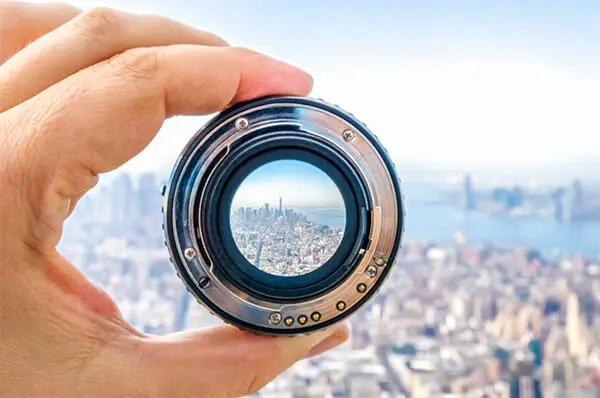
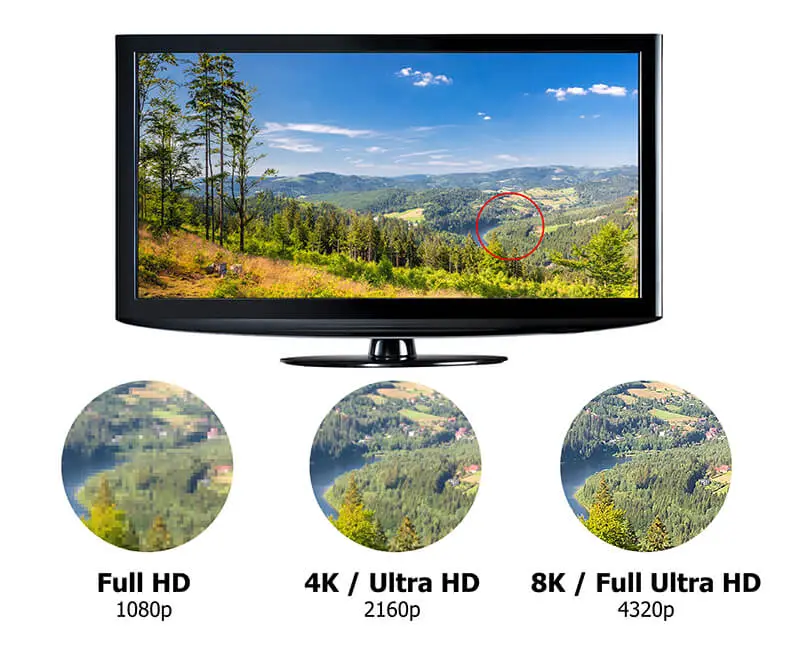
Figure 1: Different camera resolutions and image details
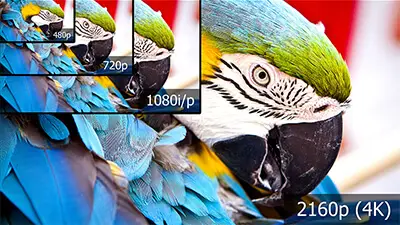
The higher the resolution, the more image information the video sequence contains. The more image information the video sequence contains, the more extensive the details that can be seen in the image. The more details you can see in the video sequence, the greater the chances of having usable forensic evidence available.
The resolution is determined by the size and quality of the image sensor in the camera. Image sensors are specified by the number of MP/megapixels (pixels). In our table, you can see how the number of megapixels (that is, pixels) in the image determines the resolution:
| Image resolution | Megapixel | Pixel ratio |
|---|---|---|
| 720p | 1 Mp / 720p | 1280x720 (921,600 pixels) |
| 1080p | 2 Mp / FULL HD 1080p | 1920x1080 (2,073,600 pixels) |
| 2K | 3 Mp / Super HD 2K | 2048x1536 (3,145,728 pixels 1.5 x 1080p) |
| 2x 1080p | 4 Mp / Super HD 2K | 2688x1520 (4,085,760 pixels 2.0 x 1080p) |
| Super HD | 5 Mp / Super HD 2K | 2592x1944 (5,038,848 pixels 2.5 x 1080p) |
| 4K | 8 Mp / Ultra HD 4K | 3840x2160 (8,294,400 pixels 4.0 x 1080p) |
| 8K 33MP | 33 Mp/ Ultra HD 8K | 7680x4320 (33,177,600 pixels 8.0x 1080p) |
What do pixels mean for an IP surveillance camera?
The ever faster technical development of CCD and CMOS sensors in the field of video surveillance makes it possible to produce increasingly fine semiconductor structures. The trend in the lower price segments of video surveillance is moving in one direction: both the sensors and the pixel sizes are getting smaller and smaller, so that more and more sensors can be punched out of a single wafer during production.
The shrinking pixel sizes are partially offset by the increased sensitivity of the pixel, but this is achieved and optimized electronically rather than through hardware. As a result, better noise tuning is also simulated accordingly. Simulated means that inexpensive surveillance cameras do achieve a high resolution for little money, but only under optimal lighting conditions.
Caution is advised before buying, because this is where the wheat is separated from the chaff in the field of video surveillance! For surveillance areas and applications with little and/or changing light, where low-noise images with a high dynamic range are required (for example, in a parking lot at night), not only the sensor size but also the pixel size is decisive.
Interested in more details? Learn more about this topic in our encyclopedia article: Everything About Pixels
Which IK impact resistance ratings are there for surveillance cameras?
The European standard for enclosures (EN 50295:98) includes the IK test class for impact resistance. This test is described in EN 50102.
| IK code | Protection against mechanical impact | |
|---|---|---|
| 00 |  |
no protection |
| 01-05 | 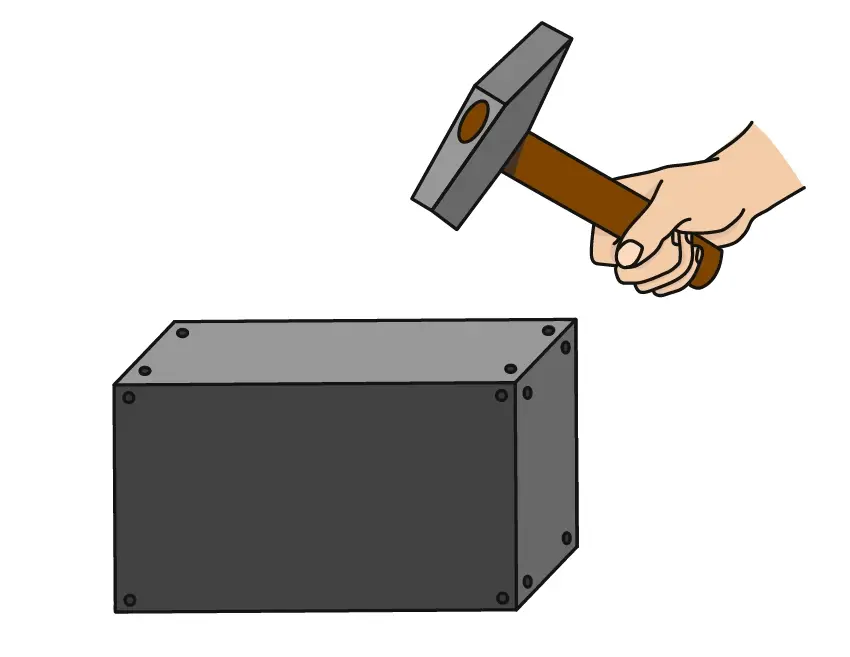 |
Impact < 1 joule |
| 06 | 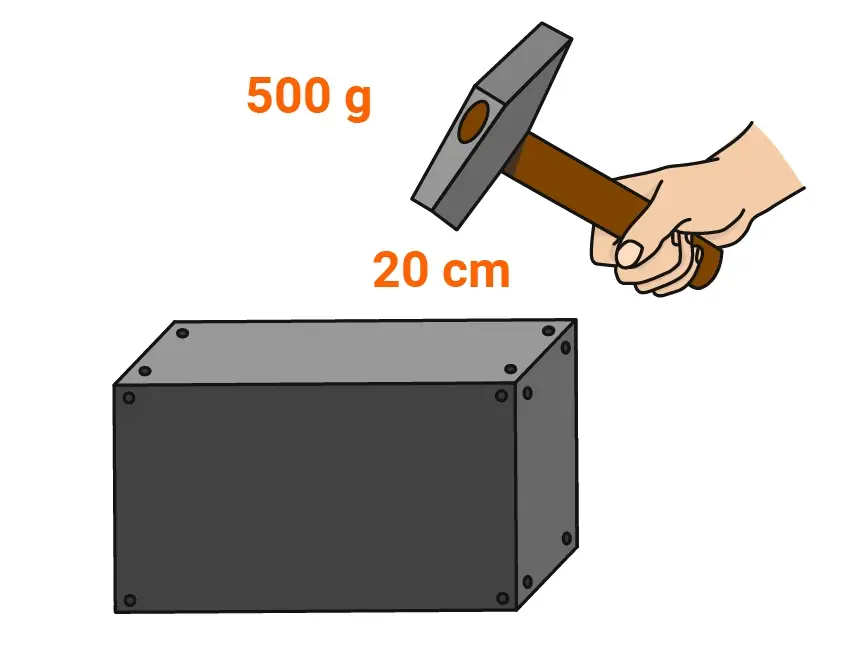 |
Impact 1 joule (500 g from a distance of 20 cm) |
| 07 | 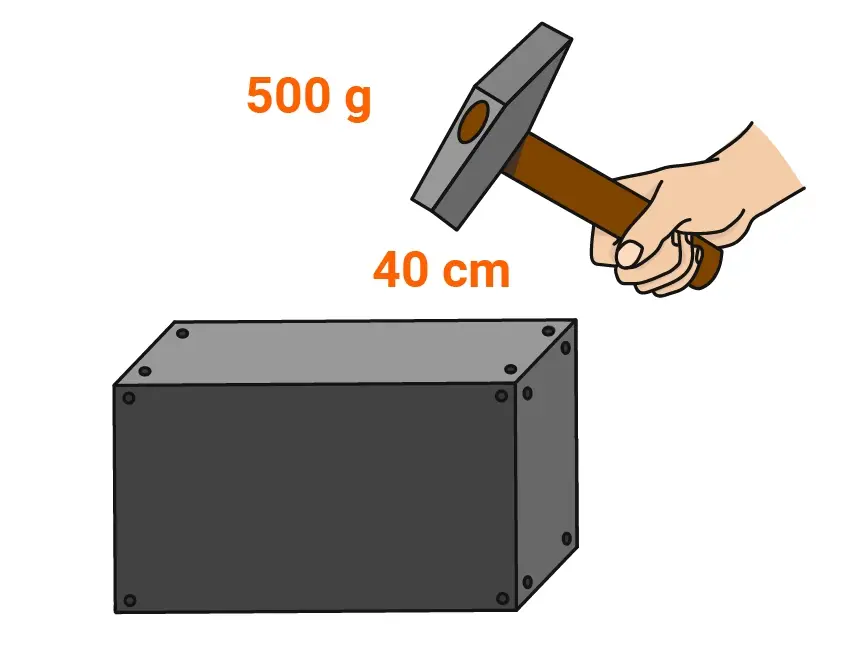 |
Impact 2 joules (500 g from a distance of 40 cm) |
| 08 | 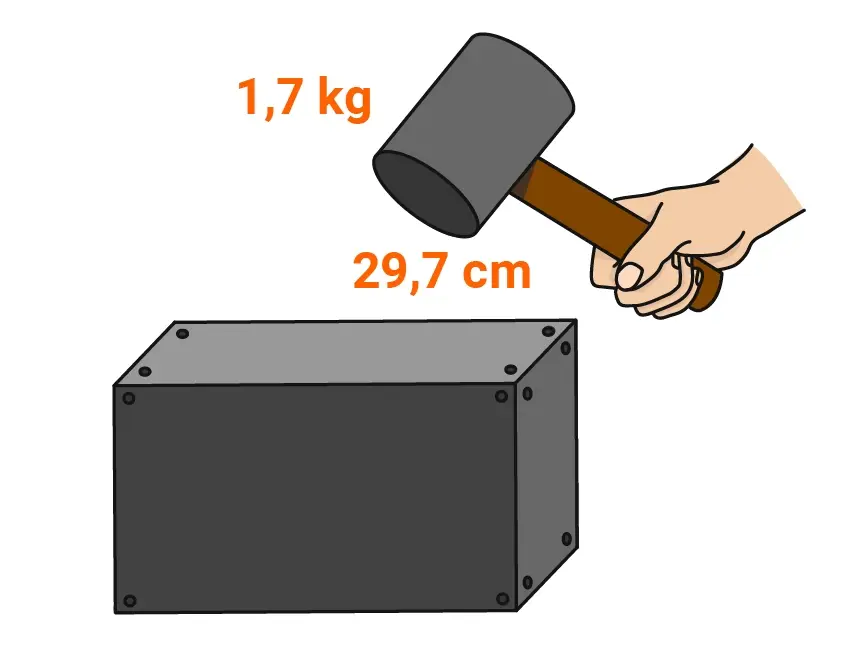 |
Impact 5 joules (1.7 kg from a distance of 29.5 cm) |
| 09 | 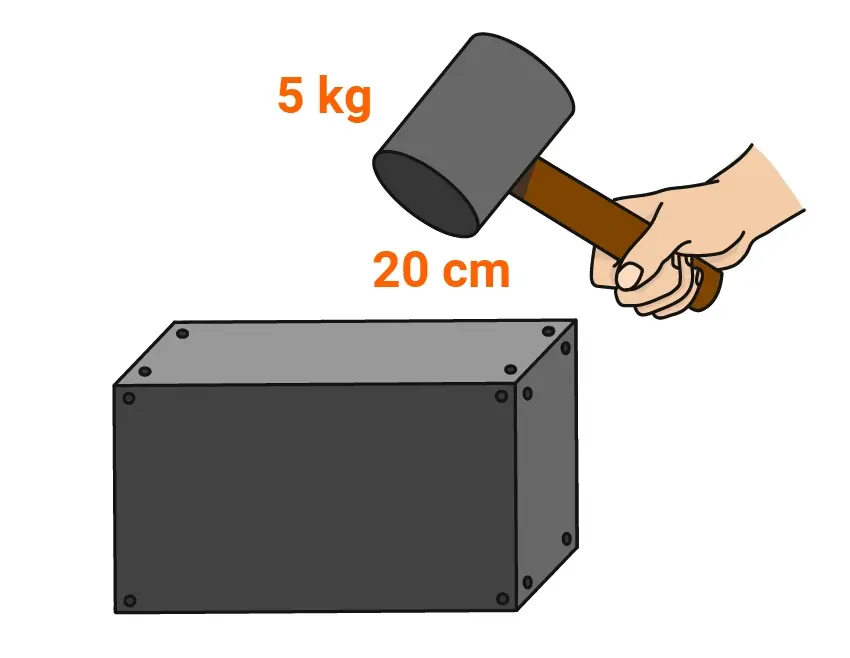 |
Impact 10 joules (5 kg from a distance of 20 cm) |
| 10 | 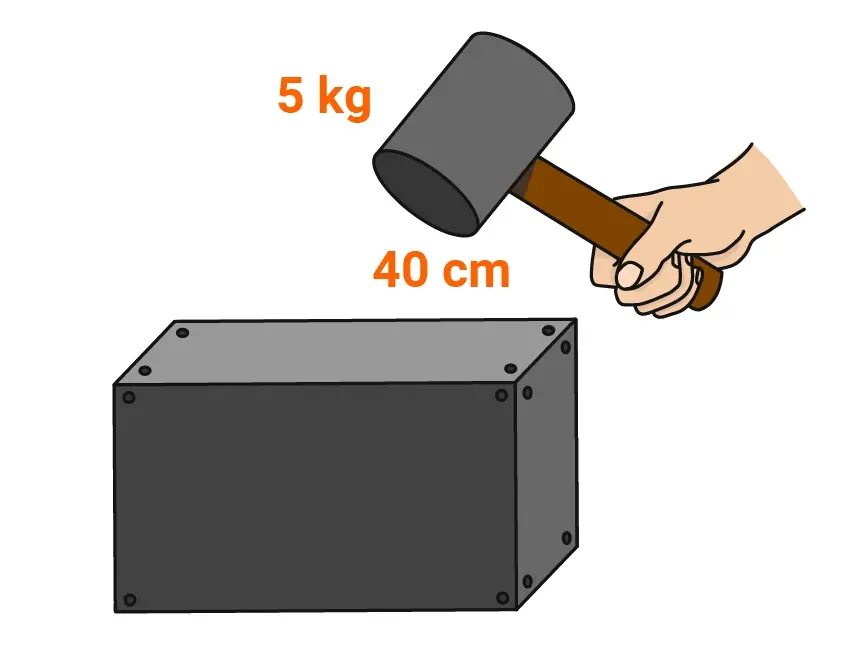 |
Impact 20 joules (5 kg from a distance of 40 cm) |
What is the IP rating for surveillance cameras?
What do the letters IP protection rating (IP number), such as IP65, mean? The abbreviation “IP” stands for “International Protection” or “Ingress Protection,” which means protection against intrusion. The first digit in the IP rating designation (IP65) indicates the protection against solid foreign objects, dust or contact. The second digit in the designation (IP65) describes the protection against the ingress of water.
What IP protection is required for surveillance cameras for outdoor use?
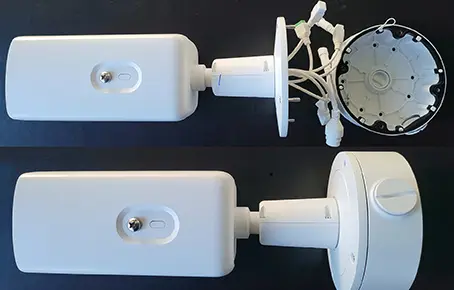
Why can fogging occur even with protected surveillance cameras?
We are often asked how the lens of an IP66-certified surveillance camera can suddenly fog up on the inside. This is usually because the camera was mounted on a façade without accessories, such as a dome camera in a vertical installation, or because the seals in the accessories were not installed correctly. It should also be taken into account here that surveillance cameras contain a lot of technology and that a lens often consists of several elements – both components are sensitive to moisture. In general, for surveillance cameras mounted on a pole or a façade (without a roof covering), we recommend protection ratings of IP65/66. Protection ratings above IP66 are only recommended for areas where extreme and sometimes constant weather conditions can occur, such as by the sea or in the mountains. If the area is covered, e.g. by a canopy, we recommend a protection rating of IP54 or higher. Surveillance cameras below protection rating IP54 are generally not recommended for outdoor use.
Latest News on Video Surveillance and Surveillance Cameras

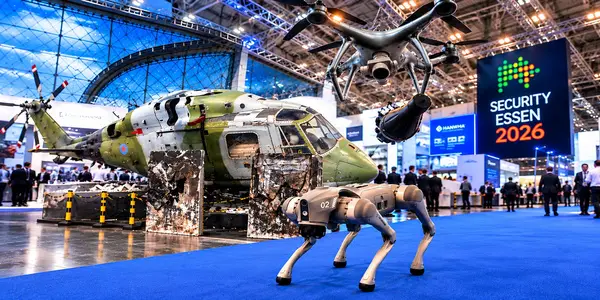
Security Essen 2026: Is Europe prepared for new threats?
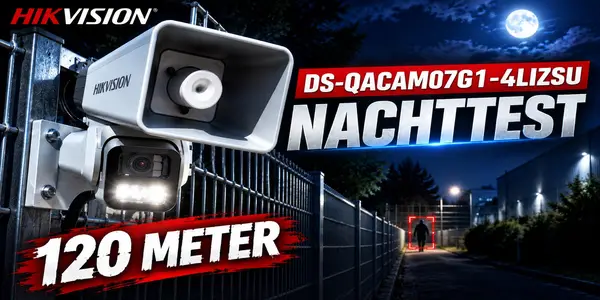
Hikvision Kamera DS-QACAM07G1-4LIZSU im German Protect Nachttest
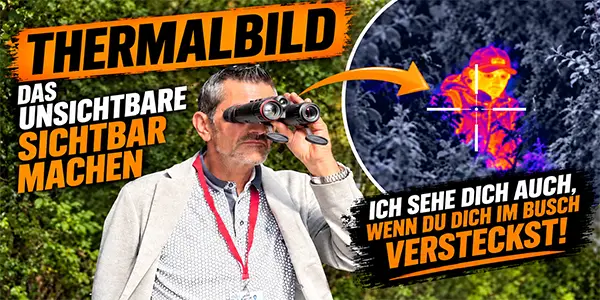
High-Tech in Action: Police and Emergency Services
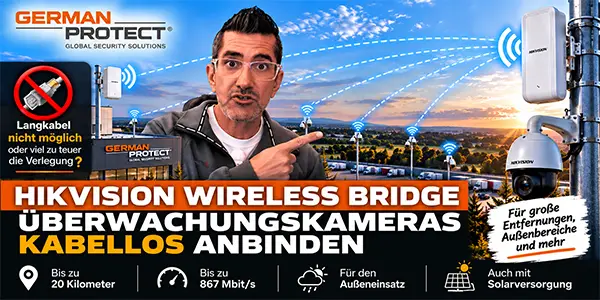
Hikvision Wireless Bridge: Connecting Outdoor Cameras Wirelessly
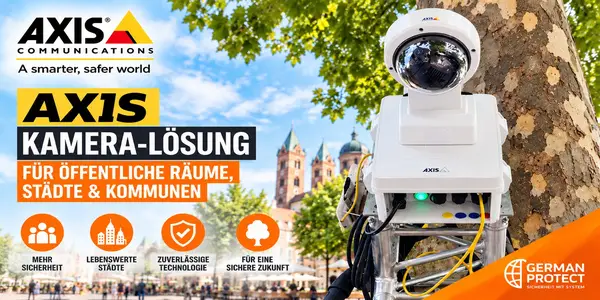
Mobile Video Surveillance in Public Spaces for Cities and Municipalities
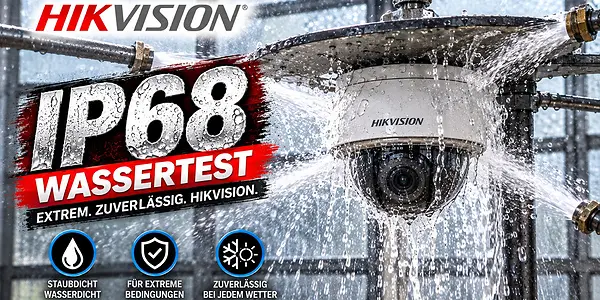
IP66, IP67 and IP68 Ingress Protection Ratings for a Surveillance Camera Explained in Our Test
The Most Common Mistakes When Buying, Mounting or Installing a Surveillance Camera, and What You Should Definitely Watch Out For!
The Most Common Mistakes When Buying, Mounting or Installing a Surveillance Camera, and What You Should Definitely Watch Out For!
Wrong Surveillance Camera Chosen for Outdoor Surveillance
The Right Surveillance Camera Model for Outdoor Surveillance
Bullet surveillance cameras or dome surveillance cameras for outdoor use?
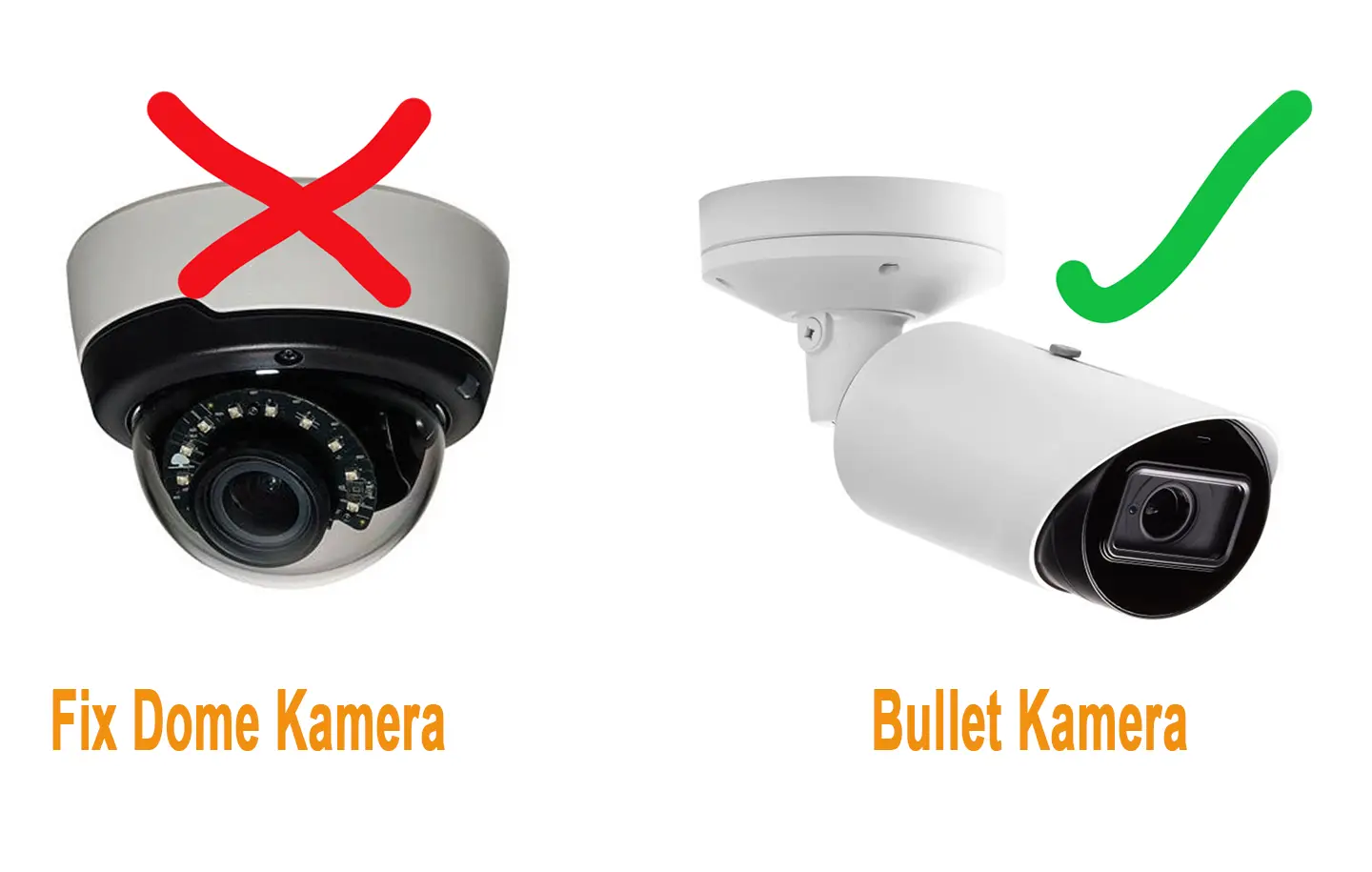 For outdoor surveillance, the bullet design is the better choice. The dome design is suited to indoor surveillance, if only for aesthetic reasons.
The bullet surveillance camera is better suited to video surveillance for outdoor use, because the infrared illuminator does not cause light reflections at night.
Disadvantages: A bullet camera is quite large and therefore clearly visible.
Advantages: Because of its size, the bullet camera is more likely to be noticed by an intruder and acts as a deterrent.
In a dome camera, the infrared illuminators are mounted inside the dome. If the dome is dusty or dirty, light cones and light reflections often appear at night.
Advantages: Discreet mounting, so it is barely visible and more aesthetically pleasing.
Disadvantages: Short range of the infrared illuminators, more susceptible to dirt and therefore more maintenance-intensive.
As a general rule, an IP protection rating of at least IP 65 should be observed for surveillance cameras for outdoor use. Depending on the mounting location, the camera should also meet an IK rating for protection against vandalism. Do not use indoor cameras outdoors; that will not work well for long.
Wrong Surveillance Camera Chosen for Outdoor Surveillance
The Right Surveillance Camera Model for Outdoor Surveillance
Bullet surveillance cameras or dome surveillance cameras for outdoor use?
For outdoor surveillance, the bullet design is the better choice. The dome design is suitable for indoor surveillance, if only for aesthetic reasons. The bullet surveillance camera is better suited for video surveillance in outdoor use, since the infrared illuminator does not cause any light reflections at night.
Advantages: Because of its size, the bullet camera is more likely to be noticed by a perpetrator and acts as a deterrent.
Disadvantages: A bullet camera is quite large and accordingly has a highly visible presence.
With the dome camera, the infrared illuminators are mounted inside the dome. If the dome is dusty or dirty, light cones and light reflections often appear at night.
Advantages: Discreet installation, so it is barely visible and more aesthetically pleasing.
Disadvantages: Short range of the infrared illuminators, more susceptible to dirt and therefore more maintenance-intensive.
As a general rule, an IP protection rating of at least IP 65 must be observed for surveillance cameras for outdoor use. Depending on the mounting location, the camera should have an IK rating for protection against vandalism. Do not use indoor cameras outdoors; that won't work well for long.
Movable Surveillance Cameras Are Not Always Suitable
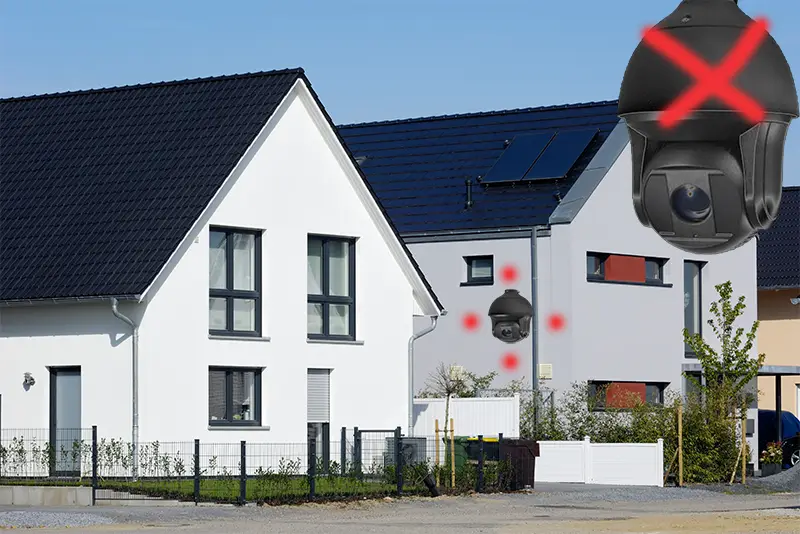
Is an outdoor PTZ 360° surveillance camera worth it for video surveillance?
Yes, it offers great added value if there are larger areas to monitor or if tracking (following people and vehicles) and patrols(automatically moving to several surveillance points) are required.
No, if your nearest neighbor is 5 meters away. In densely populated residential areas, using a PTZ 360° surveillance camera always leads to a need for discussion.
The field of view of the PTZ (even when zoomed) must not extend beyond your own property. The ability to see into the neighbors' bedrooms must be permanently prevented in the programming by masking that area with privacy zones.
Movable surveillance cameras are not always suitable
Is an outdoor PTZ 360° surveillance camera worth it for video surveillance?
Yes, it offers great added value if there are larger areas to monitor or if tracking (following people and vehicles) and patrols(automatically moving to multiple surveillance points) are required.
No, if your nearest neighbor is 5 meters away. In densely populated residential areas, using a PTZ 360° surveillance camera always leads to discussions.
The field of view of the PTZ (even when zoomed) must not extend beyond your own property. The ability to see into the neighbors' bedrooms must be permanently prevented in the programming by masking that area with privacy zones.
Using Wi-Fi surveillance cameras.
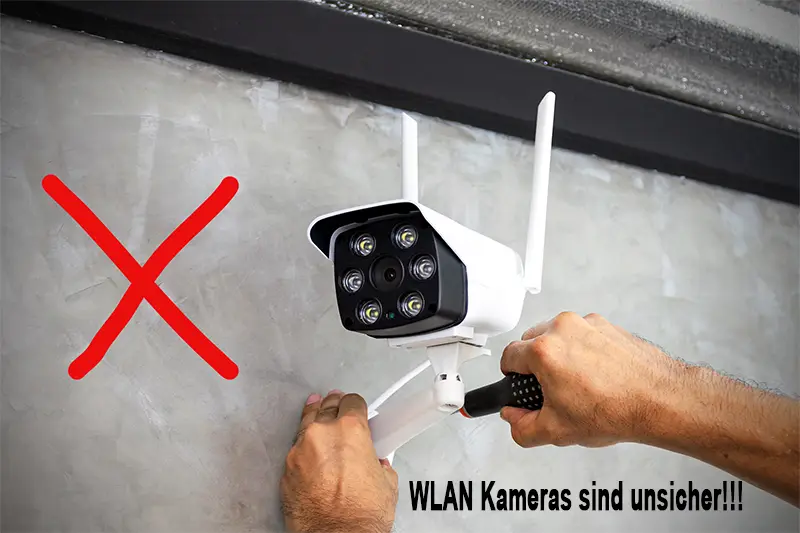 Wi-Fi, powerline, or wired surveillance cameras? Clearly wired!
Wi-Fi surveillance cameras are unreliable in transmission, highly vulnerable to cyber attacks, and severely limited in resolution. Wi-Fi surveillance cameras should only be used if it is not possible to run cables.
Transmission over the power line is only conditionally recommended, since sudden loads on the electrical circuit (vacuum cleaner/refrigerator) can often cause image interference and missing fps (frames per second) in the recording.
A wired surveillance camera is the most secure, the most reliable, and by far the reference recommendation for any video surveillance system.
Using Wi-Fi surveillance cameras.
Wi-Fi, powerline, or wired surveillance cameras? Clearly wired!
Wi-Fi surveillance cameras are unreliable in transmission, highly vulnerable to cyber attacks, and severely limited in resolution. Wi-Fi surveillance cameras should only be used if it is not possible to run cables.
Transmission over the power line is only conditionally recommended, since sudden loads on the electrical circuit (vacuum cleaner/refrigerator) can often cause image interference and missing fps (frames per second) in the recording.
A wired surveillance camera is the most secure, the most reliable, and by far the reference recommendation for any video surveillance system.
Wrong Lens Selected for the Surveillance Camera
 Surveillance camera with a varifocal lens or a fixed lens? Clearly a varifocal lens!
In most cases, surveillance cameras with a varifocal (zoomable) lens and a variable focal length of 2.8mm to 12mm are recommended for video surveillance. This saves you the complicated focal length calculation for each application of the surveillance camera, as well as the subsequent privacy masking of the image area in compliance with the GDPR. The variable focal lengths can be set precisely and effortlessly to the image area that is actually needed.
Fixed lenses with fixed focal lengths are not adjustable, and calculating the focal length for a particular surveillance application requires expertise.
The belief that the greater the fixed focal length, the wider the field of view, is wrong. The correct rule is: the smaller the focal length number, e.g. 2.8mm, the wider the field of view of the surveillance camera. A 6mm fixed focal length has a narrower field of view than a 4mm.
Wrong Lens Selected for the Surveillance Camera
Surveillance camera with a varifocal lens or a fixed lens? Clearly a varifocal lens!
In most cases, surveillance cameras with a varifocal (zoomable) lens and a variable focal length of 2.8mm to 12mm are recommended for video surveillance. This saves you the complicated focal length calculation for each application of the surveillance camera, as well as the subsequent privacy masking of the image area in compliance with the GDPR. The variable focal lengths can be set precisely and effortlessly to the image area that is actually needed.
Fixed lenses with fixed focal lengths are not adjustable, and calculating the focal length for a particular surveillance application requires expertise.
The belief that the greater the fixed focal length, the wider the field of view, is wrong. The correct rule is: the smaller the focal length number, e.g. 2.8mm, the wider the field of view of the surveillance camera. A 6mm fixed focal length has a narrower field of view than a 4mm.
Wrong Resolution for the Tasks of the Surveillance Camera
Choose the Right Resolution for the Tasks of the Surveillance Camera
The surveillance camera delivers good images during the day, but not at night. What is the cause?
The low-price segment increasingly includes high-resolution surveillance cameras that have a small image sensor. Because of the small image sensor, the surveillance camera has poor low-light sensitivity at night and is no longer able to deliver the high resolution. The surveillance image is dark and very grainy. The footage is useless for reconstructing the course of a crime.
Wrong Resolution for the Tasks of the Surveillance Camera
Choose the Right Resolution for the Tasks of the Surveillance Camera
The surveillance camera delivers good images during the day, but not at night. What is the reason?
In the low price segment, more and more high-resolution surveillance cameras are being offered, but they have a small image sensor. Due to the small image sensor, the surveillance camera is insensitive to light at night and is no longer able to display the high resolution. The surveillance image is dark and very grainy. The recordings are unusable for reconstructing the course of a crime.
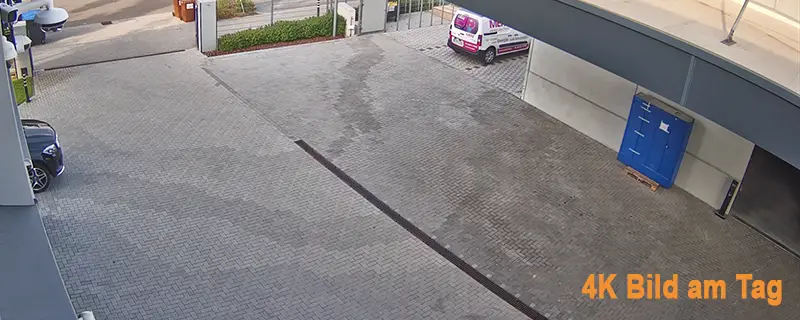
In professional video surveillance, the general rule is: the higher the resolution, the less sensitive to light the surveillance camera is.
That is why professional high-resolution surveillance cameras have large image sensors and thus enable a high-resolution surveillance image even at night.
However, such surveillance cameras are also priced higher.
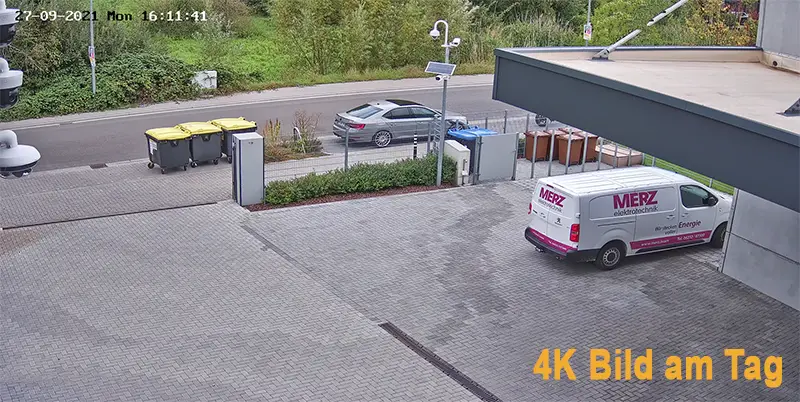
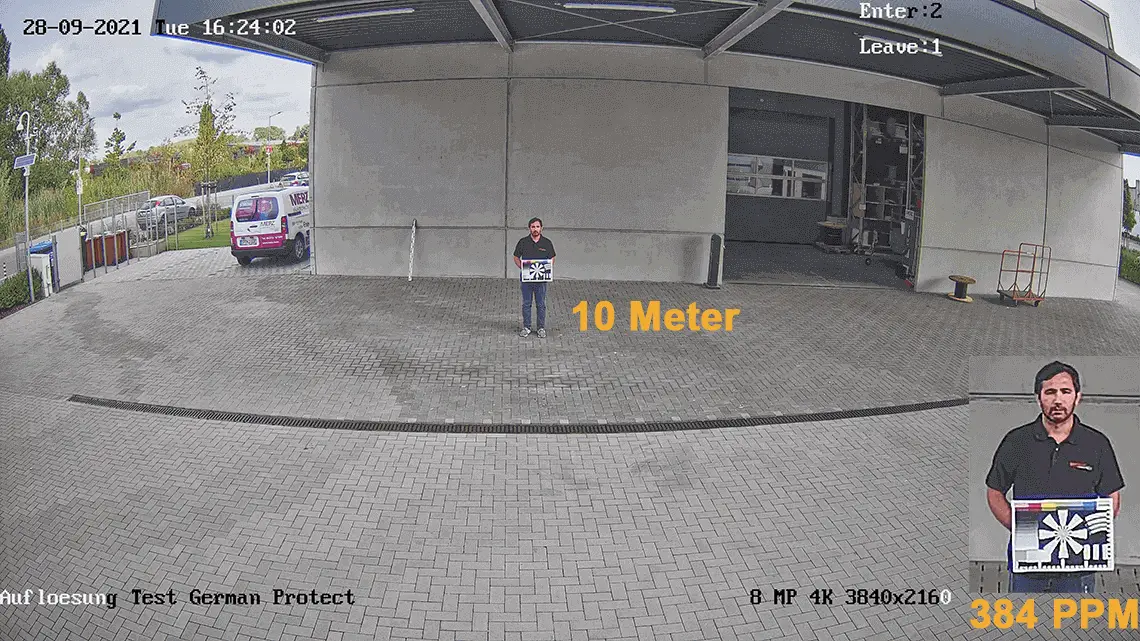
A balanced surveillance system resolution of 4 megapixels is usually sufficient for ordinary home surveillance and delivers usable video footage at night. The resolution of a surveillance camera is determined by its task. If the task of the surveillance camera is to identify faces, the available pixels per meter (PPM) is what matters, and the higher the resolution required. If the surveillance camera is mounted too high, producing a general overview from a bird's-eye view, face identification is not possible despite the high resolution.
The Wrong Recording Device for Surveillance Camera Footage
Choosing the Right Recording Device for Your Surveillance Camera Footage Is Essential
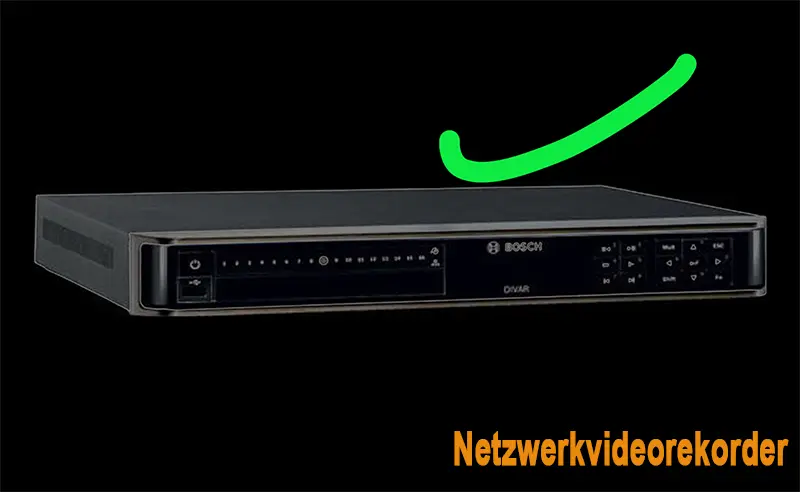
Which recording option is best for a surveillance camera? Network video recorders offer the best value for money for video surveillance.
Low-cost surveillance solutions from "no-name vendors" are often offered with an "app cloud" solution. As a general rule, we advise against these storage options. It is unclear where the data is stored (data protection) and who can view it. Constant video transmission to cloud storage depends heavily on upload speed, which can result in missing image sequences in the video recording.
We also advise against recording to a PC or laptop, since a PC is often used for other tasks such as gaming or work and is not designed for video surveillance recordings.
In addition, the PC must stay on at all times, which considerably increases power consumption and greatly shortens the PC's lifespan.
As a rule, we recommend a long-term recording device to our customers, such as a network video recorder. These devices are the most reliable and are designed for this type of recording. Even in the low price range, we offer our customers complete video surveillance kits for a variety of applications.
The surveillance camera is mounted incorrectly
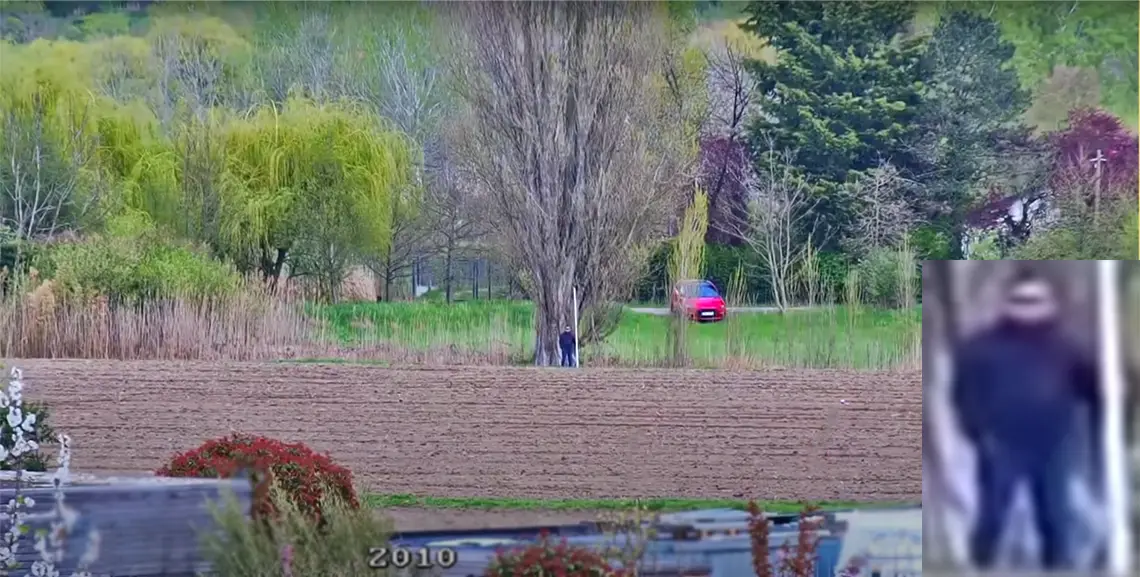 Many video surveillance “specialists” share the mindset that “the bigger the surveillance image, the better.” That view is wrong! A wide surveillance image in which a person 100 meters away can be seen, but at the same time it is impossible to tell whether it is a woman or a man, is rarely of any use.
In most cases, the reason is that the surveillance camera was mounted far too high. This does produce a large field of view for the surveillance camera, but unfortunately it is unusable for video surveillance.
Which mounting heights and tilt angles are best suited for a surveillance camera?
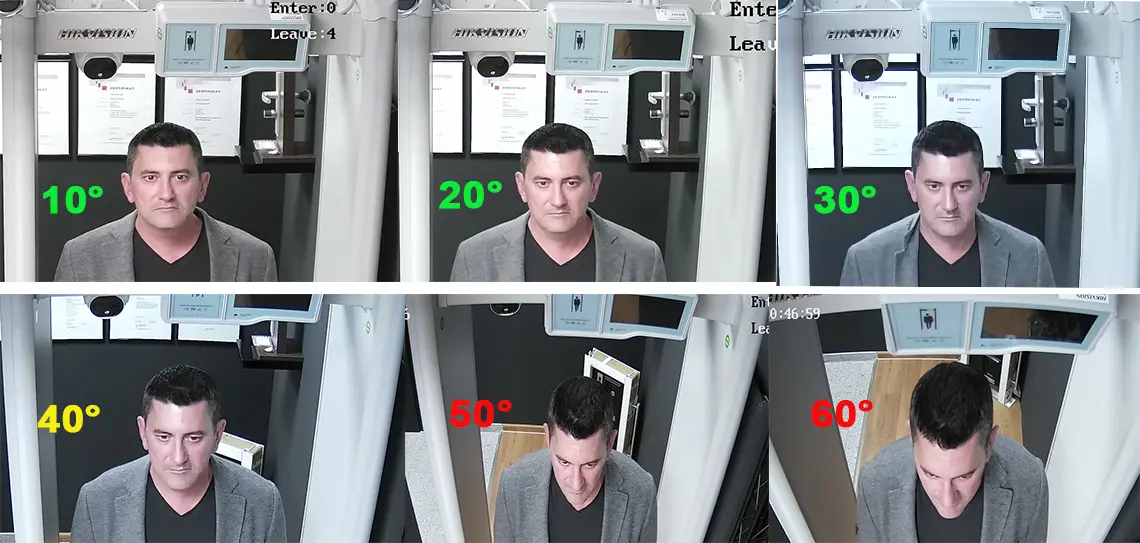
The optimal mounting height for a surveillance camera is between 2.20 and 3.50 meters, so that no bird's-eye view results and the perpetrator's face can still be recognized or identified in the footage. To be able to identify a face, tilt angles between the surveillance camera and the subject of 10°, at most 30°, are recommended. From a tilt angle of 40°, identifying the person is very difficult to impossible. The field of view, and accordingly the detection zone of the surveillance camera, must deliver an optimal image in both horizontal and vertical alignment.
The surveillance camera is mounted incorrectly
Many video surveillance “specialists” share the mindset that “the bigger the surveillance image, the better.” That view is wrong! A wide surveillance image in which a person 100 meters away can be seen, but at the same time it is impossible to tell whether it is a woman or a man, is rarely of any use.
In most cases, the reason is that the surveillance camera was mounted far too high. This does produce a large field of view for the surveillance camera, but unfortunately it is unusable for video surveillance.
Which mounting heights and tilt angles are best suited for a surveillance camera?
The optimal mounting height for a surveillance camera is between 2.20 and 3.50 meters, so that no bird's-eye view results and the perpetrator's face can still be recognized or identified in the footage. To be able to identify a face, tilt angles between the surveillance camera and the subject of 10°, at most 30°, are recommended. From a tilt angle of 40°, identifying the person is very difficult to impossible. The field of view, and accordingly the detection zone of the surveillance camera, must deliver an optimal image in both horizontal and vertical alignment.
Wrong surveillance camera chosen for nighttime use
 Most crimes happen at night. Having good surveillance images during the day but being unable to make out anything at night is of little use for video surveillance.
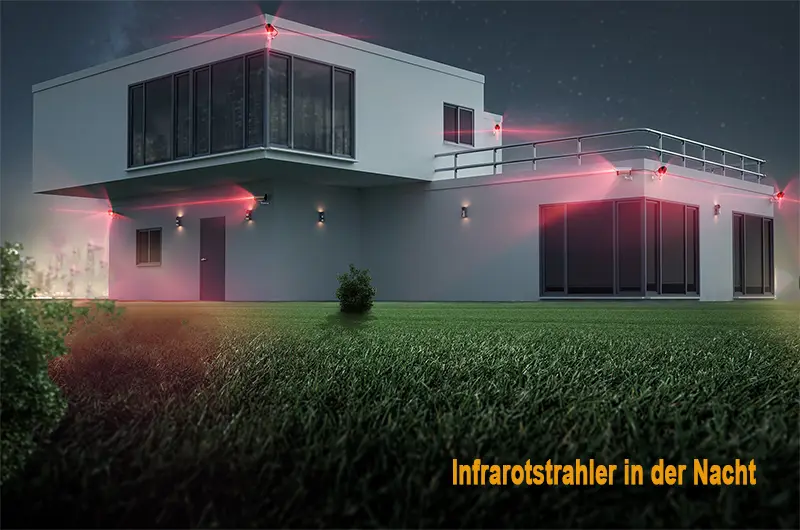
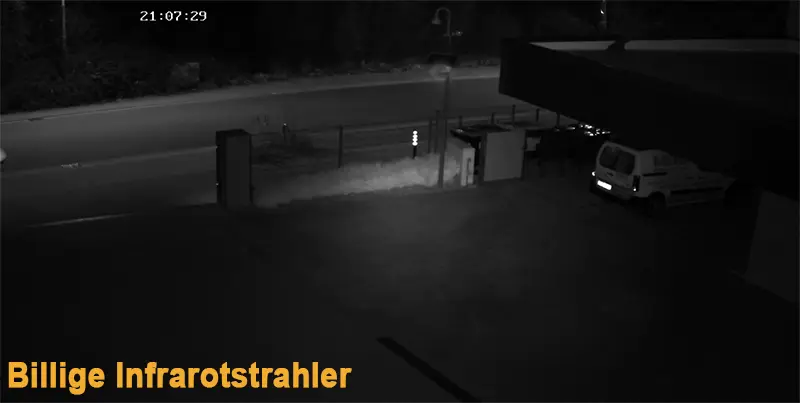
To get clear night images in which you can actually recognize something, we recommend surveillance cameras with a built-in infrared illuminator and a light-sensitive image sensor. Most surveillance cameras have an infrared range of up to 30 meters. However, there are enormous differences in illumination quality. Especially with "no-name manufacturers," you often encounter false claims about the range of the infrared illuminators, or the night images are both overexposed and underexposed. Established manufacturers use not only high-quality infrared illuminators, but also large image sensors with a light sensitivity of down to 0.001 lux. Technologies such as Lightfinder, DarkFighter, StarLight, etc., in combination with infrared light, also help to deliver high-quality and, above all, reflection-free images at night.
The latest state of the art enables infrared ranges of up to 800 meters.
Wrong surveillance camera chosen for nighttime use
Most crimes happen at night. Having good surveillance images during the day but being unable to make out anything at night is of little use for video surveillance.
To get clear night images in which you can actually recognize something, we recommend surveillance cameras with a built-in infrared illuminator and a light-sensitive image sensor. Most surveillance cameras have an infrared range of up to 30 meters. However, there are enormous differences in illumination quality. Especially with "no-name manufacturers," you often encounter false claims about the range of the infrared illuminators, or the night images are both overexposed and underexposed. Established manufacturers use not only high-quality infrared illuminators, but also large image sensors with a light sensitivity of down to 0.001 lux. Technologies such as Lightfinder, DarkFighter, StarLight, etc., in combination with infrared light, also help to deliver high-quality and, above all, reflection-free images at night.
The latest state of the art enables infrared ranges of up to 800 meters.
Installed Dummy Camera
Installed Dummy Surveillance Camera
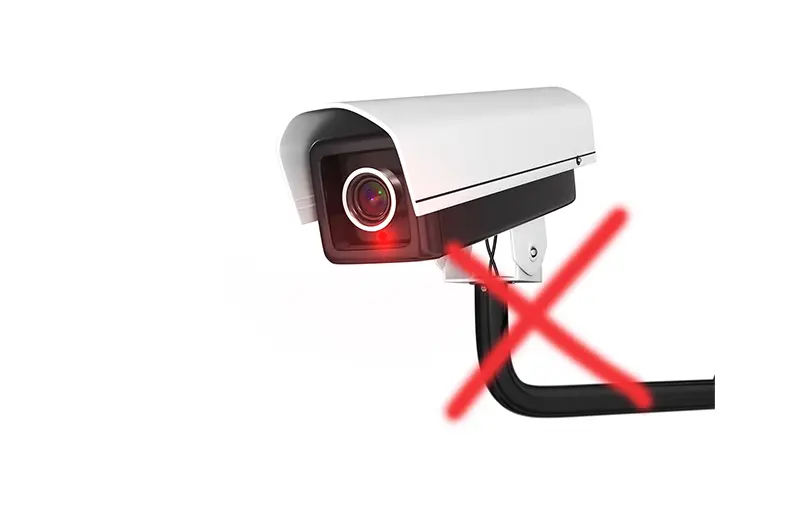 Installing a dummy surveillance camera offers only an illusion of protection. Protecting your belongings with an illusion is not a particularly good idea, because it remains just an illusion.
Even though dummy cameras today often look deceptively real, leading many people to believe that "a dummy is perfectly sufficient," unfortunately this is not true at all, for three clear reasons.
First, professional burglars are often so technically savvy that they can tell a dummy camera from a real surveillance camera.
Second, should that not quite be the case, the perpetrator will first try out various tricks (which, for security reasons, we would rather not describe publicly here) to test whether it is a real surveillance camera.
If the perpetrator finds out the truth, it is practically a free pass for his criminal plans.
Third, apart from recording the perpetrator, real surveillance cameras enable an audible or visual alarm on the network video recorder as well as a push notification on a mobile phone in the event of a break-in attempt. A dummy camera, on the other hand, simply does nothing.
The illusion of security provided by a dummy camera evaporates when something actually happens. That is why the police, and we as professional installers of security technology, strongly advise against using a dummy camera.
Installed Dummy Camera
Installed Dummy Surveillance Camera
Installing a dummy surveillance camera offers only an illusion of protection. Protecting your belongings with an illusion is not a particularly good idea, because it remains just an illusion.
Even though dummy cameras today often look deceptively real, leading many people to believe that "a dummy is perfectly sufficient," unfortunately this is not true at all, for three clear reasons.
First, professional burglars are often so technically savvy that they can tell a dummy camera from a real surveillance camera.
Second, should that not quite be the case, the perpetrator will first try out various tricks (which, for security reasons, we would rather not describe publicly here) to test whether it is a real surveillance camera.
If the perpetrator finds out the truth, it is practically a free pass for his criminal plans.
Third, apart from recording the perpetrator, real surveillance cameras enable an audible or visual alarm on the network video recorder as well as a push notification on a mobile phone in the event of a break-in attempt. A dummy camera, on the other hand, simply does nothing.
The illusion of security provided by a dummy camera evaporates when something actually happens. That is why the police, and we as professional installers of security technology, strongly advise against using a dummy camera.
Buying Cheap "No-Name" Surveillance Cameras on Amazon, eBay and Similar Platforms
When we, as qualified professional installers of video surveillance technology, read through the reviews online that name a surveillance camera as "the best," we simply feel sorry for the customers who buy it. The reviews are often fake and contain no expertise whatsoever.
A surveillance camera is supposed to monitor reliably and protect against intruders. Not every surveillance camera is suitable for your needs.
That is why qualified advice from a specialist company before you buy is very important.
Most online sales platforms have neither the necessary expertise nor can they truly help when problems occur by offering support.
Surveillance cameras that come from outside the DACH countries very often come with problems such as: no support, no warranty, no security updates, no communication possible in German. We advise against buying a surveillance camera from outside the EU.
You do not know what security weaknesses the security camera has from the outset. If you are seriously planning to purchase a video surveillance system, we recommend consulting professional expertise before buying. That saves you from buying twice, and from a lot of frustration.
Surveillance Camera with Audio Function
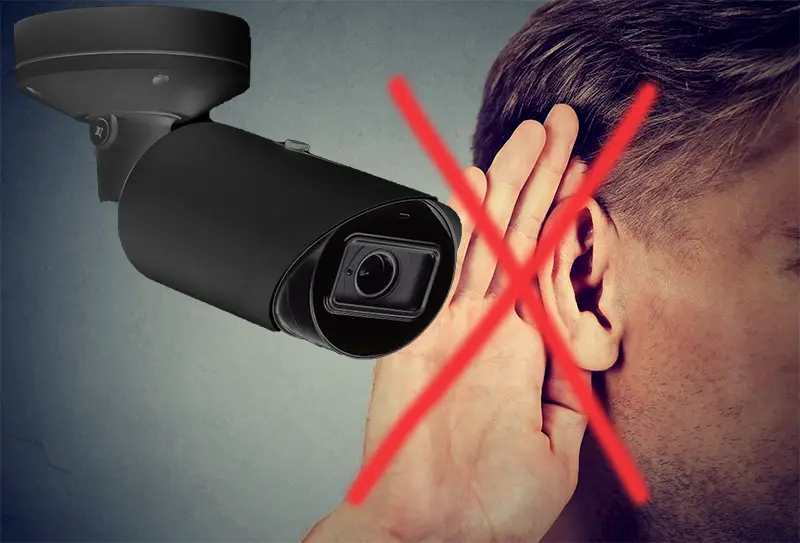 Audio recording with a surveillance camera is prohibited in Germany and the EU.
People often think, “no plaintiff, no judge.” This view is wrong!
Video surveillance recordings of a business or of the neighboring house that include sound are punishable by high fines. Even if the field of view of the surveillance camera is GDPR-compliant, if the camera is installed in such a way that the recordings pick up the neighbor arguing with his wife, it is inadmissible and punishable accordingly.
This also applies to surveillance cameras mounted in an entrance area that can pick up sound from the public area (sidewalk).
We advise against surveillance recordings with sound.
Surveillance Camera with Audio Function
Audio recording with a surveillance camera is prohibited in Germany and the EU.
People often think, “no plaintiff, no judge.” This view is wrong!
Video surveillance recordings of a business or of the neighboring house that include sound are punishable by high fines. Even if the field of view of the surveillance camera is GDPR-compliant, if the camera is installed in such a way that the recordings pick up the neighbor arguing with his wife, it is inadmissible and punishable accordingly.
This also applies to surveillance cameras mounted in an entrance area that can pick up sound from the public area (sidewalk). We advise against surveillance recordings with sound.
Apply for KfW Funding
Apply for KfW funding early and save additional money
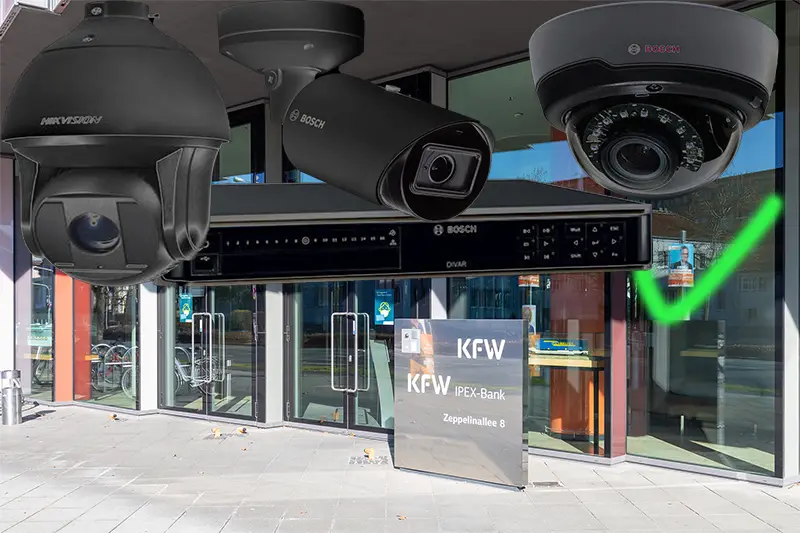 Since 2014, the German government has been funding burglary-prevention construction measures through the KfW (Kreditanstalt für Wiederaufbau) that help reduce apartment and house burglaries.
Through this support program, the KfW subsidizes the installation of surveillance cameras and larger video surveillance systems with up to 10% of the purchase costs and a maximum of 1,500 euros. Investments are only funded from a minimum value of 2,000 euros. KfW funding can also be applied for security doors, windows, roller shutters and an alarm system.
If the security installations are integrated as part of an “age-appropriate conversion” of the apartment or house, the funding amounts can be increased to a maximum of 6,250 euros. Labor and material costs are only funded by the KfW if the renovation work is carried out by a qualified specialist company.
KfW funding can be applied for by an owner as well as by the tenant of the property. Please note, however, that it is essential to commission an expert in advance in order to obtain approval of the funding. The expert inspects and supervises the construction measures and confirms to the KfW that they have been carried out.
No KfW Grant to Apply For
Apply for a KfW grant early and save additionally
Since 2014, the German government has been funding burglary-resistant construction measures through the KfW (Kreditanstalt für Wiederaufbau) that help reduce apartment and house burglaries.
Under this support program, the KfW subsidizes the installation of surveillance cameras and larger video surveillance systems with up to 10% of the purchase costs and a maximum of 1,500 euros. Investments are only funded from a minimum value of 2,000 euros. The KfW grant can also be applied for security doors, windows, roller shutters and an alarm system.
If the security installations are integrated as part of an "age-appropriate renovation" of the apartment or house, the funding amounts can be increased to a maximum of 6,250 euros. Labor costs and material costs are only funded by the KfW if the renovation work is carried out by a qualified specialist company.
A KfW grant can be applied for by an owner as well as by the tenant of the property. Please note, however, that it is absolutely necessary to commission an expert in advance in order to obtain approval of the funding. The expert inspects and supervises the construction work and confirms to the KfW that it has been carried out.