GUIDE
Video Servers: An Important Component of Video Technology
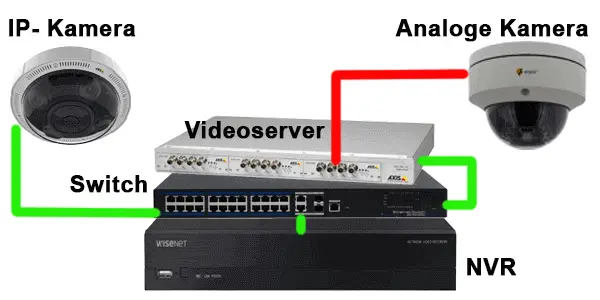
Video servers are components of video technology that convert analog video and audio signals into digital signals, enabling an analog surveillance camera to be connected to a network-based video surveillance system. In addition to digitizing the analog signals, video servers also convert the compression method of the video data to modern codecs such as H264 or H265, which significantly reduces the amount of data transmitted within the network.
Through this complete conversion of video signals from analog to digital, video servers also enable the provision of s of the surveillance camera.
Multi-streaming is used in video surveillance to provide different video signals (streams) with different resolutions from one surveillance camera for targeted video surveillance applications.
Viewed this way, the video server functions within an analog video surveillance system as a converter, as it not only digitizes the surveillance cameras but also simultaneously enables recording. Not so long ago, costly VHS video tapes were needed to ensure the recordings of an analog video surveillance system. Thanks to the video server, analog surveillance cameras can today be recorded on hard drives (HDD) by digitizing the video signals, which saves not only immense costs but also increases the efficiency of video surveillance.

Video Servers: An Important Component of Video Technology
Video servers are components of video technology that convert analog video and audio signals into digital signals, enabling an analog surveillance camera to be connected to a network-based video surveillance system. In addition to digitizing the analog signals, video servers also convert the compression method of the video data to modern codecs such as H264 or H265, which significantly reduces the amount of data transmitted within the network.
Through this complete conversion of video signals from analog to digital, video servers also enable the provision of s of the surveillance camera.
Multi-streaming is used in video surveillance to provide different video signals (streams) with different resolutions from one surveillance camera for targeted video surveillance applications.
Viewed this way, the video server functions within an analog video surveillance system as a converter, as it not only digitizes the surveillance cameras but also simultaneously enables recording. Not so long ago, costly VHS video tapes were needed to ensure the recordings of an analog video surveillance system. Thanks to the video server, analog surveillance cameras can today be recorded on hard drives (HDD) by digitizing the video signals, which saves not only immense costs but also increases the efficiency of video surveillance.
Another advantage of video servers is that they convert an analog camera into an IP camera, allowing it to take advantage of the far greater capabilities of network technology.
Capabilities such as analytics or multi-streaming, which were previously impossible with purely analog systems. Combining older analog surveillance cameras with high-resolution IP cameras also offers major advantages for video surveillance and upgrades it. As a result, analog cameras that provide sufficient resolution for the respective application do not need to be discarded, which saves the cost of converting the video surveillance system.
Overall, the video server is an extremely effective component of video technology for upgrading video surveillance at manageable cost.
Our expert tip! Before you decide to discard an analog camera, consider whether its image resolution is actually insufficient and whether a video server would be an option.
Our technical team is happy to advise you on ideas and questions about how best to integrate a video server into your video surveillance system.