

Pixel
What is a pixel, and how important is it for good video surveillance?
An image is made up of pixels, that is, light-sensitive picture elements. Each pixel represents a specific color combination. One million pixels equal one megapixel. surveillance cameras have a megapixel resolution, which is decisive for the quality of the images delivered. Depending on the application and the role of the camera, you should perform an appropriate pixel calculation when buying.
Why is the number of pixels relevant for good video surveillance, depending on the application?
To implement video surveillance that works properly, it is important to determine in advance, for the respective application task, which surveillance camera with which resolution and which viewing angle is required. The necessary pixel density for the application task of the IP surveillance camera results from the resolution, which in turn depends on the image sensor size.
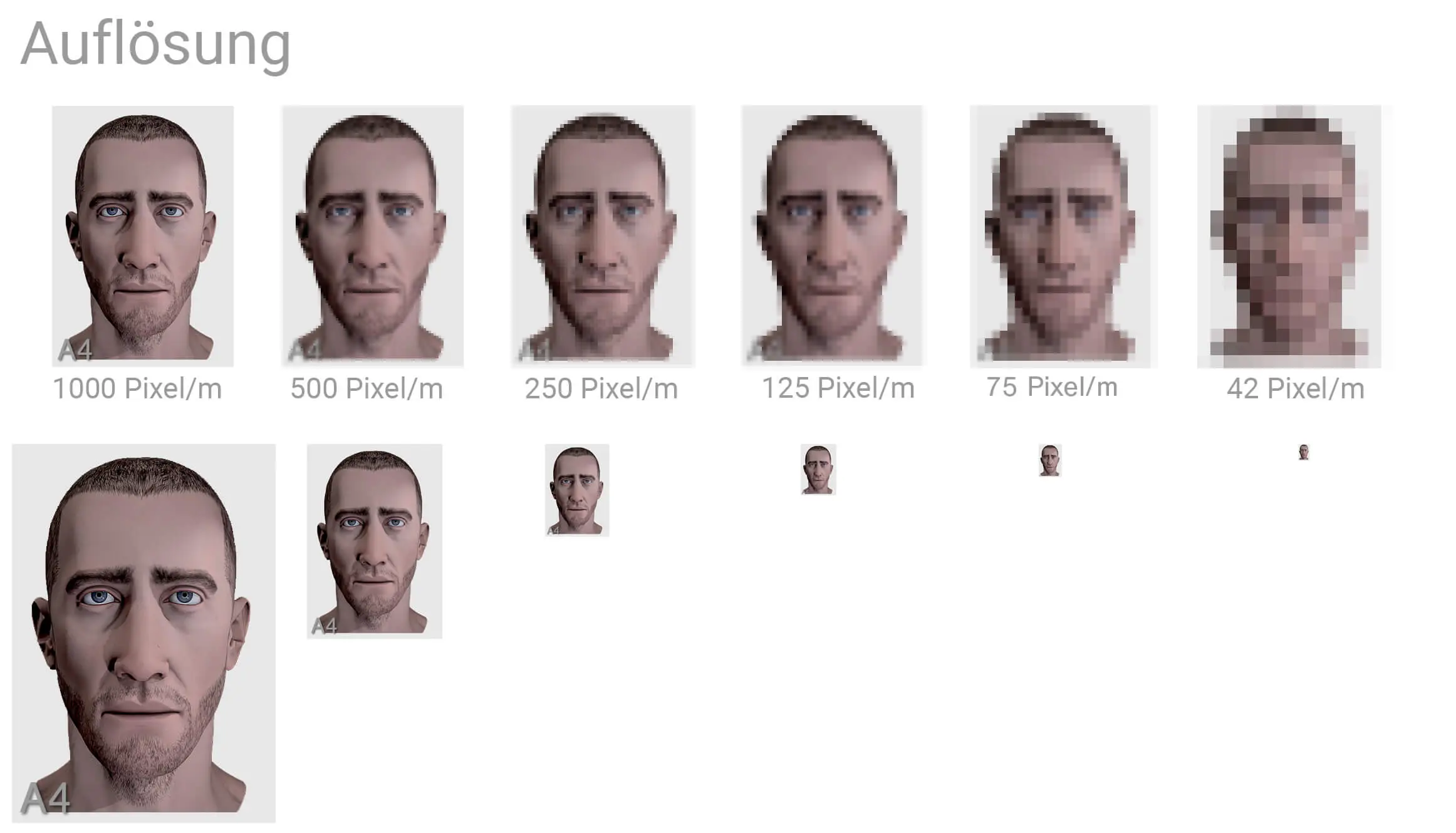
Accordingly, you can calculate
Accordingly, you can calculate how many meters away the IP surveillance camera can still reliably perform its task, for example facial identification. For this, a certain pixel density of 80 pixels in the facial area is required in the recordings. If the distance in meters is exceeded, a second surveillance camera is needed for the same application.
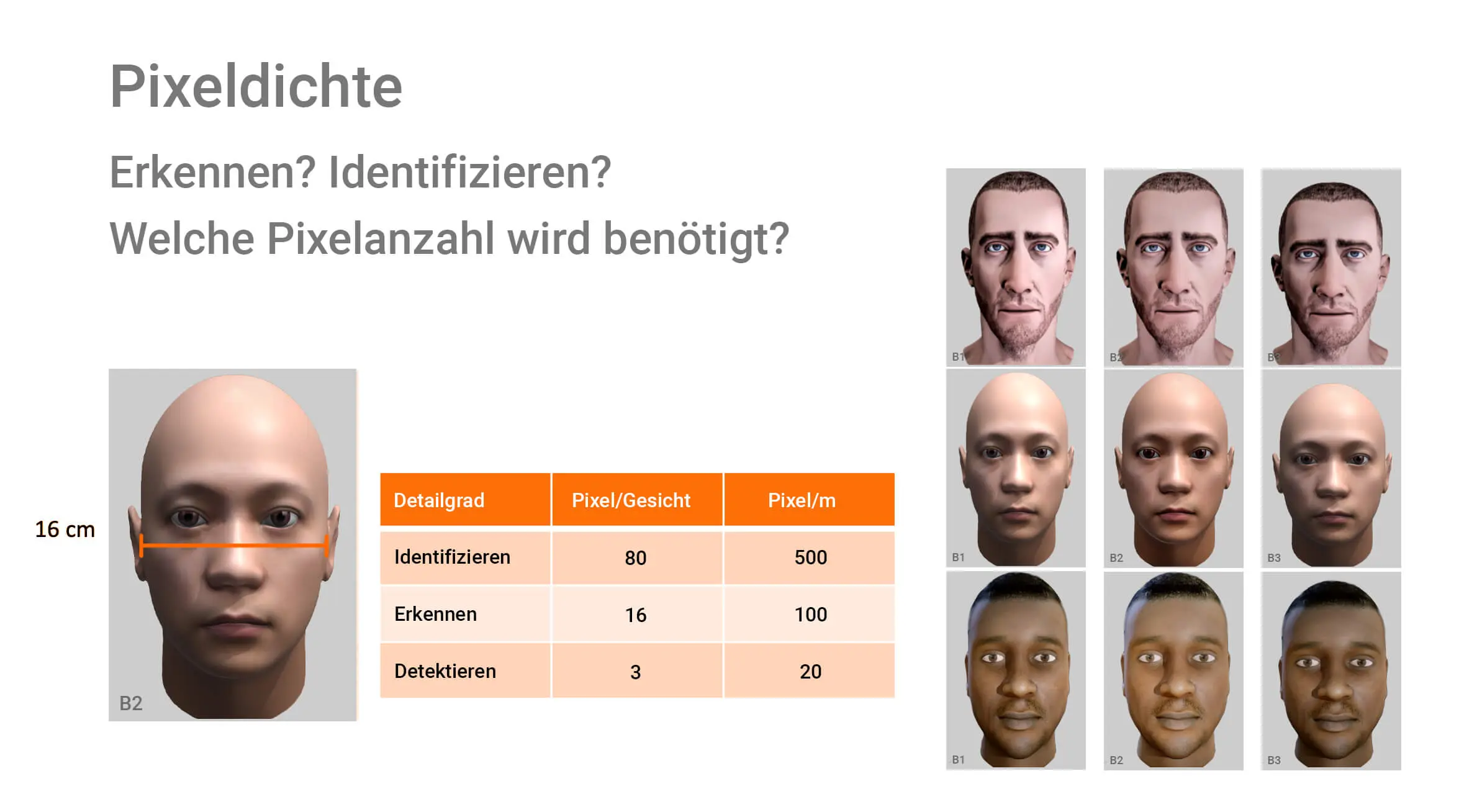
A video surveillance system should
A video surveillance system should serve to secure the property. Securing it can only be carried out effectively if the perpetrator can be clearly and distinctly identified in the recordings, regardless of whether it is day or night. For this, selecting the right IP surveillance camera with the appropriate resolution for the respective application is extremely important. As you can see from the illustration below, identification is only possible from a resolution of 2 megapixels and a distance of 7.7 meters. Our tip: if the identification point is 10 meters away, you should switch to 4 megapixels to ensure reliable person identification.
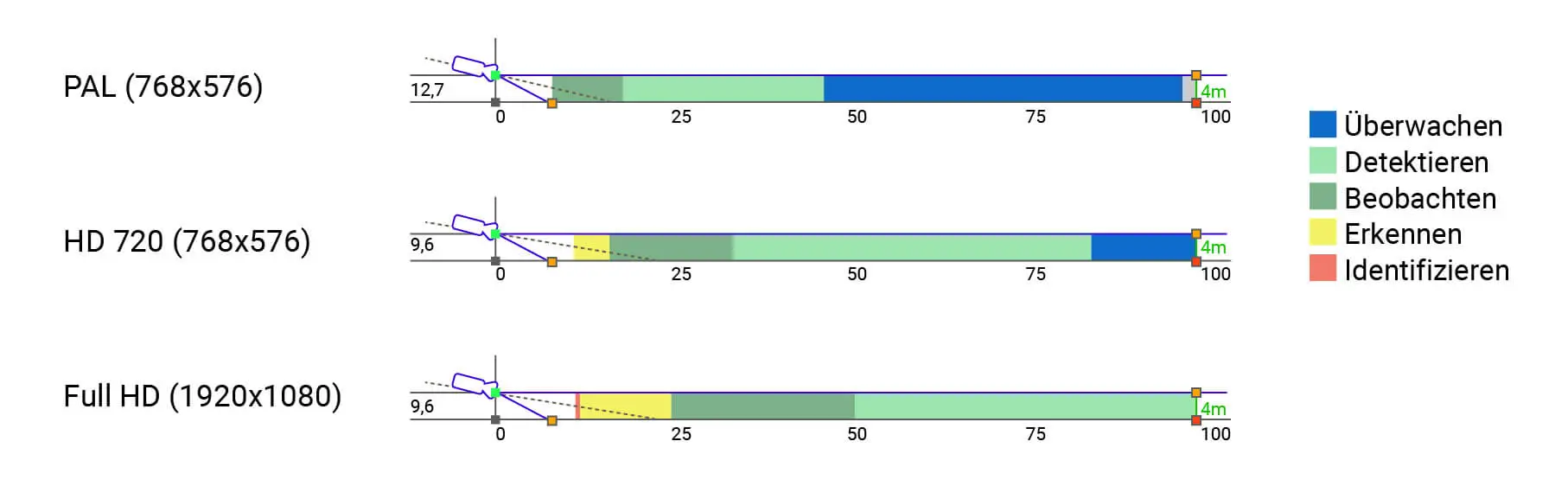
For a video surveillance system that works well
For a video surveillance system that works well, we distinguish between six task criteria that an IP surveillance camera should fulfill depending on the application.
1. Is a surveillance camera needed for simple monitoring, i.e. an overview of my parking lot to see whether it is full?
In this application, I do get a large image in which I can see movement in the distance, but without any way to recognize who it is. The problem usually lies in the very large image area (wide angle) combined with insufficient pixels per meter from the IP surveillance camera. The pixel count in the recordings is often 12.5 pixels per meter, which makes identifying a person impossible due to insufficient pixels.
2. Do I want to detect whether an intruder enters my property at 150 meters?
For detection, pixels are irrelevant, since this is usually a thermal imaging IP surveillance camera that displays a thermal image. This IP surveillance camera offers no added value for identification, but all the more for precise detection of an intruder at long distances. This type of application is of great importance for a video surveillance security system, because timely detection greatly reduces the response time of security guards or police. For clarity: a 4K UHD camera, despite its high resolution, can neither identify nor detect a person at 150 meters.
3. Is the video surveillance system needed purely for observation?
That is, with such a video surveillance system I can see what is happening on my property, but without being able to identify which person or vehicle it is. The existing pixel count of 62.5 pixels per meter in the image area is not sufficient to identify a person at 40 meters. I can see the person, but I cannot tell what they look like.
4. Is the video surveillance system designed for recognition? At least 62.5 pixels per meter in the monitored area are required.
For smaller monitored areas, this pixel count per meter is sufficient to recognize a person you know. To identify unfamiliar people, the 62.5 pixels at a distance of 10 meters from the surveillance camera are not sufficient in the image material.
5. The video surveillance system is configured for identification.
To achieve identification with a surveillance camera, at least 250 to 500 pixels per meter are required. For security areas where uncompromising identification is essential, we recommend choosing 500 pixels per meter.
But what does identification actually mean? In video surveillance, identification means providing a video recording that contains essential characteristics of the monitored person or object in the image material, for example for a search, and being able to compare it with a database if needed.
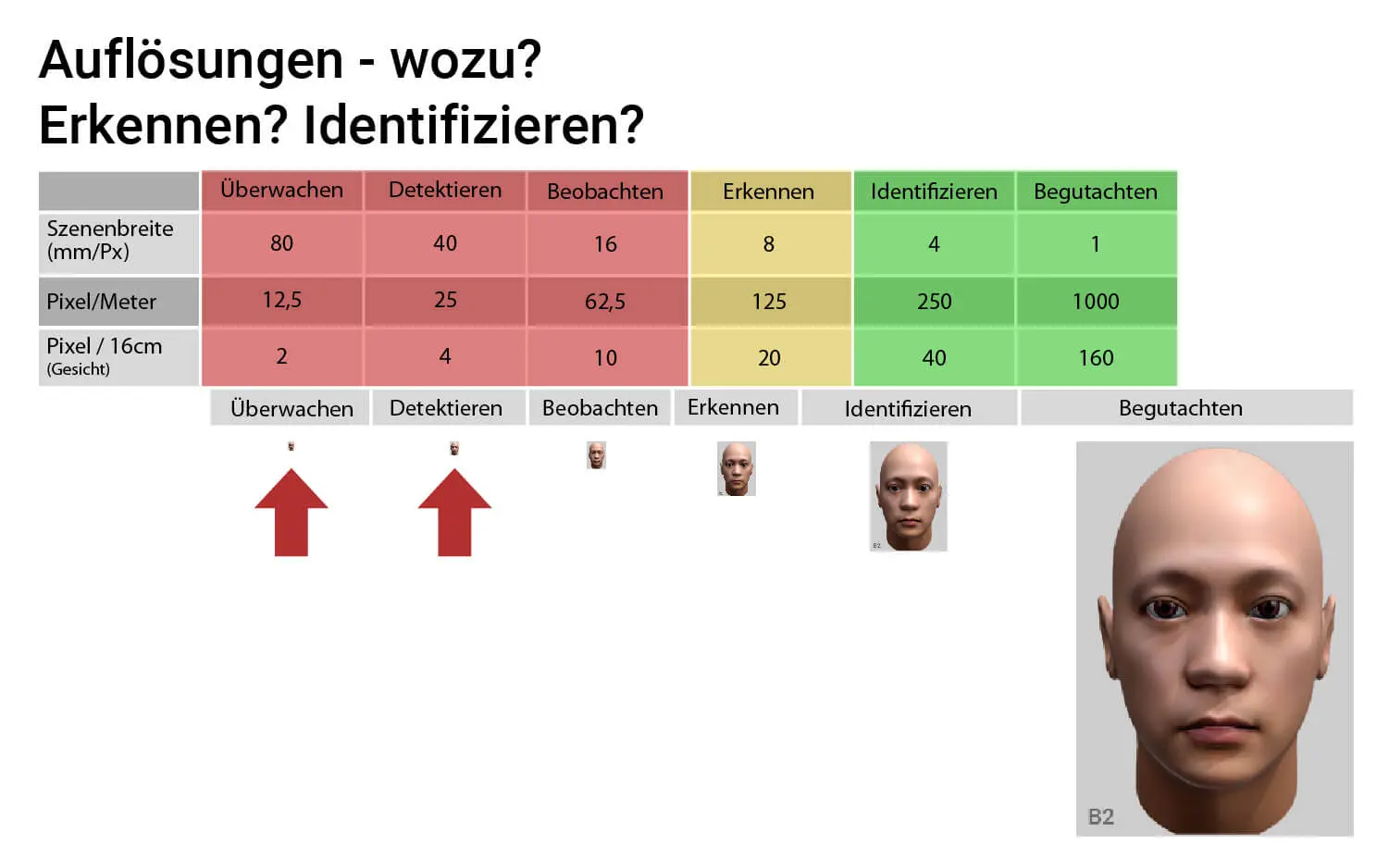
6. Is the video surveillance system designed for forensic examination?
Such surveillance systems are mostly used in high-security areas where a so-called “forensic examination” is required. To achieve a forensic examination, the IP surveillance camera must deliver 1000 pixels per meter. But what does “forensic examination” actually mean? In professional video surveillance, it refers to the ability of the IP surveillance camera to recognize all features (not just essential ones) in the recordings in fine detail.
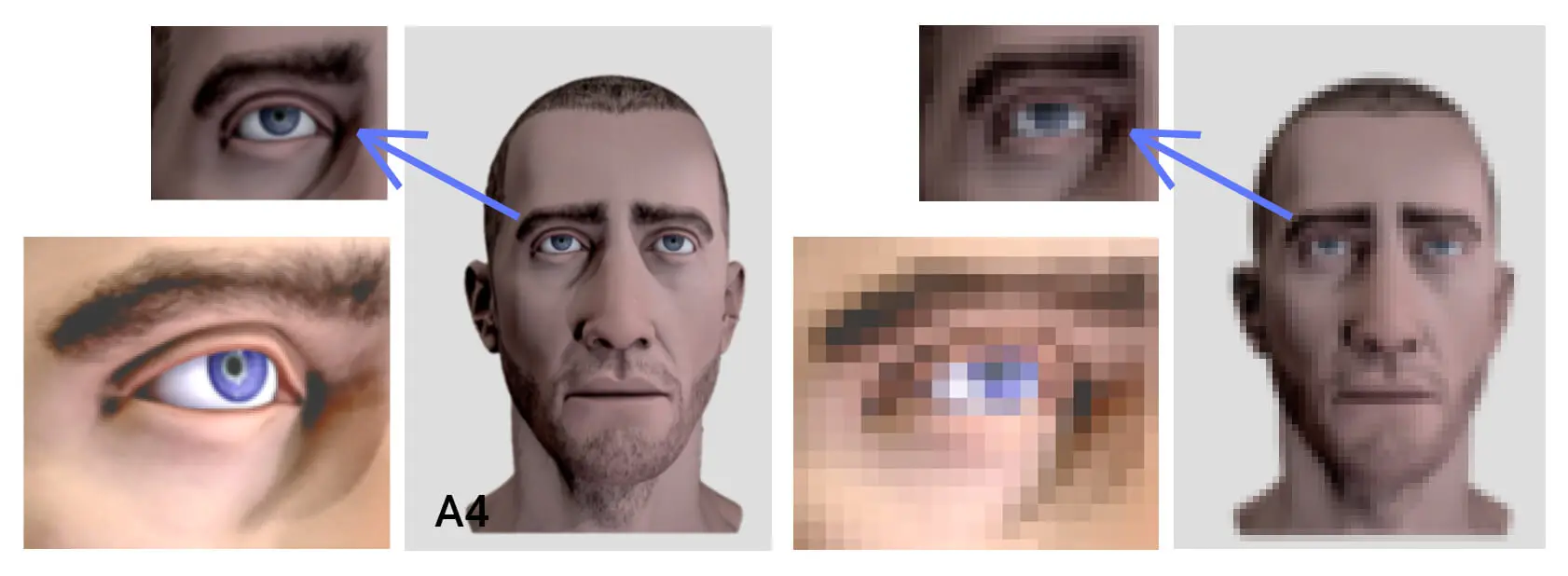 That means not only recognizing the perpetrator's tattoo on the neck, but also, when zoomed in, every detail of it, such as color and outlines. The same applies to eye color. With the “forensic examination” capability, recordings produce forensic images, which ensures they can be used as evidence in court. Video surveillance systems suitable for this are mostly used by authorities for high-security areas. For private and commercial use, they are too expensive.
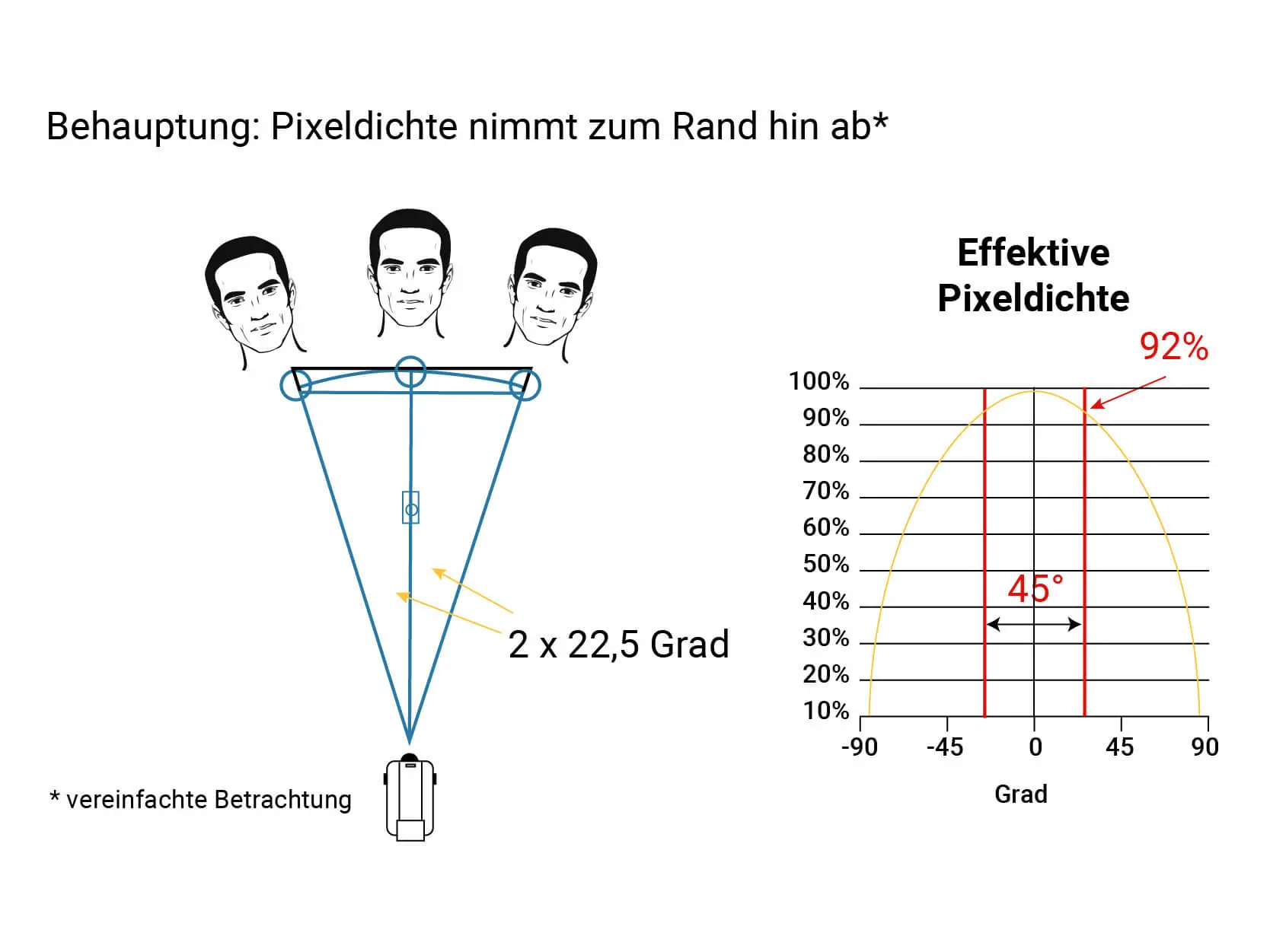
Why is a surveillance image not good enough for identification despite the available pixels in the footage?
Why is a surveillance image not good enough for identification despite the available pixels in the footage?
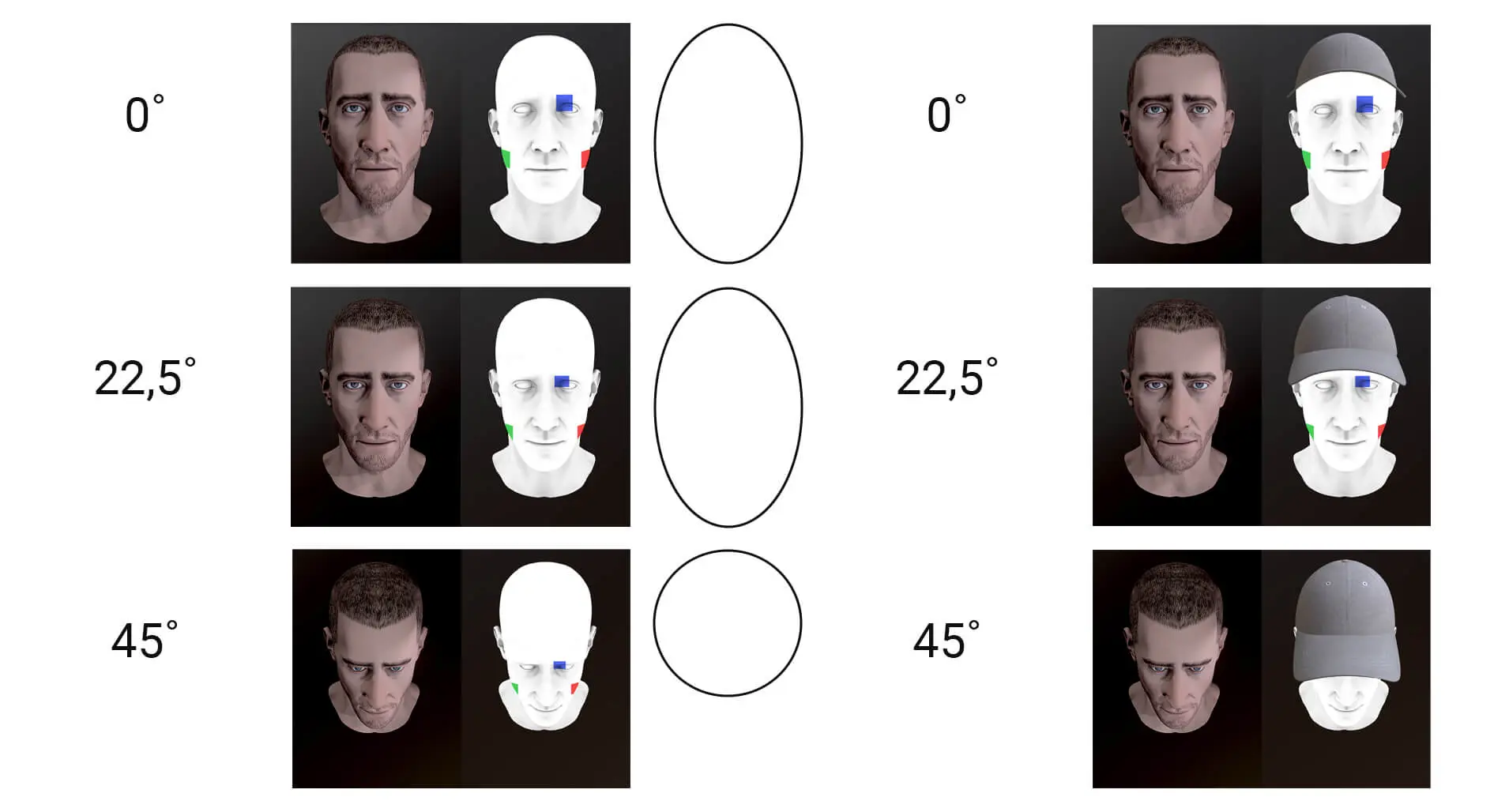
This is usually because the tilt angle of the IP camera is too steep, or the camera is mounted too high.
For accurate identification
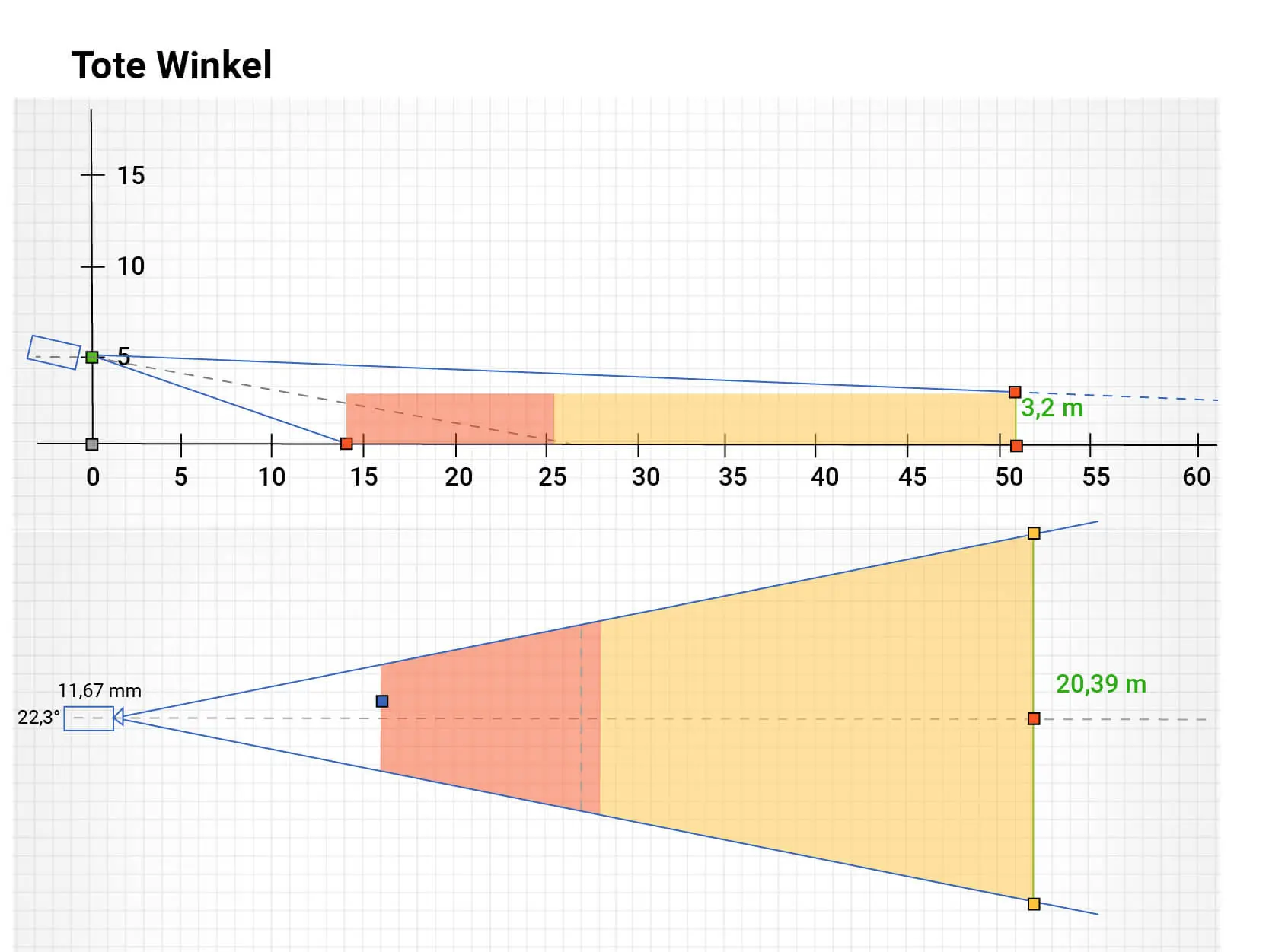
To achieve accurate identification, the camera tilt must not exceed a tilt angle of 22.5°. The mounting height of the IP surveillance camera is also important and should be no more than 3.50 meters. The optimal height for facial identification is 2.20 to 2.70 meters. However, note that at this mounting height, blind spots often occur in the image area.
FURTHER RELATED ENTRIES
See also glossary entry: Megapixel
See also glossary entry: Pixel Calculation
See also glossary entry: Resolution