

Dialers
-
Product
range - Guide
Dialers and Transmission Devices for Alarm Systems in Houses and Apartments
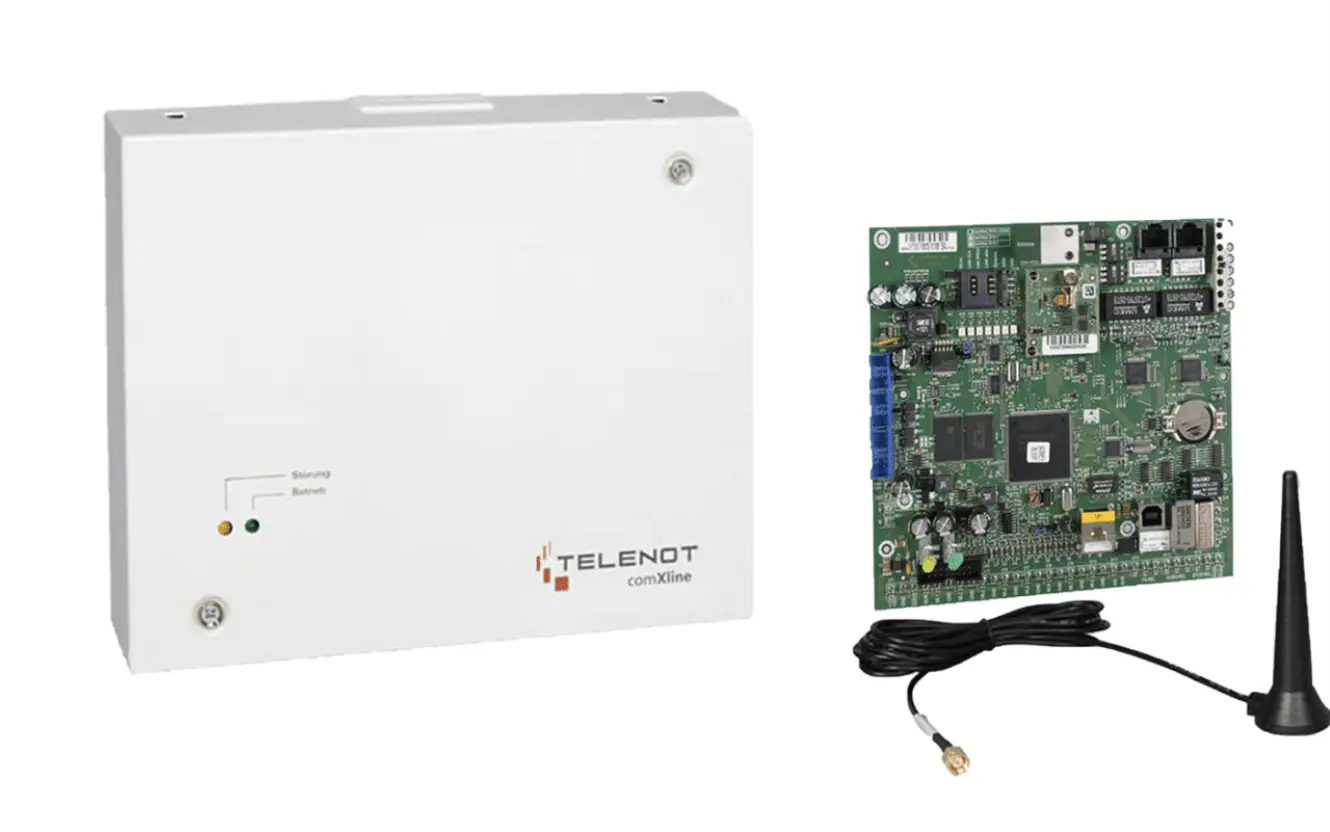 The dialer, also called a transmission device, is responsible for transmitting alarms or other messages, such as faults or tamper alerts, to an alarm receiving center, police, fire department and property owners. The dialer can distinguish whether, for example, a smoke detector or a motion detector has triggered an alarm and alert the correct authority (fire: fire department / burglary: police). Depending on the manufacturer, visual alarm verification from a surveillance camera to an NSL (emergency call service control center) via the dialer is also possible.
The recipients to be notified in the event of an alert are preprogrammed in the device configuration, and the notification sequence is defined.
The transmission device is usually located on a circuit board inside the alarm control panel, but it can also be installed as a standalone device separate from the alarm system.
In wireless alarm systems, the dialer is always located in the alarm control panel.
Dialers and transmission devices use two transmission paths: IP transmission path and GSM transmission path.
For safety reasons, all dialers and transmission devices use both transmission paths. If the internet is unavailable during an alarm, notification is immediately initiated via GSM mobile network. This ensures reliable alarm transmission in the event of an alarm. It is rather unlikely that both transmission paths fail at the same time.
The IP transmission path runs over the Internet Protocol (IP) and therefore over the internet. The transmission device is connected to the router, which establishes the external connection to the internet, via a CAT cable connection. Many alarm systems without VdS certification can also connect to the router via WLAN. Although this connection is convenient, it is vulnerable to attacks from outside and is not recommended by us. For this reason, a VdS-certified alarm system is never WLAN-capable.
The GSM transmission path (Global System for Mobile Communications) runs over the mobile network. The dialer has a GSM card slot, into which the GSM SIM card can be inserted. GSM transmission is independent of specific mobile network operators. Depending on the tariff, relatively high costs may also arise.
For applications such as an alarm monitoring connection we offer special GSM card tariffs including alarm monitoring connection to an NSL emergency call service control center. These special GSM cards, developed for alarm transmission, use multiple networks to always ensure optimal signal reception.
Attention! When using your own SIM cards, the signal strength of the respective mobile provider must be checked on site in advance.
Interesting Categories of Security Technology and Video Surveillance
Learn more about the author of this content:

Tobias Nabinger
Mr. Tobias Nabinger has been active in the field of security technology since 2001. During his more than 20-year career, Mr. Nabinger has acquired practical expertise in the planning and installation of intrusion detection and video surveillance technology. Under his project management, ESA GmbH successfully completed a large number of projects for German Protect for public facilities and institutions as well as industrial corporations. This expertise has been continuously deepened since 2011 through countless product and manufacturer certifications. A brief selection of his certifications: Telenot Specialist Installer and Service Point, planning and installation of intrusion alarm systems in accordance with VdS 2311 and VDE 0833, Q-Certified Specialist for Smoke Detectors in accordance with DIN 14676, Videofied Certified Partner, Risco Certified, Jablotron Certified Partner, Ajax Alarmsystems Specialist Installer, rayTec Professional Partner, SimonsVoss Partner, certified Axis Solutions Partner, IHK Certified Specialist for Video Security Technology, Hikvision Diamond Partner, Vivotek Expert, Hanwha Security Engineering, Mobotix Advanced Partner, Avigilon Partner, Sony Video Security Gold Partner, Flir Partner, Eneo System Integrator, Bosch Partner, Seetec Professional, Milestone Partner, Wave Professional, Aimetis Certified, etc.