

Transponders
-
Product
range - Guide
GUIDE
RFID Chips and RFID Cards for Private and Business Customers
In the field of security technology, RFID cards and RFID chips are the link between users and a security device such as an access control system (e.g., a turnstile in an office complex) or an electronic door lock (e.g., a hotel room). RFID cards and chips thus enable communication between the user and the security device.
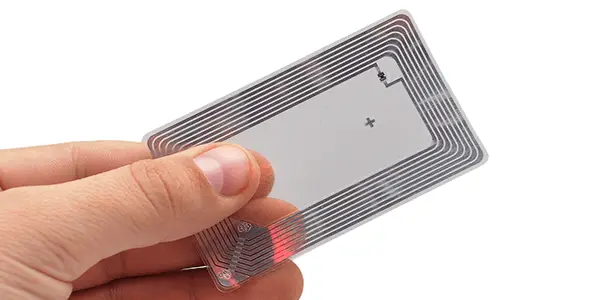
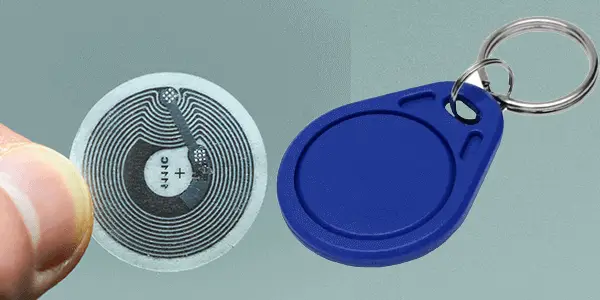
As the name suggests, this type of communication via RFID (Radio Frequency Identification) is necessary so that a person can identify themselves as an authorized person at the access control system for secure entry. RFID transponders are usually housed as a chip inside an RFID card (see Figure 1) or as an RFID chip (see Figure 2) and can be equipped with different RFID standards. The most widespread and relevant RFID standards for security technology include: Mifare Classic, Mifare Plus, Mifare DESFire EV1/EV2 as well as LEGIC prime/advant and HID 200x. These RFID standards belong to the so-called high-frequency (HF) RFID and NFC transponder chips and operate at a frequency of 13.56 MHz (megahertz).
FAQs about RFID Cards and RFID Chips
Is every RFID chip or RFID card compatible with every device?
What RFID cards or RFID chips are available?
Our tables list all common RFID HF/NFC – 13.56 MHz transponder chip types.
|
NXP MIFARE® Chip Types |
Memory Capacity |
|
MIFARE Classic® EV1 1K, 4Byte NON UID |
1024 Byte |
|
MIFARE Classic® EV1 4K, 4Byte NON UID |
4096 Byte |
|
MIFARE Classic® EV1 1K, 7Byte UID |
1024 Byte |
|
MIFARE Classic® EV1 4K, 7Byte UID |
4096 Byte |
|
MIFARE Ultralight® |
48/128 Byte |
|
MIFARE Ultralight® C |
192 Byte |
|
MIFARE Plus® SE 1K |
1024 Byte |
|
MIFARE Plus® X 2K |
2048 Byte |
|
MIFARE Plus® X 4K |
4096 Byte |
|
MIFARE Plus® EV1 2K |
2048 Byte |
|
MIFARE Plus® EV1 4K |
4096 Byte |
|
MIFARE DESFire® Light |
640 Byte |
|
MIFARE DESFire EV1 / EV2 2K |
2,048 Byte |
|
MIFARE DESFire EV1 / EV2 4K |
4,096 Byte |
|
MIFARE DESFire EV1 / EV2 8K |
8,192 Byte |
|
MIFARE DESFire EV2 16K |
16,384 Byte |
|
MIFARE DESFire EV2 32K |
32,768 Byte |
|
LEGIC ® Chip Types |
Memory Capacity |
|
LEGIC prime® MIM 256 |
256 Byte |
|
LEGIC prime® MIM 1024 |
1024 Byte |
|
LEGIC advant® ATC 256-MV410 |
256 Byte |
|
LEGIC advant® ATC 1024-MV110 |
1024 Byte |
|
LEGIC advant® ATC 1024-MV010 |
1024 Byte |
|
LEGIC advant® ATC 4096-MP311 |
4096 Byte |
|
LEGIC advant® ATC 4096-MP312 |
4096 Byte |
|
LEGIC advant® CTC 4096-MP410 |
4096 Byte |
|
LEGIC advant® CTC 4096-MM410 |
4096 Byte |
|
NXP NTAG ® Chip Types |
Memory Capacity |
|
NTAG® 210 |
48 Byte |
|
NTAG® 212 |
128 Byte |
|
NTAG® 213 |
144 Byte |
|
NTAG® 215 |
504 Byte |
|
NTAG® 216 |
888 Byte |
|
NTAG® 413 DNA |
144 Byte |
|
NXP ICODE ® Chip Types |
Memory Capacity |
|
ICODE® SLIX |
869 Byte |
|
ICODE® SLIX 2 |
2,528 Byte |
|
ICODE® ILT |
Read only |
|
ICODE® DNA |
2,016 Byte |
|
Infineon Chip Types |
Memory Capacity |
|
NRG™ SLE66R35I 4Byte NON-UID |
1 KByte |
|
NRG™ SLE66R35R 4Byte reused ID |
1 KByte |
|
NRG™ SLE66R35E7 7Byte UID |
1 KByte |
|
my-d™ |
|
|
CIPURSE™ |
|
| Other Chip Types |
Memory Capacity |
|
HID 200x iClass |
256 – 4096 Byte |
|
SmartMX® P5Cxxx mit MIFARE® Emulation |
72 – 144 Kbit |
|
SmartMX2® P60Dxxx mit MIFARE® Select Emulation |
72 – 144 Kbit |
|
SmartMX3® P71Dxxx mit MIFARE® Select Emulation |
256 – 344 KB |
How do I know which RFID card my device requires?
This information can usually be found in the manufacturer's specifications or the data sheet of the RFID device and is labeled, for example, as "RFID protocols: HF/NFC – 13.56 MHz – MIFARE DESFire EV1 / EV2 2K".
What is the difference between RFID and NFC?
NFC (Near-Field Communication) stands for short-range wireless near-field communication and is based on RFID protocols. In contrast to RFID, NFC can also act as a tag thanks to its card emulation mode, which makes it possible, for example, to pay at the checkout or gain access at an access control system with a mobile phone without using an RFID card. Put more simply, thanks to NFC technology, the mobile phone can imitate an RFID card or RFID chip.
What is an RFID card or RFID chip?
RFID cards or RFID chips use RFID (Radio Frequency Identification) radio transmission for contactless data transfer in order to log in and identify themselves at an RFID-capable device such as a time recording system, an access control system, an alarm system or a video surveillance system. The RFID devices generate an electromagnetic field, which activates the RFID chip and supplies it with power. Touching the device with the card is not necessary, as the RFID chip is read wirelessly by the RFID device.
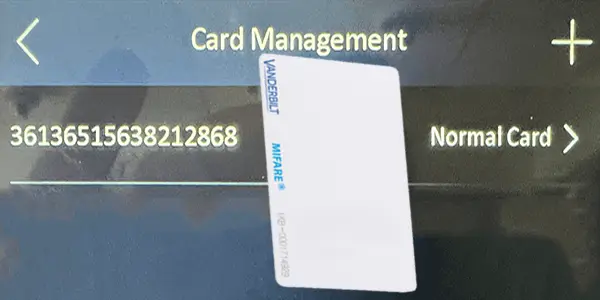
Most RFID transponders are passive chips that do not require their own power supply. The energy needed for this is provided by the reader in the form of an electromagnetic field, which powers and activates the chip for data exchange. Every RFID card or RFID chip has its own multi-digit identification number (see Figure 3), by which it can be registered with the reader.
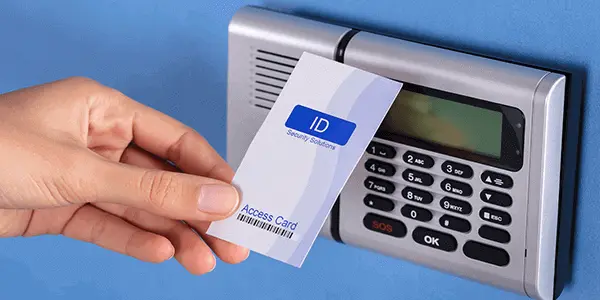
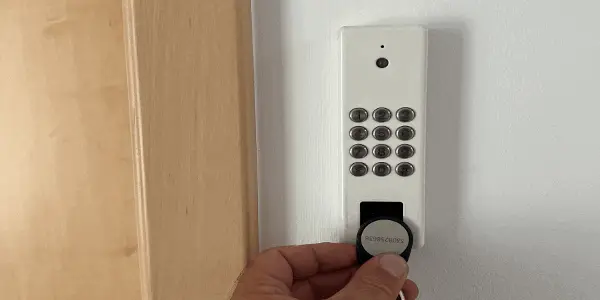
After the registration process, which usually takes place directly at the reader, the RFID card or chip can be equipped with various functions and assigned to a person. The data required for security checks is programmed both onto the RFID chip or card and into the reader (access control). As soon as the user holds the RFID card or RFID chip to the access control unit (see Figure 4), the stored data on the device is compared with that on the card or chip, and if they match, access is granted.
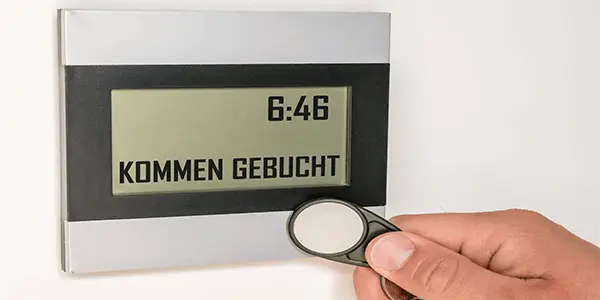
For areas of use such as identification for controlled access, RFID cards or RFID chips can be equipped with efficient functions such as time recording (see Figure 5). Security-relevant applications such as arming and disarming an alarm system or video surveillance (see Figure 6) can also be easily implemented using RFID.
Modern RFID cards and chips can, depending on their storage capacity, be equipped with functions that allow different applications and various security systems to be controlled with a single card. This also works across different buildings.
The inconvenient and heavy key ring in your pocket is a thing of the past thanks to RFID technology.
To implement such multiple applications with just one RFID card, special attention must be paid to the memory capacity of the RFID chip. The more functions you need, the more memory space must be available.
The memory capacity can be identified from the card designation. For example: MIFARE DESFire EV1/EV2 4K. The designation “4K” indicates that the RFID card has 4,096 bytes of memory. You can find more information on the various memory sizes in our table under "Which RFID Cards or RFID Chips Are Available?".
Our Expert Tip! Using RFID cards or RFID chips modernizes access to the house, the apartment, the garage or the commercial building, making conventional keys unnecessary.
In addition, RFID-controlled access increases the security of the door many times over. While losing a hardware key often means the costly replacement of the entire locking system, the RFID card or chip can be deleted from the system and replaced within seconds. To increase the security of the door, RFID readers can also be equipped with a keypad, enabling two-factor authentication for controlled access. Effective security is often simpler than you think thanks to qualified consulting. Contact us! Our expert team for security technology and video surveillance is happy to provide you with professional advice.