Trust. Experience. Handshake quality.
Over 20 years of solid experience.
Expert advice.
Free support.
B2B purchase on account.
Free shipping on orders over €100.

BLACK WEEKS Countdown

Only a short time left until the promotion ends

Promotion ends on 30.11.2026

01 Days
05 Hours
32 Minutes
53 Seconds

Up to 40% off

Free & professional installation from €1,500 purchase value

Promotion ends on 30.11.2026

Back

UPS

  • Product
    range
  • Guide
  • ROLINE LineSecure 1500R - UPS (Rack-Mountable) - AC 230 V - 960 Watt - 1500 VA
    Listenpreis: 661,68 €
    437,92 € 368,00 €
  • ROLINE LineSecure 1000R - UPS (Rack-Mountable) - AC 230 V - 670 Watt - 1000 VA
    Prices visible after login >>
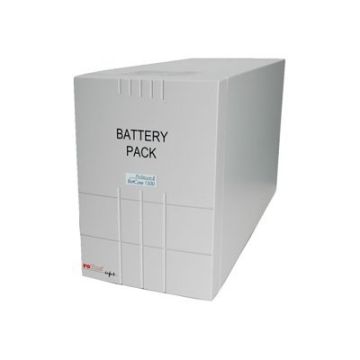
  • ROLINE ProSecure II BatteryPack 3000 - UPS Battery Pack - Gray - for ProSecure II 2000, 3000
    Prices visible after login >>
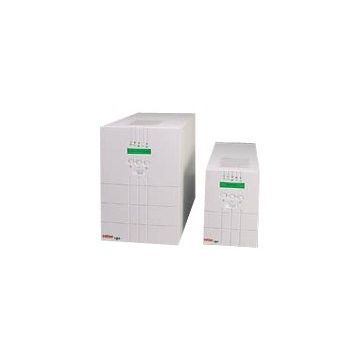
  • ROLINE ProSecure II 3000 RM2HE - UPS (Rack-Mountable) - AC 160 - 230 V - 2.1 kW
    1.695,75 € 1.425,00 €
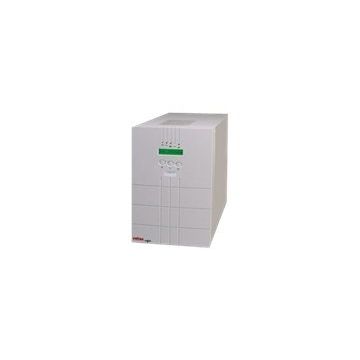
  • ROLINE ProSecure II 2000 - UPS - AC 160 - 230 V - 1.4 kW - 2000 VA
    Listenpreis: 1.388,77 €
    922,25 € 775,00 €
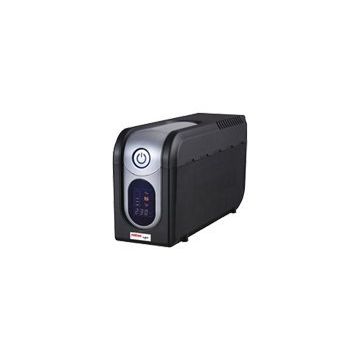
  • ROLINE DesignSecure 825 - UPS - AC 230 V - 825 VA - Black, Silver
    198,73 € 167,00 €
  • ROLINE DesignSecure 525 - UPS - AC 230 V - 525 VA - Black, Silver
    Prices visible after login >>
  • ROLINE ProSecure II 1500 RM2HE - UPS (Rack-mountable) - AC 120/140/160-276 V - 1500 VA - 2U
    Listenpreis: 999,20 €
    655,69 € 551,00 €
  • ROLINE ProSecure II 1000 RM2HE - UPS (Rack-mountable) - AC 120/140/160-276 V - 1000 VA - 2U
    Listenpreis: 860,92 €
    560,49 € 471,00 €
  • ROLINE ProSecure II 700 RM2HE - UPS (Rack-mountable) - AC 120/140/160-276 V - 700 VA - 2U
    Listenpreis: 792,52 €
    514,08 € 432,00 €
  • ROLINE ProSecure II 1000 RM1HE - UPS (Rack-mountable) - AC 120/140/160-276 V - 1000 VA - 1U
    Listenpreis: 857,94 €
    574,77 € 483,00 €
  • ROLINE ProSecure II 700 RM1HE - UPS (Rack-mountable) - AC 120/140/160-276 V - 700 VA - 1U
    Listenpreis: 776,17 €
    517,65 € 435,00 €
  • ROLINE ProSecure II 3000 - UPS - AC 120/140/160-276 V - 3000 VA
    Prices visible after login >>
  • ROLINE ProSecure II 2000 - UPS - AC 160 - 230 V - 1.4 kW - 2000 VA
    Prices visible after login >>
  • ROLINE ProSecure II 1500 - UPS - AC 120/140/160-276 V - 1500 VA
    Listenpreis: 889,17 €
    579,53 € 487,00 €
  • ROLINE ProSecure II 1000 - UPS - AC 120/140/160-276 V - 1000 VA
    Listenpreis: 749,40 €
    485,52 € 408,00 €
  • ROLINE ProSecure II 700 - UPS - AC 120/140/160-276 V - 700 VA
    Listenpreis: 681,00 €
    437,92 € 368,00 €
  • ROLINE LineSecure 1500 - UPS - 1500 VA
    Listenpreis: 570,97 €
    377,23 € 317,00 €
  • ROLINE LineSecure 1000 - UPS - 1000 VA
    Listenpreis: 389,57 €
    260,61 € 219,00 €
  • VALUE 1200 - UPS - AC 230 V - 720 Watt - 1200 VA - USB
    Listenpreis: 260,21 €
    198,73 € 167,00 €
  • VALUE 800 - UPS - AC 230 V - 480 Watt - 800 VA - USB
    Prices visible after login >>
  • VALUE 600 - UPS - AC 230 V - 420 Watt - 600 VA - USB
    Listenpreis: 107,80 €
    82,11 € 69,00 €
  • VALUE 400 - UPS - AC 230 V - 240 Watt - 400 VA - USB
    Listenpreis: 92,19 €
    70,21 € 59,00 €
  • ROLINE ProSecure III 3000 Online UPS
    Listenpreis: 1.602,88 €
    1.101,94 € 926,00 €
  • ROLINE ProSecure III 2000 - Online UPS
    Listenpreis: 1.231,16 €
    846,09 € 711,00 €
  • ROLINE ProSecure III 1500 - Online UPS
    Prices visible after login >>
  • ROLINE ProSecure III 1000 - Online UPS
    Listenpreis: 701,81 €
    485,52 € 408,00 €

Items 121-147 of 147

GUIDE


What Is an Uninterruptible Power Supply (UPS) and How Is It Used?

The abbreviation UPS stands for “Unterbrechungsfreie Stromversorgung” (uninterruptible power supply) and is used by many manufacturers from overseas as “Uninterruptible Power Supply.”
UPS units or UPS systems are used in security technology and video surveillance to maintain the power supply of security-relevant systems during power disturbances or outages. UPS units are not only used to ensure the power supply, but also to improve the power quality for the power supply of sensitive security components.
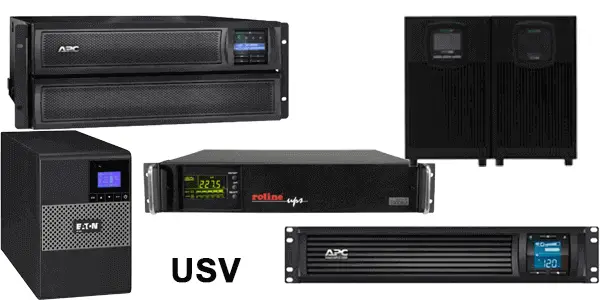
Especially in the IT sector, irregularities in the power supply of network equipment caused by micro-interruptions or voltage spikes are a major risk factor for total failures of the network infrastructure. Since video surveillance systems are usually network-based video systems that use an NVR (Network Video Recorder) to record the footage from the surveillance cameras and therefore use fast HDDs (hard disk drives) with high write and read speeds, the quality of the power supply is also critical to the system here. Especially for large networks that contain a high number of IP cameras and accordingly use powerful NVRs with, for example, 128 channels or more, the use of a UPS or even a UPS system is necessary. Apart from the voltage spikes that can damage the NVR or NAS, the micro-interruptions often cause strong and, for the layperson, inexplicable latency times in the surveillance recordings.
Another function of a UPS that is of great relevance for video surveillance is the ability to shut down the entire surveillance system in a controlled manner during a power outage, thus preventing damage to the hard drives and IP cameras. Depending on the battery voltage capacity and the power consumption of the video surveillance system, a UPS can maintain power to the system for several minutes or hours during a power outage. To calculate the required power capacity for video surveillance, manufacturers label UPS units and UPS systems with various power rating indications such as VA, KVA, Watt, KW and KW/h.

  • VA stands for volt-ampere and is the unit of measurement for apparent electrical power.
  • KVA stands for kilovolt-ampere. In calculation, 1000VA = 1KVA.
  • Watt is the unit of measurement for power, i.e., energy conversion per unit of time.
  • KW stands for kilowatt. 1000 watts equal 1KW.
  • KW/h stands for kilowatt per hour.

To calculate the required capacity of the UPS, i.e., how long a video surveillance system or alarm system can run in emergency power mode during a power outage, you must first add up the total wattage of all security components.
For example, for video surveillance with 64 IP cameras, where each surveillance camera requires 7.4 watts per hour, the following calculation applies: 7.4 watts x 64 IP cameras result in a total power of 473.6 watts.
To calculate the duration of the emergency power supply for, for example, 5 hours of emergency operation, the following calculation is required:
473.6 watts x 5 hours result in 2,368 watt-hours and accordingly 2.368 kilowatt-hours.
Based on this example, the wattage of all components of the security system, switches as well as PoE injectors, NVRs, etc. must be calculated.

But be careful! Especially with video surveillance systems, it is absolutely essential to calculate the total wattage under full load, because at night an IP camera, for example, switches on the infrared illuminators to ensure night vision and therefore requires higher wattage. The same applies to a surveillance camera that includes a heater, ventilation or other additional component.
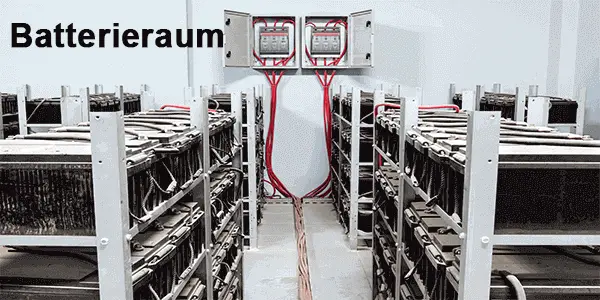
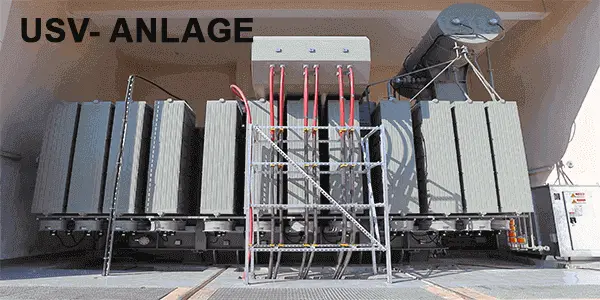
For reasons of cost and space, UPS units are usually used for conventional video surveillance to ensure a controlled shutdown of the surveillance system. The basic rule is: the higher the wattage of the surveillance system, the larger the batteries of the UPS that are required. The longer the emergency power supply needs to last, the greater the required power and number of batteries. The more batteries for the UPS, the greater the space required. It must be taken into account that battery rooms require special safety precautions such as cooling or protection against leaking battery acid. Areas of application for video surveillance at critical locations, such as motorway or tunnel surveillance, where the emergency power supply must be guaranteed for several hours, require the use of UPS systems.

For reasons of cost and space, UPS units are usually used for conventional video surveillance to ensure a controlled shutdown of the surveillance system. The basic rule is: the higher the wattage of the surveillance system, the larger the batteries of the UPS that are required. The longer the emergency power supply needs to last, the greater the required power and number of batteries. The more batteries for the UPS, the greater the space required.
It must be taken into account that battery rooms require special safety precautions such as cooling or protection against leaking battery acid. Areas of application for video surveillance at critical locations, such as motorway or tunnel surveillance, where the emergency power supply must be guaranteed for several hours, require the use of UPS systems.

Our Expert Tip! Using a UPS in connection with video surveillance primarily serves to shut down the surveillance system in a controlled way during a power outage so that it is not damaged and no data is lost. For private use, we recommend limiting the extended backup power supply that keeps video surveillance running during a power outage to a maximum of 15 minutes, for cost reasons. Secondarily, using a UPS helps supply video surveillance continuously with “clean power,” which extends the service life of the system and improves the quality of the recordings. In connection with an alarm system, using a UPS is only rarely necessary, since most alarm systems have their own batteries for backup power.

Our online shop for professional video surveillance and security technology offers a wide range of UPS products from well-known manufacturers such as APC, Cyber Power, Roline and Value. Our technicians are happy to help you choose a suitable UPS for your video surveillance or alarm system.