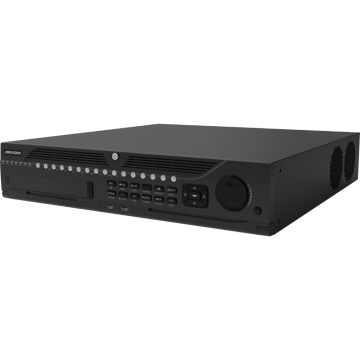
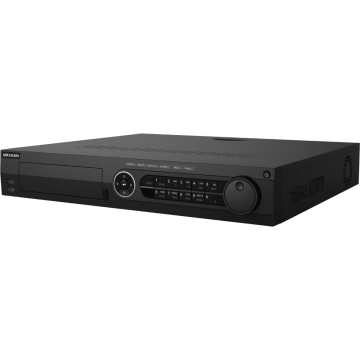
HDCVI Recorders – The Latest Standard in Video Surveillance Technology
Alongside the camera, the recorder is a central element of video surveillance technology. It allows the footage supplied by the
surveillance cameras to be analyzed and archived. While analog systems dominated the security technology market in the past, digitalization has long since taken hold. Today, modern digital cameras are capable of delivering video in Full HD resolution with crisp, sharp images and transmitting them to the recorder via various transmission technologies. Alongside HD-SDI and IP technology, HDCVI recorders and HDCVI cameras are also playing an increasingly important role in the digitalization of video surveillance technology. System operators often hesitate to switch their security technology to high-resolution technology, as it can involve major investments. Especially when the coaxial cabling previously used for analog transmission can no longer be used, enormous costs may arise. The HDCVI standard is the ideal solution for such cases. HDCVI technology offers the opportunity to simply keep using the existing cabling. Thanks to HDCVI, modernizing video surveillance technology only requires replacing the cameras and the central recorder.
The HDCVI Standard in Detail
The abbreviation HDCVI stands for High Definition Composite Video Interface Technology and describes a relatively new standard that enables high-resolution footage to be transmitted over coaxial cable and long distances. This makes HDCVI the modern solution for running megapixel applications over coaxial cable with low latency and over long distances. The transmission technology uses baseband and quadrature amplitude modulation with separation of the luminance and chrominance signals. This results in high image quality with low VCBS crosstalk. HDCVI technology offers two different image qualities: Full HD with 1080P (1920×1080) and HD with 720P (1280×720). In addition, the patented ASC (Auto Signal Compensation) feature can be used, further minimizing interference over long distances. In HDCVI video surveillance, the HDCVI recorder acts as the central element to which the cameras are connected in a star configuration, point to point.
HDCVI – Ideal for Switching to High-Definition Video Surveillance
One reason HDCVI is particularly well suited for switching to high-definition video surveillance is its ability to transmit footage over long distances via coaxial cable. While the maximum transmission distance of the HD-SDI standard is limited to 100 meters, HDCVI systems reach up to 650 meters over coaxial cable. The maximum achievable distances depend on the image mode, whether Full HD or HD, as well as on the connector and cable quality. While 75-3 coaxial cable is suitable for distances up to 500 meters, 75-5 coaxial cable enables distances over 500 meters.
Another advantage of the HDCVI recorder and camera is the ability to carry three signals in one coaxial cable. In addition to the video signal, audio and control signals can also be transmitted over the cable. As a result, control signals for a pan-tilt-zoom PTZ camera can be transmitted over the same cable that delivers the footage. This ensures simple and fast installation, even with bidirectional data transmission.
Key Features of HDCVI Recorders
HDCVI recorders are distinguished by storing video footage in excellent Full HD quality. The HDCVI cameras send the captured images in the highest resolution and color quality via coaxial cable, uncompressed, to the HDCVI recorder. This prevents compression losses, such as those typical of IP surveillance systems. Depending on the model, four, eight or more cameras can be connected to the HDCVI recorder. Since many HDCVI recorders are equipped with integrated motion detection, valuable hard drive space can be saved. Recording only starts once motion has been detected by the HDCVI recorder. In addition to the camera connections, the HDCVI recorder also offers further connection options for monitors, control elements and the network. Thanks to its ability to integrate into existing networks, cameras can also be accessed over the network from mobile devices such as tablets or smartphones.