

PoE Injectors / Midspans
-
Product
range - Guide




GUIDE
PoE Injectors
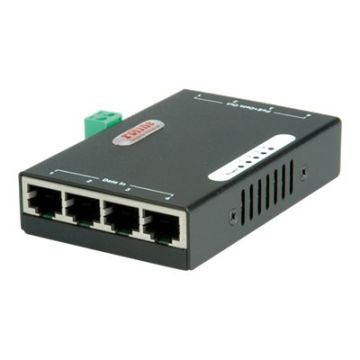
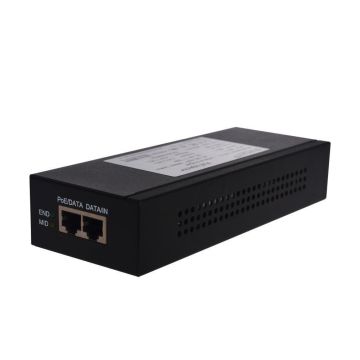
The PoE injector supplies a network device with power and connects it to a non-PoE-capable LAN port of, for example, a router or a switch. The term PoE (Power over Ethernet) comes from English and means power supply via the network cable.
Frequently Asked Questions (FAQ)
What is a PoE injector?
A PoE injector is a type of power supply that powers network devices over the network cable at a distance of up to 100 meters with PoE (Power over Ethernet). In addition to supplying power over the network cable, the PoE injector also enables data communication between the end device, such as an IP camera, and the switch or network video recorder. To ensure the PoE injector has its own power supply, it must be plugged into a 230-volt power outlet.
What does PoE mean?
PoE is the abbreviation for Power over Ethernet (power via the network cable) and describes the ability of various network devices, such as IP cameras or video door stations, to be powered via Ethernet (CAT cable). The network device receives the required power via the data line (patch cable) from a PoE switch or PoE injector. This eliminates the need for a power line or power outlet near the network component.
What is the difference between PoE and PoE+?
PoE, with the PoE standard designation IEEE 802.3af, delivers a maximum output power of up to 15.4 watts.
PoE+ Plus, with the PoE standard designation IEEE 802.3at, delivers a maximum output power of up to 30 watts.
Both PoE standards af and at feature the “Shakehand procedure” to protect the network device against overvoltage.
What does the “Shakehand procedure” mean in PoE?
The “Shakehand procedure” in PoE is a parameter negotiation process between the PoE source, such as a PoE switch or PoE injector, and the power consumer, such as an IP camera. When the surveillance camera or network component is switched on, the “Shakehand procedure” first sends a lower voltage so that relevant parameters, such as the voltage level required by the end device, can be determined. Only after the “Shakehand procedure” has been successfully completed does the network device receive the full required voltage. If the “Shakehand procedure” cannot be completed, the power supply via PoE is immediately interrupted. In this way, overvoltages are avoided and the network components are protected.
Which PoE standards feature the “Shakehand procedure”?
All PoE standards with the designation IEEE 802 feature the “Shakehand procedure”.
These include: IEEE 802.3af, IEEE 802.3at, IEEE 802.3bt Type 3 and IEEE 802.3bt Type 4.
The only exception is Passive PoE, which does not meet an IEEE standard and accordingly does not feature a “Shakehand procedure” either.
What types of PoE are there?
In the fields of network technology and video surveillance, PoE injectors or PoE switches with the following PoE standards are relevant:
| Designation | PoE Standard | Output Power |
| PoE | IEEE 802.3af | 15.4 Watt |
| PoE+ Plus | IEEE 802.3at | 30.0 Watt |
| PoE++,High PoE,4PPoE, Ultra PoE | IEEE 802.3bt Type 3 | 60.0 Watt |
| PoE++,High PoE,4PPoE, Ultra PoE | IEEE 802.3bt Type 4 | 90.0 Watt |
Where does the power for PoE come from?
The power via PoE Power over Ethernet (power over the network cable) is supplied by a PoE injector or PoE switch that is connected to a power outlet.
A PC or notebook as well as router network ports only rarely have PoE capability.
What are the benefits of PoE?
PoE Power over Ethernet (power over the network cable) offers many advantages in networking technology. For example, PoE enables power supply over Ethernet (network cable) at a distance of 100 meters to network components such as IP cameras, LTE routers or intercom systems without requiring an additional power cable or power outlet. The equipment of the various PoE standards with the so-called „Handshake Procedure“ is another advantage for efficiently protecting network components against overvoltage.
Function and Benefits of PoE Injectors

In the field of video surveillance, PoE injectors are primarily used for the simple power supply of an IP camera. At the same time, the IP camera can be connected to a switch or NVR (network video recorder) via the same cable connection to enable communication. This saves a second cable connection. Due to this type of connection, PoE injectors, along with switches, are among the most important components that networking technology provides for IP video surveillance. For example, mounting a surveillance camera on a pole (Figure 1) requires an electrician to install the necessary power supply. By using a PoE injector, the installation-intensive power outlet for outdoor use in IP-based video surveillance becomes almost obsolete.
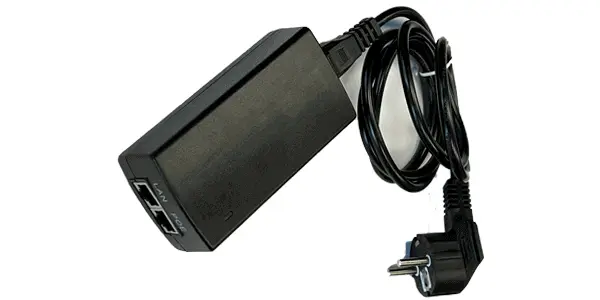
Of course, PoE injectors need a power outlet to be supplied with power. However, PoE injectors can be conveniently connected to a power outlet indoors, so the IP camera can be powered via PoE at a distance of, for example, 100 meters. Since most PoE injectors are plug-in ready devices, connecting them to the IP camera is straightforward (Figure 2) and requires no special knowledge.
Despite the simple solution, the following factors must be observed when installing the PoE injector:
- In principle, PoE injectors supply power to an IP camera over a network cable length of 90 meters up to a maximum of 100 meters. If the length of 100 meters is exceeded, the use of a PoE extender is additionally required.
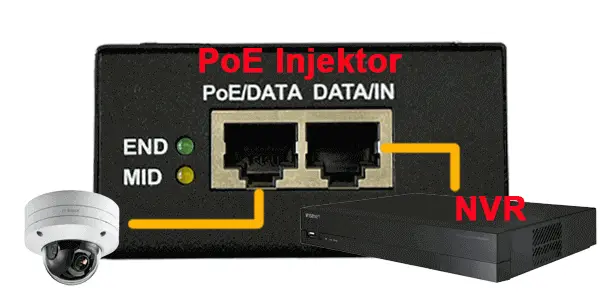
- PoE injectors have two LEDs, one green and one yellow. The green LED indicates data transmission via LAN. The yellow LED indicates the PoE power supply.
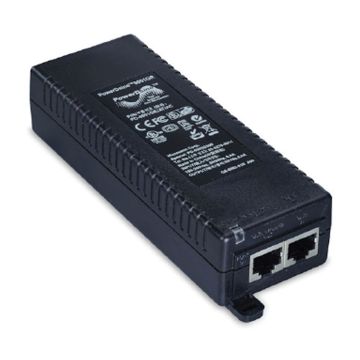
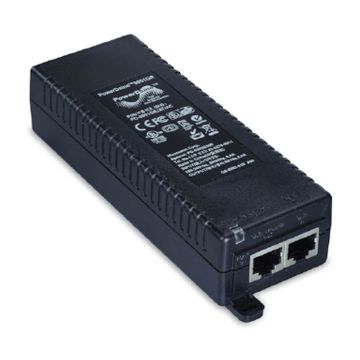
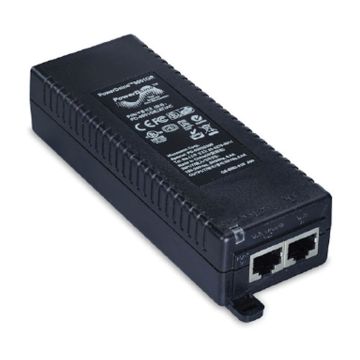
- PoE injectors have two LAN ports (Figure 3) The port labeled PoE/Data is responsible for supplying power to the IP camera. The port labeled Data/IN or LAN is responsible for data transmission toward the NVR (network video recorder)/switch. These labels depend on the manufacturer and may therefore differ accordingly. In principle, however, the port labeled PoE is the same for all manufacturers.
- Depending on the model and equipment of the surveillance cameras, they may have different power consumption specifications, to which the PoE standard of the PoE injector should be matched. For example, a PTZ 360° camera generally requires a higher power supply than a dome camera or bullet camera, due to its movable motors and powerful infrared illuminators alone.
Outdoor cameras for outdoor use that are equipped with a heater or fan, in order to guarantee functionality under various weather conditions, require a higher power supply than a surveillance camera for indoor use.
Therefore, the PoE injector should at least match the maximum power requirement of the IP camera. If the PoE injector is more powerful than the IP camera, there are no disadvantages. If the PoE injector is weaker than the maximum power required by the surveillance camera, failures may occur. - PoE injectors allow bidirectional communication (in both directions), which enables not only audio and video transmission but also the control of movable IP cameras such as a PTZ 360° camera.
- The PoE injector should only be plugged into the power outlet once all components are fully connected.
- PoE injectors are suitable exclusively for IP cameras and not for analog or HD analog cameras.
- Using the surveillance camera manufacturer's own PoE injectors is always recommended.
PoE standards and wattage of PoE injectors
To suitably cover the wide range of surveillance cameras on the market, manufacturers of video and network technology offer various PoE injectors with different standards. The power rating of a PoE injector can be easily identified visually by its PoE standard designations such as af, at or bt. The bt standard is further divided into two types, 3 and 4, for different voltages (see entry in our glossary).