

Network Cables
- Categories
-
Product
range - Guide
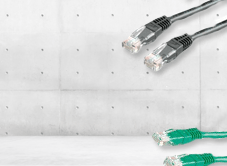
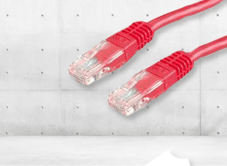
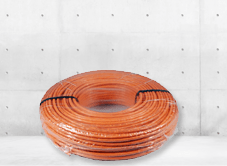

GUIDE
Network Cables in Security Technology
In video surveillance, the network cable establishes the connection between individual components such as the surveillance camera and the network video recorder. To ensure the flawless and high-performance functionality of the video system, selecting the right network cables is very important.
What Types of Network Cables Are There?
Network cables are divided into several categories, ranging from CAT 1 to CAT 8. The categories refer to the operating frequencies for the transmitted data.
For example, the frequency of a CAT 1 network cable is 100 MHz. This means such cables are only suitable for telephony.
Network cables of categories 1 to 4 hardly play a role today. The most common are CAT 5 to CAT 7.
For video surveillance applications, categories from CAT 5 UTP / CAT 5e; CAT 6 / CAT 6A; CAT 7 / CAT 7A and CAT 8 / CAT 8A are relevant, although CAT 5 is not necessarily recommended.
CAT 5 UTP network cables (Unshielded Twisted Pair) are unshielded twisted-pair cables. They have no shielding whatsoever, neither in the wire pairs nor on the overall cable.
CAT 5 UTP network cables have an impedance of 100 ohms at a maximum transmission frequency of 100 megahertz. In video surveillance, the interference-free transmission range of CAT 5 UTP is a maximum of 30 meters.
CAT 6 network cables are available on the market in various versions of categories 6 and 6A. Category 6 offers a transmission frequency of 250 megahertz with a transmission rate of 1000 Mbit to 10 gigabit and a range of 55 meters.
Category 6A network cables even offer transmission frequencies of 500 megahertz, which likewise achieves a transmission rate of up to 10 gigabit per second, but with an extended transmission range of up to 100 meters. CAT 6A network cable is the most widely used in video surveillance.
CAT 7 network cables are also offered in two versions, category 7 and category 7A. CAT 7 network cables operate at a transmission frequency of 600 megahertz, and CAT 7A cables up to 1000 megahertz. Both categories are designed for a 10 gigabit transmission rate. Most CAT 7 network cables are available with S/FTP (Screened/Foiled Shielded Twisted Pair) shielding and are therefore more expensive than CAT 6A network cables.
CAT 8 network cables are divided into categories such as 8.1 and 8.2. CAT 8.1 network cable is compatible with standard Ethernet connectors, while the CAT 8.2 version requires special connectors. Category 8 network cables operate at a transmission frequency of 1600 to 2000 megahertz and a transmission rate of up to 40 gigabit.
CAT 8 network cables were developed for professional IT network use and offer no added value in video surveillance.
Which Type of Shielding for Network Cables Is Best Suited
for Video Surveillance?
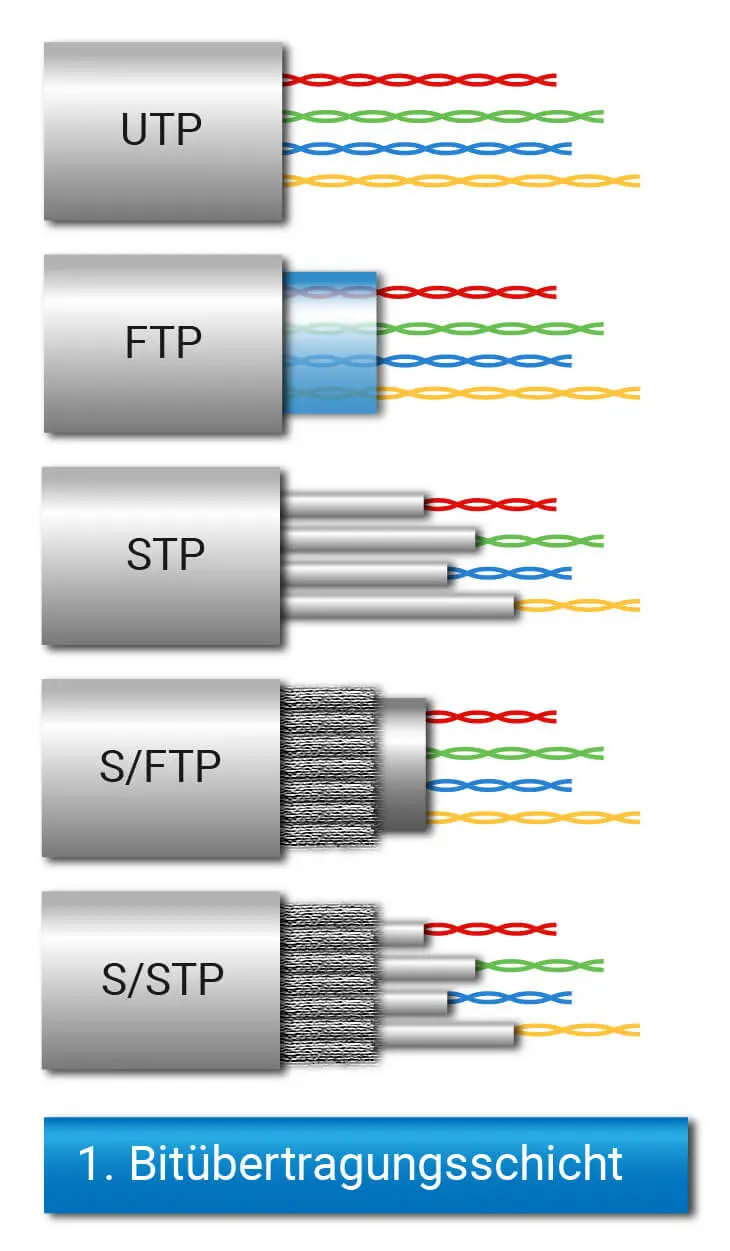
Designations such as UTP, FTP, STP, S/FTP and S/STP describe the shielding of the cable conductors in a network cable. The quality of a network cable and its shielding is very important for interference-free communication of the video components, depending on local conditions, and should be considered accordingly. The following rule applies: always keep network cables away from power cables. If this cannot be ensured due to local conditions (for example, because cable conduits or cable trays are already occupied by power cables), the shielding can be decisive for interference-free video transmission.
The shielding types differ as follows:
UTP network cable
Network cables designated UTP have neither wires twisted together inside the cable (twisted pair) nor a shield on the cable itself. Accordingly, UTP network cables are highly susceptible to electromagnetic interference and are not recommended for video surveillance, regardless of their short transmission range.
FTP network cable
Network cables designated FTP (Foiled Shielded Twisted Pair) have only the main cable shielded, not the individual pairs. FTP network cables are suitable for single runs (directly from the NVR to the camera) and for situations in which no electromagnetic interference from power lines or other influences can occur.
STP network cable
Network cables designated SFTP (Shielded Twisted Pair), i.e. with inner wires shielded in pairs, have the inner conductors shielded in pairs. The shielding of STP cables is sufficient to enable networking, for example with a switch.
S/FTP network cable
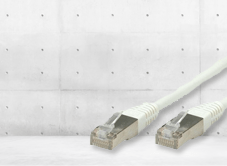
Network cables designated SFTP (Screened/Foiled Shielded Twisted Pair) have the inner wires all together shielded with a foil, and additionally the cable shielded with a wire braid. As a result, S/FTP network cables offer very good shielding and are well suited for wall installation.
S/STP network cable
Network cables designated S/STP (Screened/Shielded Twisted Pair) have the twisted inner wires shielded in pairs with a sheath, and additionally the entire cable shielded with a wire braid. As a result, S/STP network cables offer very good shielding and are suitable for all installation types. Especially for networking larger video surveillance systems with 128 or more surveillance cameras, S/STP network cables are indispensable.
Power supply via the network cable: PoE
A power supply is not always available at the desired location. This can be problematic when a surveillance camera is to be operated in exposed locations.
Using PoE technology ("Power over Ethernet"), the components in a surveillance system can also be operated without a separate power supply. The power simply flows to the camera via the network cable. All network cables from CAT 5 onward are suitable for this.
PoE involves different standards. These relate to the power that can be supplied to a connected device over the network cable. The power is supplied by a PSE ("Power Sourcing Equipment"), and can be drawn by the end device or PD ("Powered Device").
- 802.3af: Each port provides 15.4 watts (PoE). The power supplied is 15.4 watts.
- 802.3at: Each port provides 25.5 watts (PoE+) of usable power, and the supplied power is 30 watts.
- 802.3bt: This standard offers higher power levels of up to 71 watts. It is also known as 4PPoE or PoE++. 802.3bt also covers additional power levels from 5 to 8, using up to four wire pairs of the LAN cable.
Conclusion
Network cables are an essential component of a video surveillance system, linking many important components together. A video surveillance system is a complex system of highly developed devices that must communicate with one another. To make full use of the performance of a video surveillance system, reliable and trouble-free communication is essential.For this reason, you should not save money on the quality of the cabling.
Decide on the suitable network cables based on the specific conditions. For the entire system, the same network cable category and shielding should always be used.
For these reasons, the planning of a surveillance network should be carried out by specialist companies. When installing the cables, care must also be taken that important criteria, such as keeping the network separate from the power grid, are observed .
Cable installation is often the most costly part of a surveillance system. This is not due to the price of the cables, but is instead determined by the cable installation work.
Correcting a wrong cable selection or improper installation afterwards is often very problematic and especially costly.
Our staff are happy to advise and assist our customers with selecting network cables and planning the network correctly.
FAQs on Network Cables for Surveillance Cameras
What type of network cable do I need for my surveillance cameras?
Network cables in a surveillance system should be at least CAT 5 to ensure sufficient transmission bandwidth. Depending on your requirements, a CAT 6 or CAT 7 cable may also be necessary. In addition, the cables must be adequately shielded. Unshielded cables labeled UTP are not suitable.
As for cable length, the rule is: as short as possible and as long as necessary.
Can I power a surveillance camera via a network cable?
Yes, that is possible. For this, PoE must be used, which stands for "Power over Ethernet". Power flows through the network cable and supplies the camera. Depending on the power requirement, various PoE power levels are available.
What does a network cable for a video surveillance system cost?
Prices for network cables depend on the category (for example CAT 5 or CAT 6), the shielding, and the required length. In general, the price differences between the individual categories are not very large.
The cost of the network cables themselves, i.e. the hardware, is in any case not the decisive factor. Far greater influence on the price comes from the cabling process, because it must be carefully planned and professionally carried out.