

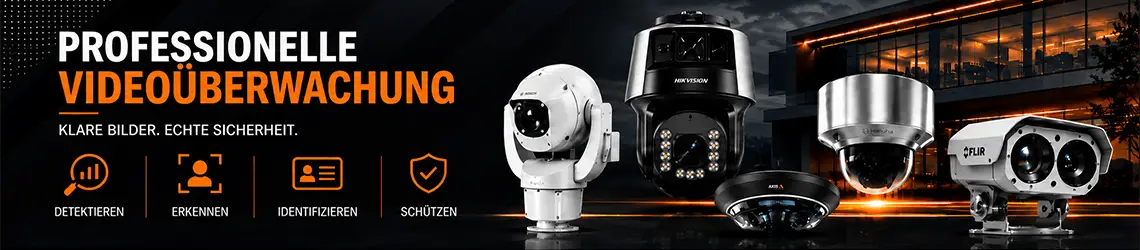
Professional Video Surveillance
Professional Video Surveillance
Professional video surveillance does not begin with selecting a surveillance camera, but with careful planning. Planning is decisive in whether a reliable security concept is ultimately created. This is exactly where the key difference lies between ordinary video surveillance and a professional video surveillance system.
A surveillance camera can have a high resolution and still fail to deliver the required image quality at the critical point. What matters is not how large the displayed area is, but whether people, vehicles and relevant events can be reliably detected, recognized or identified where it is actually required.
Professional video surveillance is therefore planned on a project-specific basis. Camera type, focal length, mounting height, positioning, lighting and technology are selected according to the respective task. Optical surveillance cameras, PTZ cameras, thermal imaging cameras, bispectral surveillance cameras, license plate recognition cameras, radar systems and radar-assisted surveillance cameras can be combined with one another.
The Difference Between Standard and Professional Video Surveillance
While standard video surveillance primarily focuses on detection and a general overview of the situation, professional video surveillance must meet several criteria. These include, in particular, detection, recognition and identification.
Detection means determining that a person or vehicle is within a defined area. Recognition requires sufficient image information to reliably recognize, for example, a person or vehicle. Identification places considerably higher demands. Here, a face, for example, must be displayed with sufficient detail quality.
Already during planning, it must therefore be defined what task a surveillance camera is to perform.
Ordinary video surveillance often uses surveillance cameras with a fixed focal length and a wide viewing angle. While this creates a comprehensive overview of the situation, it does not automatically provide sufficient detail quality.
The larger the displayed area, the more the available pixels are spread across the entire image width. A surveillance camera can therefore have a viewing angle of over 100 degrees and still, after a comparatively short distance, fail to provide enough image detail for reliable identification.
Professional Surveillance Cameras with Varifocal and P-Iris Lens
For professional video surveillance systems, professional surveillance cameras with a motorized varifocal lens are therefore frequently used.
The image section is deliberately set to the relevant surveillance area. Focal length, angle of view and focus are chosen so that the required level of detail is achieved precisely there.
For demanding applications, professional surveillance cameras may also be equipped with a P-Iris lens. P-Iris enables precise dynamic aperture control and adjusts the aperture opening in a controlled way to the lighting conditions. In addition to the amount of incoming light, this also affects depth of field and image quality.
Professional video surveillance is therefore not about covering the largest possible areas with as few surveillance cameras as possible. What matters is obtaining usable images at the relevant points.
Pixels per Meter and Identification
A key factor in planning professional video surveillance systems is the pixel density at the target object. A high resolution alone does not guarantee reliable identification.
If, for example, detailed person identification is planned at 500 pixels per meter, this pixel density must actually be achieved at the relevant point.
A 4K surveillance camera typically has 3,840 horizontal pixels:
3,840 pixels ÷ 500 pixels per meter = 7.68 meters image width
So that 500 pixels per meter are available across the entire image width, the area shown at the relevant distance may only be about 7.68 meters wide.
With an image width of 20 meters, only about 192 pixels per meter are available mathematically, and at 30 meters about 128 pixels per meter.
The achievable identification distance therefore cannot be derived from 4K resolution alone. It depends on factors including focal length, sensor size, angle of view, mounting height and positioning.
This is where the vario lens comes into play. The surveillance camera is zoomed in on the area of interest. This concentrates the available pixels on a smaller image section, so the required pixel density can be achieved at the relevant point.
It must be taken into account that a person normally does not stand still. They move toward the surveillance camera, away from it, or across the monitored area. In addition to pixel density, exposure time, motion blur, focus and lighting conditions are therefore decisive.
500 pixels per meter are of little help if a face is shown blurred due to movement.
Professional Video Surveillance by Day and Night
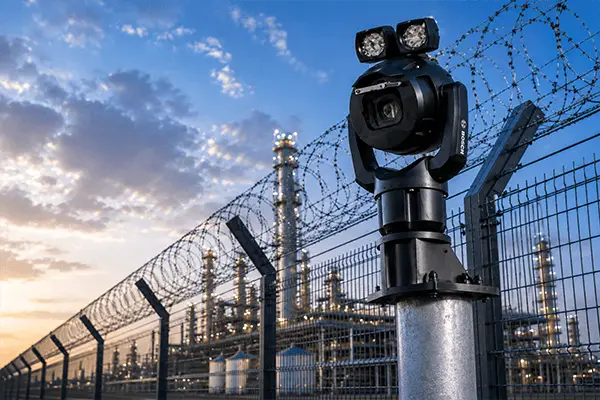
Professional video surveillance must work just as reliably at night as during the day. The required image quality must therefore be ensured even in darkness.
An important basis for this is the DORI principle. DORI stands for Detection, Observation, Recognition and Identification, meaning detection, observation, recognition and identification. DORI describes different requirements for pixel density, depending on the task a surveillance camera is to perform.
The planned DORI area must also be sufficiently and, if possible, evenly illuminated at night. Integrated or external infrared illuminators and white light illuminators can be used for this.
The maximum range of an illuminator alone is not the only deciding factor. The illumination must match the focal length and the actual field of view of the surveillance camera. If a vari-focal lens is zoomed in on a more distant identification area, this area must also be sufficiently illuminated at night.
Poor illumination can cause the foreground to be overexposed while the relevant background is displayed too dark. Reflections on walls, vehicles or license plates must also be taken into account.
A professional surveillance camera that can identify a person during the day but cannot perform this task at night only partially achieves the planned security objective.
Mounting Height and Positioning
In addition to selecting the surveillance camera, mounting height and positioning are decisive.
A surveillance camera mounted too high may provide a good overview of the area, but at the same time an unfavorable angle for facial identification. If it is mounted too low or in an unfavorable position, vehicles, walls or other objects can obscure important areas.
For this reason, professional video surveillance planning does not focus on where a surveillance camera can be mounted most easily. What matters is where it must be mounted to reliably fulfill its defined task.
An overview of the scene may require a different mounting height than person identification, license plate recognition or perimeter monitoring.
License Plate Recognition and Automated Vehicle Access
In professional video surveillance, specialized surveillance cameras with license plate recognition are frequently used.
A license plate recognition camera can, for example, be connected to a barrier system or access control system. If the surveillance camera recognizes an authorized license plate, a barrier or gate can be opened automatically. This allows vehicle access to parking areas, company premises or security zones to be automated.
For these automated functions to work reliably, a license plate recognition camera must also be planned precisely in advance.
Mounting height, distance to the vehicle, capture angle, direction of travel, traffic lane, focal length and vehicle speed must all be taken into account. In addition, varying lighting conditions, headlights and reflective license plates must be considered.
If the license plate recognition camera is positioned incorrectly, the license plate may not be captured reliably. As a result, the associated automated functions will not work reliably either.
Different Technologies for Different Tasks
Modern video surveillance today does not consist exclusively of optical surveillance cameras.
Thermal cameras can, for example, detect people and vehicles over longer distances and under difficult lighting conditions. Bispectral surveillance cameras combine an optical image sensor with a thermal imaging sensor.
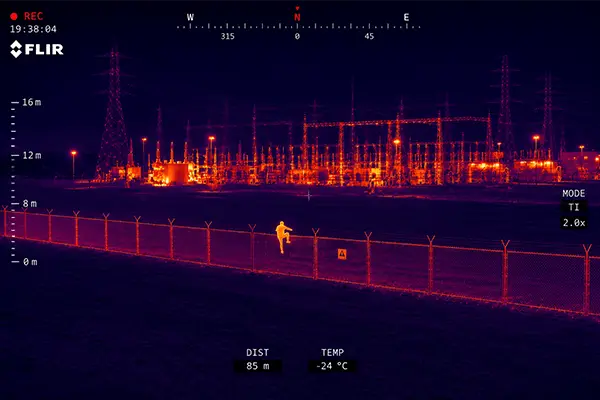
For extensive or particularly security-critical areas, radar systems and radar-assisted surveillance cameras can additionally be used. Radar can detect objects and, depending on the system, determine their position, direction of movement and distance.
If a radar detects a person or vehicle within a defined area, a PTZ camera can, for example, be automatically aimed at the event. The PTZ camera can optically zoom in on the object and keep tracking its movement.
Likewise, a bullet camera or dome camera can trigger an alarm and hand the event over to a PTZ camera.
As a result, the individual components do not work in isolation. Detection, recognition, tracking and identification are linked together within a professional video surveillance system.
More surveillance cameras can deliver the better result
Professional video surveillance may therefore require more surveillance cameras than a simple video surveillance system.
A single wide-angle surveillance camera can, for example, cover an entire parking lot. However, for a professional security concept, several surveillance cameras may make sense.
One surveillance camera provides the overall situational picture, another handles detection, another is specifically aimed at person identification, and a license plate recognition camera monitors vehicle access.
Each surveillance camera thus fulfills a clearly defined task.
Professional Video Surveillance as a Complete Concept
Professional video surveillance does not simply mean using especially expensive surveillance cameras. Planning and the overall concept are what matter.
Even before installation, it must be determined which areas are to be monitored, which distances are relevant, and where detection, recognition or identification is required. Afterwards, surveillance cameras, focal lengths, lenses, mounting heights, lighting and technologies are selected.
Professional surveillance cameras with varifocal lenses and P-Iris technology can be part of the system, as can PTZ cameras, license plate recognition cameras, thermal imaging cameras, bispectral surveillance cameras, radar systems and radar-assisted surveillance cameras.
This creates modern video surveillance that does more than provide a situational picture. It can detect events early, recognize persons and vehicles, enable identification, analyze license plates, automate access and track movements across a site.
This is precisely where the difference lies between conventional video surveillance and a professional video surveillance system.
Professional Video Surveillance for Different Application Areas
Professional video surveillance places different demands on technology, planning and security concepts depending on the application area. Whether video surveillance for industry and commerce, critical infrastructure, government agencies, cities and municipalities in the field of public video surveillance, or private video surveillance, every solution requires individual planning.
Discover our security concepts for professional video surveillance, tailored to the respective areas of use.
German Protect stands for professional video surveillance from a single source: from planning through to installation. For modern video surveillance that works reliably and delivers results when it matters.