

IP Dome Cameras
-
Product
range - Guide
The IP dome camera - modern surveillance technology for outdoor or indoor use
The standout feature of the IP dome camera is its distinctive glass dome, behind which the actual surveillance camera sits. Thanks to the hemispherical shape of the dome, the camera can be aimed at almost any area. If the dome is also tinted, outsiders cannot tell which area the surveillance technology is currently covering. Another characteristic of the IP dome camera is its good protection against external influences and vandalism, which comes from its design. In addition, pan, tilt and zoom cameras that can be controlled precisely from a distance make it possible to capture a flexible image area that can be adjusted at any time. Users can follow individual objects, zoom in on details or react flexibly to events. Depending on the application, the IP dome camera is designed for indoor or outdoor use. Some models have built-in infrared illumination that can be switched on and allows video recordings in perfect image quality even in the dark. Because infrared light is invisible to the human eye, it is impossible to tell whether an object is being illuminated or not. At Germanprotect you will find the IP dome camera in many different technical configurations from renowned manufacturers such as Axis, Vivotec, Arecont Vision and many more.Pan range and resolution of the IP dome camera
Besides the fixed version, which is permanently aimed at a specific image area, the IP dome camera is available in a flexible pan and tilt design. It is controlled remotely over the network from a control unit for surveillance cameras. Depending on the type of camera, huge areas can be covered this way. The cameras can often pan through 360 degrees and provide a complete all-round view when needed. Zoom lenses or a digital zoom allow image sections to be enlarged and examined more closely. Depending on the type, the resolution of the surveillance camera ranges from a few megapixels to the high megapixel range and enables Full HD recordings with the finest details. Thanks to fast lenses and sensitive image sensors, high-quality images are possible even in difficult lighting conditions. Cameras with built-in infrared illumination even work in complete darkness and capture objects reliably at night.Cabling and data transmission of the IP dome camera
IP cameras are connected to the IP network by cable or wirelessly via Wi-Fi and communicate with other components of the surveillance system using the Internet Protocol. Modern compression methods such as H.264 or MJPEG make sure the available bandwidth is used as economically as possible for image transmission. Besides transmitting the footage, the cameras also receive their control commands over the network. Some models even offer full-duplex audio communication. If the Power over Ethernet standard (PoE) is also supported, the camera draws the electrical power it needs through the network cabling as well. This reduces the installation effort and makes costly additional cabling unnecessary. If the network connection is ever unavailable, cameras with a memory card slot can store the video directly in the camera and keep it ready for later retrieval. If internet access is available, control commands and images can be retrieved and sent from anywhere and with any device such as smartphones or tablets.The IP dome camera for outdoor or indoor use
IP dome cameras can be suitable for both indoor and outdoor use. The resistance to external influences such as water or dirt is documented, among other things, by the device's protection rating. Cameras with protection rating IP67 are very well protected against the ingress of water or dust. If standards such as IK-10 are also met, the IP dome camera survives even vandalism attacks undamaged.The IP dome camera is mounted either on the ceiling or on the wall using a bracket arm. Particularly small devices that can also be recessed into the wall or ceiling provide very discreet surveillance that is hard to spot from the outside. For use in very cold temperatures, models with a built-in heater are available. The heater can be switched on as an option and allows the IP dome camera to operate safely even at temperatures of -40 degrees Celsius or below.
GUIDE
Frequently Asked Questions (FAQ)
What is a Dome Camera?
The term “Dome” comes from the English language and means dome. A Dome Camera is a surveillance camera that has the shape of a dome. Surveillance technology includes two different types of Dome Cameras: pure Dome surveillance cameras, which are not movable, and PTZ 360° Dome Cameras, which are equipped with pan, tilt and zoom functions.
How does a Dome Camera work?
A Dome surveillance camera is generally not movable, but it can be adjusted manually or mechanically to a desired image area of up to 360°. The tilt angle can also be adjusted manually. Movable Dome surveillance cameras are designated PTZ 360° (Pan, Tilt, Zoom) and are equipped with pan, tilt and zoom functions. The Dome Camera is installed in a semi-spherical glass dome and is mostly equipped with an infrared illuminator for night vision. A Dome Camera can be protected against vandalism through various IK certifications, as well as against moisture and water through IP certifications. Most Dome Cameras transmit the captured image over the network (IP) or via WLAN. Only technologies such as TVI, AHD or CVI still use the analog transmission path for a Dome Camera.
What focal lengths and angles are available for dome cameras?
Dome cameras can be equipped with variable focal lengths between 1.68 and 12 mm or with fixed focal lengths of 2.8mm/4mm/6mm/8mm/10mm or 12mm. For the variable focal lengths of the dome surveillance camera, an electronically zoomable varifocal lens is used.
The fixed focal lengths of a dome camera are fixed and cannot be adjusted. For dome cameras, a distinction is made between horizontal, vertical and diagonal viewing angles, which are marked as FOV (Field of View). The viewing angles are measured in degrees (°). The vertical and diagonal viewing angle values depend on the number of degrees of the horizontal viewing angle. For example: a horizontal viewing angle of 114° has a vertical viewing angle of 62° and a diagonal viewing angle of 135°. A smaller horizontal viewing angle of 108° has a vertical viewing angle of 56° and a diagonal viewing angle of 131°. Dome surveillance cameras can be equipped with a horizontal viewing angle of 30° to 142°.
The interplay between focal length and viewing angle is very important for correctly setting up a dome camera. The following rules apply: the larger (higher) the focal length, the more the viewing angle decreases. Example: with a focal length of 2.8mm, you have a viewing angle of 114°. A 4mm focal length has a viewing angle of only 86°.
Dome Camera - Infrared Illuminator Visibility at Night from a Distance of 5 Meters
At night, however, it is different: when the infrared illuminators for the night image are switched on, the direction becomes visible through the red LEDs. If the direction of the dome camera is to be concealed at night as well, infrared illuminators with a wavelength of 940 nanometers must be used. Compared to infrared illuminators with a wavelength of 850 nanometers, however, these offer only a limited illumination range. They are therefore only recommended for close-range applications.
Dome cameras with the designation “Fixed Dome Camera” can in principle only be adjusted manually on three axes. During operation they are rigid. Moving dome cameras are designated “PTZ”. This designation stands for "Pan, Tilt, Zoom" and means that the cameras are equipped with pan, tilt and zoom functions. Furthermore, dome cameras are also available as Wi-Fi Camera, which enables wireless installation of the surveillance camera.
Despite the similar designation and designs, there are therefore considerable differences within the category of dome cameras.
Lens Types and Focal Lengths of Dome Cameras
Dome cameras are available with various lenses and focal lengths:
- Fixed lens, i.e. not zoomable, with a fixed focal length of, for example: 1.7 mm / 2.8 mm / 4 mm / 6 mm / 8 mm / 12 mm. These are pre-zoomed and not adjustable.
- Varifocal lens, i.e. zoomable, with a variable focal length of, for example: 2.8 mm to 12 mm and 8 mm to 32 mm. They are equipped with a so-called optical zoom. However, the optical zoom only serves to align the camera to the optimal image section, so that the image does not have to be blurred for data protection reasons. Of course, the camera can be zoomed in and out as needed. For frequent zoom changes, PTZ Dome Cameras are generally recommended.
Mounting Options for Dome Cameras
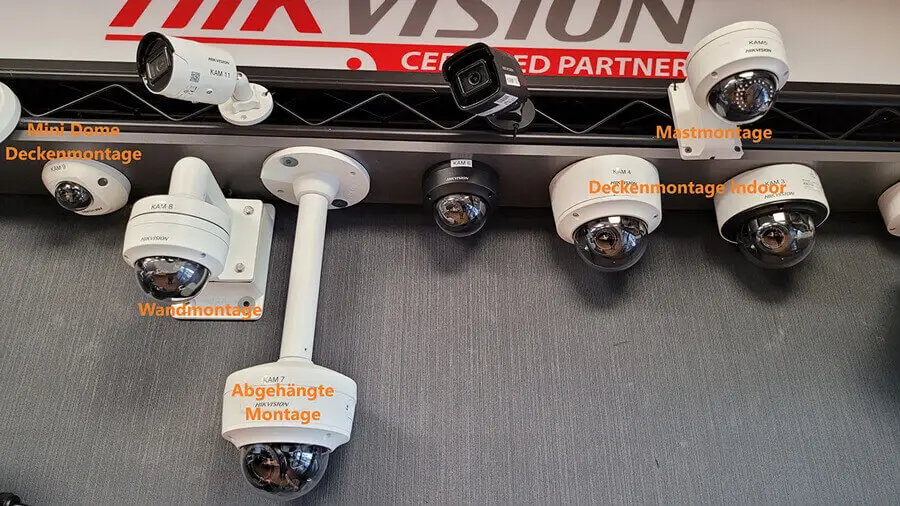
Dome cameras are available in various sizes from different manufacturers for indoor and outdoor use with various mounting options.
Example of ceiling mounting of a dome camera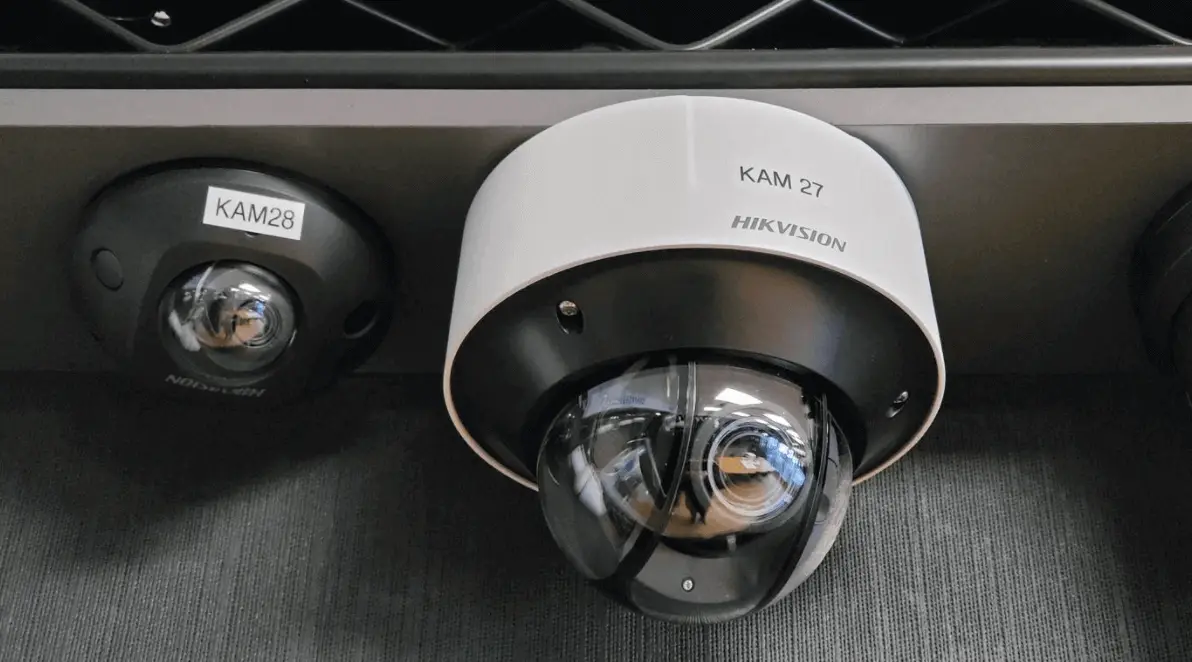
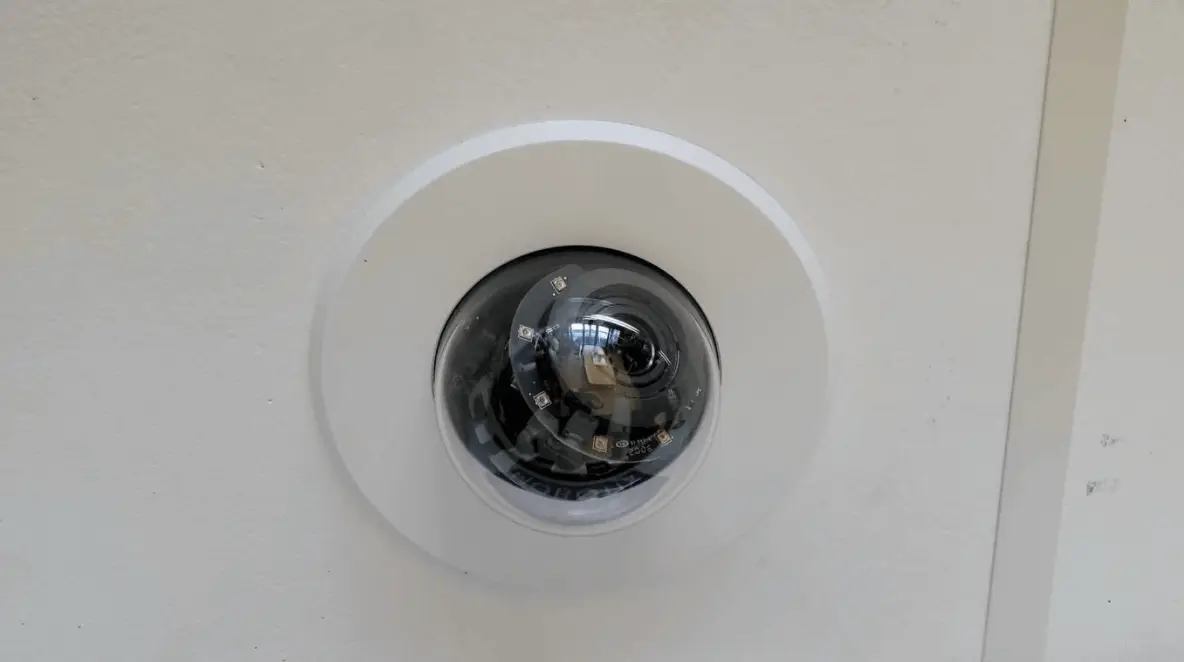
Example of recessed ceiling mounting of a dome camera
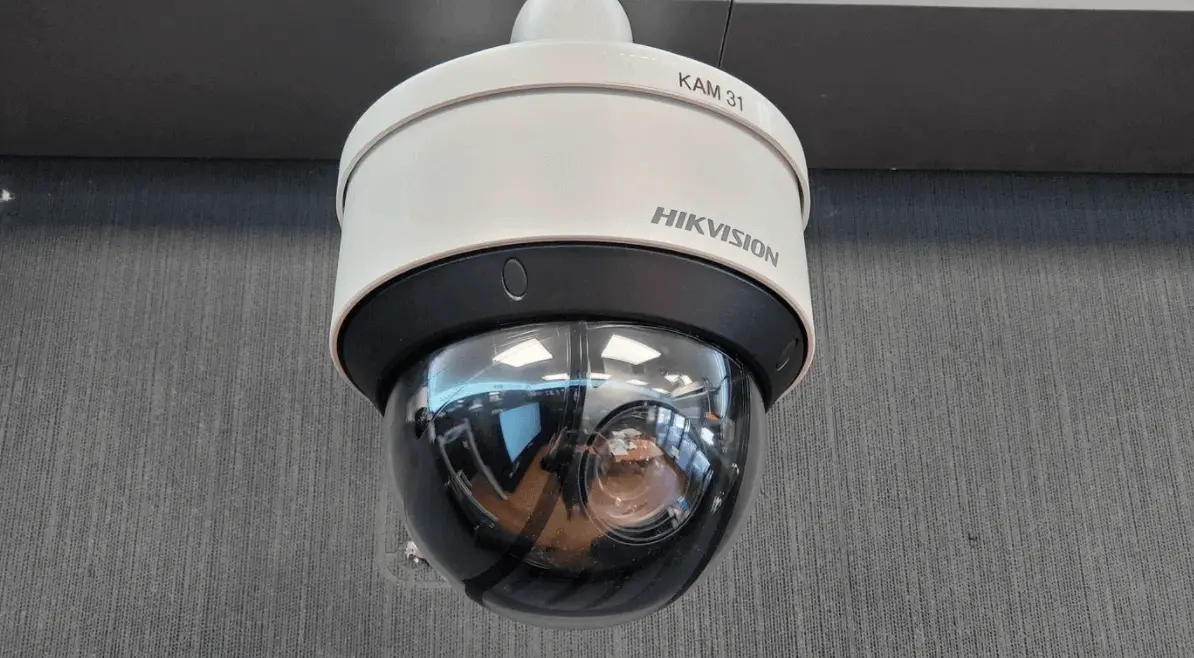
Example of wall mounting of a dome camera
Example of vertical wall mounting of a dome camera with weather shield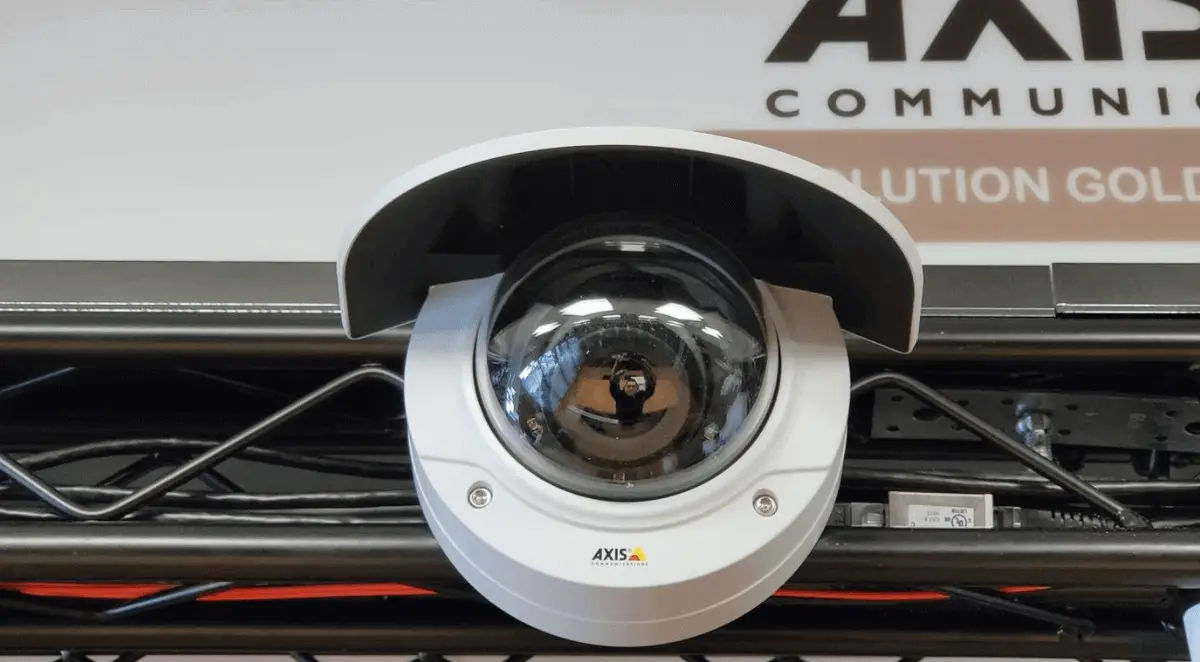
Example of suspended mounting of a dome camera
Example of a mini dome camera
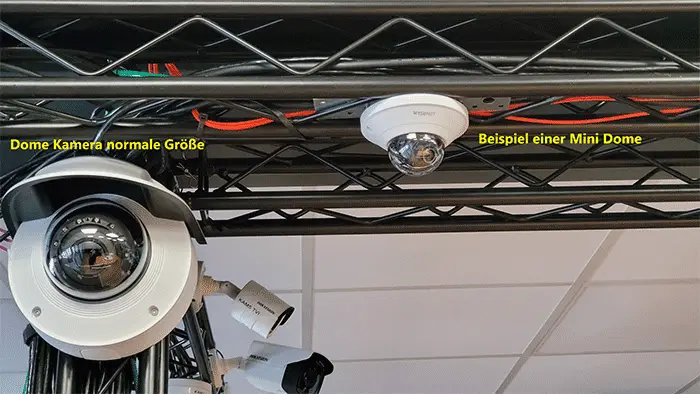
When mounting a dome camera, be sure to also order suitable accessories for the various applications and assemble them correctly. For vertical mounting outdoors, be sure to use a rain cover to avoid light reflections from rain when the infrared illuminator is switched on.
Resolutions and Additional Features of Dome Cameras
The resolution of a dome surveillance camera can be selected, ranging from under one megapixel to models with 4K Ultra HD, 12 MP and 8K / 33-megapixel resolution.
Additional features of dome cameras include, for example, alarm input and output, integrated motion detectors, audio support, heating, ventilation and various onboard analytics, up to AI (artificial intelligence) are available.
Dome cameras can be used together with various transmission technologies:
- Purely analog over coaxial cable (up to 1000 TV lines)
- Analog digitized TVI / CVI / AHD / SDI / Turbo HD (also over coaxial cable) up to 8 megapixels
- IP-based from 720p up to 33 MP. IP transmission is also possible as WLAN transmission
The abbreviations mean:
- TVI: Transport Video Interface - enables the transmission of lossless and uncompressed images without an additional digital interface
- CVI: Composite Video Interface - images can be transmitted over long distances. Coaxial and network cables can be used.
- AHD: Analog High Definition - uses analog transmission up to 4 MP over coaxial cable or twisted-pair cable.
- SDI: Serial Digital Interface - transmission via coaxial or fiber optic cable up to 270 Mbit/s.
- Turbo HD: Integrates the HDTVI standard (High Definition Transport Interface) into analog transmission. Enables reliable transmission, including over longer distances.
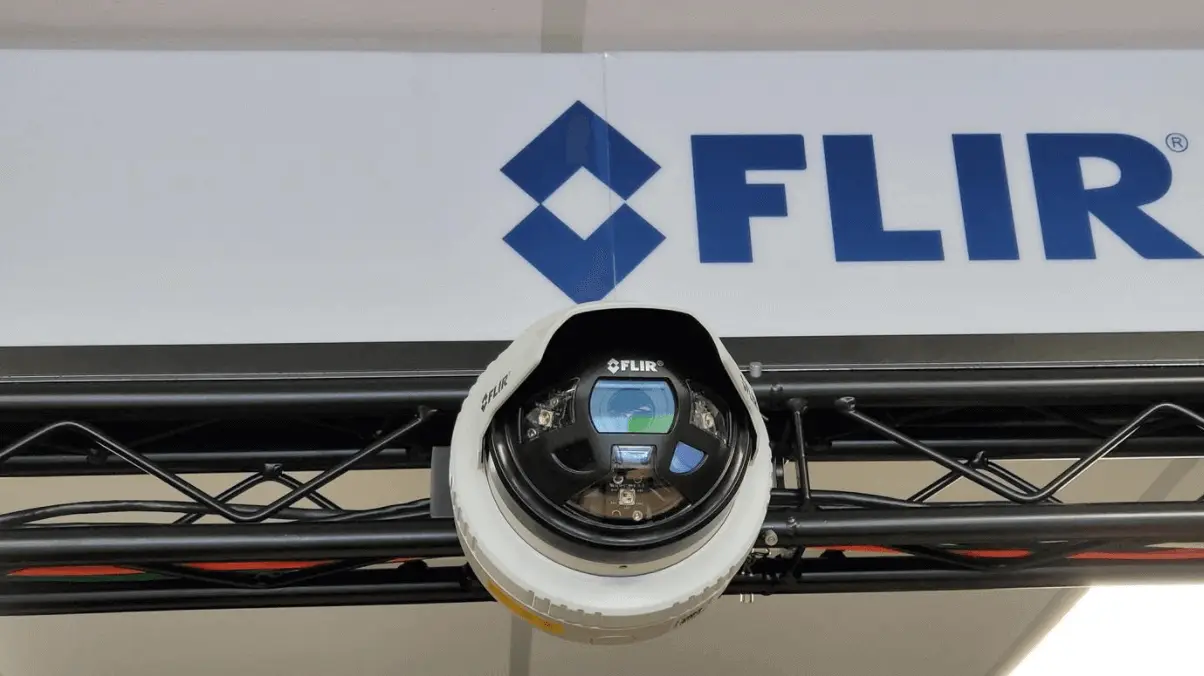
In professional applications, dome cameras are also available as a bispectral-variant. This technology offers considerable advantages through bi-sensor technology. It enables the dome camera to simultaneously display an optical and a thermal image. The thermal sensor detects even in difficult conditions such as smoke and fog, while the optical sensor identifies.
Example of a bispectral dome camera
In our dome camera portfolio, you will find a complete product range, from analog dome cameras, TVI- / CVI- / AHD- / SDI- / Turbo HD dome cameras, IP dome cameras, WLAN dome cameras to PTZ cameras.
ADVANTAGES AND DISADVANTAGES OF DOME CAMERAS
The advantages and strengths of a dome camera lie in its wide range of mounting options, which enable many different applications. The cameras are very flexible in use and also impress with their attractive appearance.
A disadvantage of dome cameras is that the infrared illuminators mounted inside the dome (depending on the manufacturer) and the degree of dirt on the dome can cause light cones and reflections in the image at night.
To avoid light reflections, some manufacturers also mount the infrared illuminators inside the dome, but separated from the lens.
A dome camera also requires more maintenance, because the dome must be regularly cleaned of heavy dirt.
TIPS FOR THE PRACTICAL USE OF DOME CAMERAS
When a dome camera is used for outdoor use, attention must be paid to IP protection classes such as IP65 to IP69, as well as to heating and ventilation, depending on the conditions and changing weather.
By using suitable accessories, a dome camera should always deliver straight images when properly set up, depending on the mounting type. For wall mounting, make sure to align the dome camera so that the infrared illuminators are not pointed at the wall, which helps avoid overexposed night images.
It is very important when mounting a dome camera not to touch the dome from the inside. Skin grease residue that may result is difficult to remove afterward and only becomes visible at night due to light reflections.
The mounting height of a dome camera for outdoor use must also be considered, because the dome must be regularly cleaned of heavy dirt, depending on the surroundings.
When choosing a mounting location for a WLAN dome camera for outdoor use, wooden facades that get wet in the rain should be avoided where possible in order to ensure flawless transmission.
For detailed advice on choosing the dome camera that suits you, our technicians are happy to help.