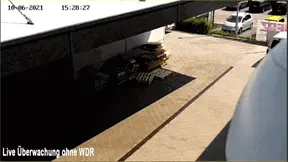
HD-TVI
The abbreviation HD-TVI stands for High Definition Transport Video Interface. It is a standard for transmitting high-resolution HD video over analog channels. The advantage: existing coaxial cabling can be used. Resolutions of up to 1080p (2 megapixels) are possible.
HD-TVI can be described as a bridging technology that connects analog and IP systems. HD-TVI devices such as HD-TVI recorders and HD-TVI surveillance cameras can be easily integrated into existing analog systems.
In earlier times, analog surveillance systems based on coaxial cables were installed in many buildings, such as banks, warehouses and other security-relevant areas. Today there is often a desire to use devices with higher resolution. To avoid having to dismantle an existing system and install a new one including cabling, which would result in high costs, HD-TVI offers the option of using the existing infrastructure. HD-TVI cameras make significantly better use of the potential of coaxial cables than the SD cameras used earlier.
Because no new cabling has to be laid, disruptions to ongoing operations caused by installing new devices are minimal. Only the surveillance cameras and the recording devices need to be replaced.
Advantages of HD-TVI
Using HD-TVI offers several advantages:
- HD-TVI components can be easily integrated into existing analog video surveillance systems. In this way, the systems can be upgraded without having to make large investments.
- HD-TVI cameras are less expensive than pure IP cameras. There is also a large selection of suitable devices.
- Another plus of HD-TVI is reliability. Video data can be transmitted without major latency and is also fairly well protected against electromagnetic interference sources.
- Compared to HD-SDI, HD-TVI can bridge longer distances without additional equipment. This applies to audio, video and control data. Ranges of up to 500 meters are possible.
- HD-TVI enables the transmission of video, audio and control data over a single cable – unlike HD-SDI. This saves costs and effort for additional cabling.
- A gradual changeover to HD-TVI is possible, by replacing individual devices one by one.
Conclusion
HD-TVI offers a cost-effective way to upgrade video surveillance systems and to gradually switch from analog to IP technology. Numerous cost-effective yet high-performance HD-TVI surveillance cameras and video recorders are available.