

Viewing Angle
EXAMPLES OF VIEWING ANGLES
The viewing angle of a security camera defines the size of the image section (FOV / Field of View).
EXAMPLES OF VIEWING ANGLES IN VIDEO SURVEILLANCE
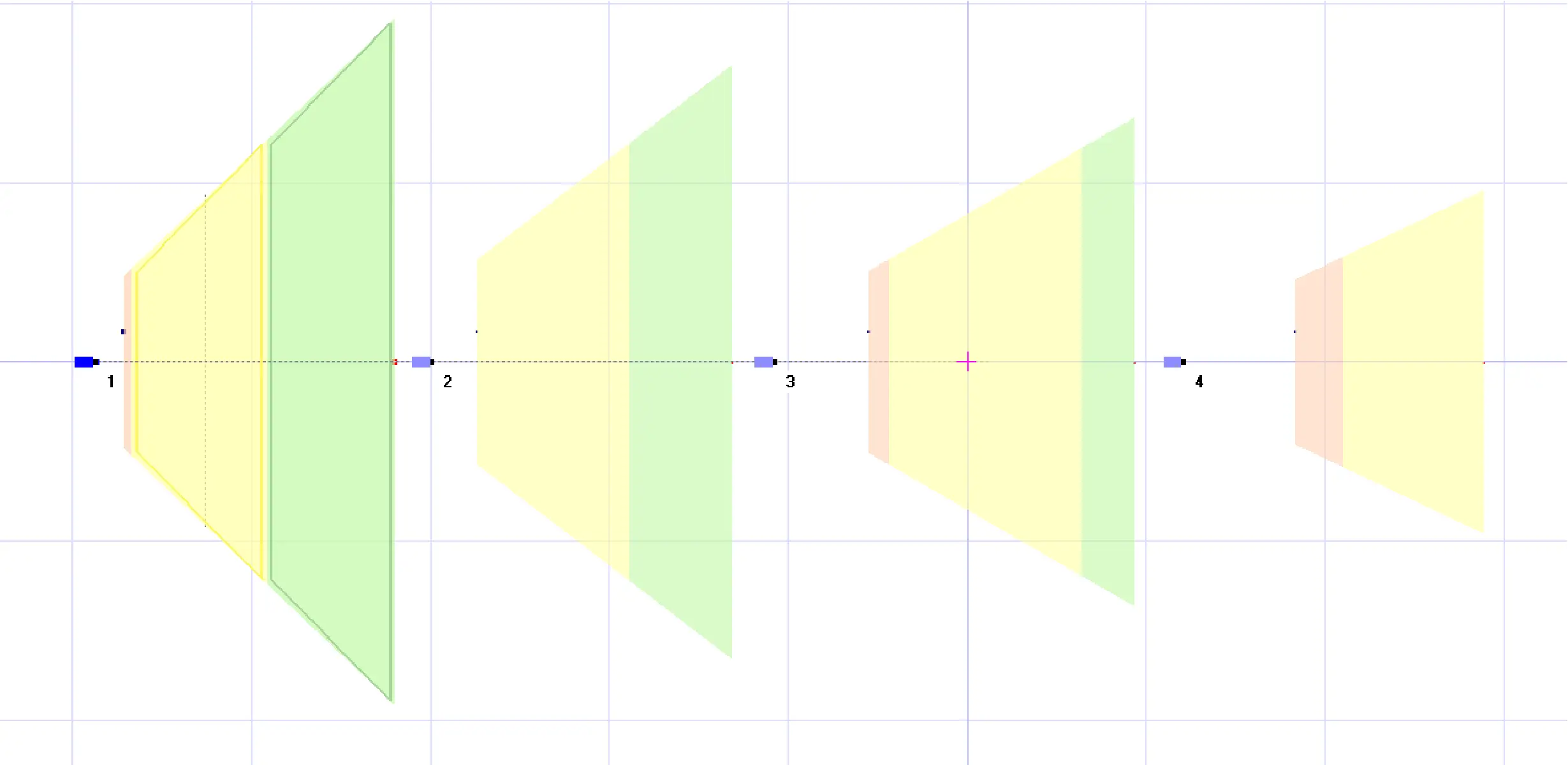
From left to right:
- Image sensor 1/3 - 4MP resolution - Lens 90°/ FOV (visible area) 41.6 meters wide
- Image sensor 1/3 - 4MP resolution - Lens 70°/ FOV (visible area) 29.6 meters wide
- Image sensor 1/3 - 4MP resolution - Lens 60°/ FOV (visible area) 24.6 meters wide
The viewing angle of a surveillance camera s
The viewing angle of a surveillance camera is made up of the horizontal viewing angle (how wide the image is), the vertical viewing angle (how high the image is) and the diagonal viewing angle (how large the image is on the diagonal). The result of the horizontal, vertical and diagonal viewing angles is referred to as the visible image section FOV (Front of View). Choosing the correct viewing angle for the respective application is one of the most important prerequisites for efficient video surveillance.
The viewing angle of a surveillance camera always depends on the image sensor size. The larger the sensor, the wider the viewing angles that can be achieved with a given focal length.
The focal length setting of the lens also plays a major role in the viewing angle values. With a fixed focal length (the lens has no zoom mechanism) the viewing angle cannot be changed. With a variable focal length (the lens has a zoom mechanism) the viewing angle decreases the greater the focal length is (the more the lens is zoomed)
The following images show examples of how the viewing angle changes as the focal length (zoom factor) increases. The test was carried out with a 4 megapixel camera with a 1/3 image sensor at a distance of 22 meters and at a tilt angle of 40.3 °.
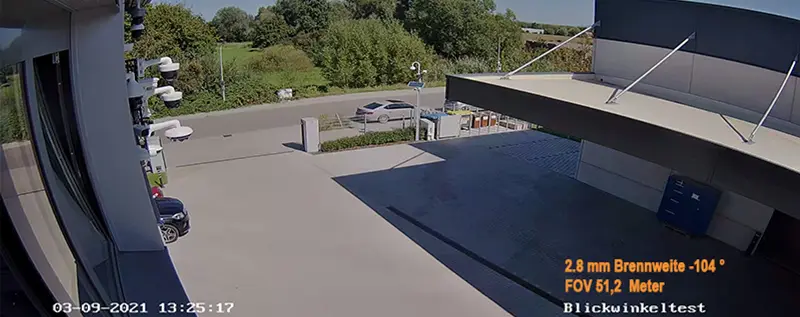
For this reason, the viewing angle specifications
For this reason, the viewing angle specifications of a surveillance camera can always be found in the manufacturer's data sheets or in the products listed here.
Therefore, correct planning of a surveillance camera with a fixed focal length is very important in advance.
With a variable focal length, the focal length can be changed electronically using the existing varifocal lens (lens with zoom mechanism), which makes it less problematic than with a fixed focal length.
Of course, it is also possible to calculate viewing angles precisely in advance during planning, using various planning software for the respective surveillance camera application.
This planning software was developed for installers and planners and requires in-depth knowledge of surveillance technology.