

The viewing angle of surveillance depends on the width and length of the area to be monitored and is determined by the focal length of the lens.
The rule is: the higher the focal length, the smaller the viewing angle (see Figure 1).
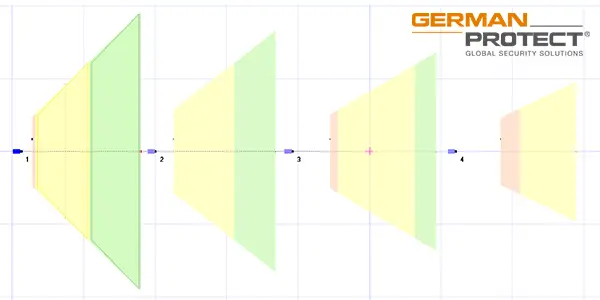
This interplay between focal length and viewing angle in the lens creates the so-called image section, also known in technical jargon as FOV (Field of View).
The field of view (FOV) of a surveillance camera is made up of the horizontal image width, the vertical image height and the diagonal image. The specifications for the horizontal viewing angle of the surveillance camera are decisive here (see Figure 2).
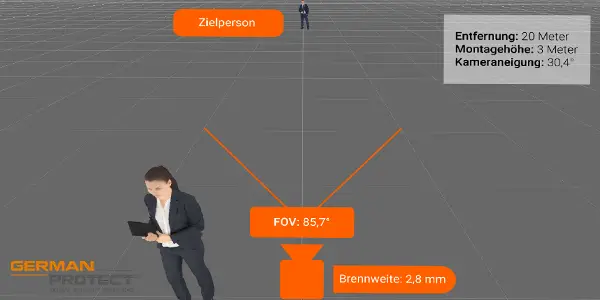
For example, take a lens with a focal length of 2.8mm and a detection angle of 104°, which produces a field of view of approx. 51.2 meters. Surveillance cameras with a wide horizontal viewing angle of more than 100° have the advantage of being able to produce correspondingly large field-of-view surveillance images.
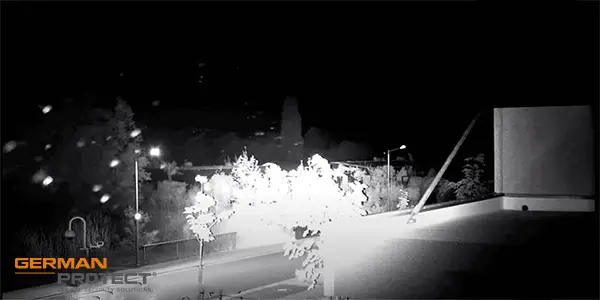
At the same time, however, there are disadvantages for uniform exposure of the entire image area at night.
Often, such wide surveillance images at night are only lit in the center despite infrared illuminators, and are very dark at the edges and therefore blurry (see Figure 3).
To avoid such problems, we recommend either using a second surveillance camera or a panoramic camera with two lenses.
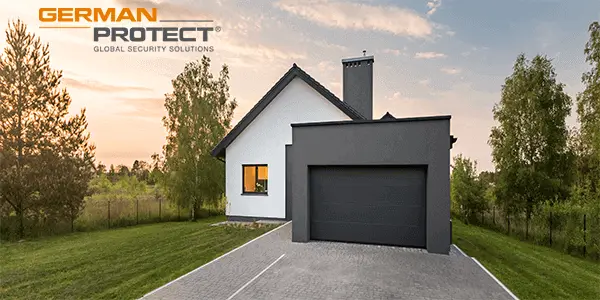
In professional video surveillance, generally only lenses with a maximum viewing angle of up to 100° are used. However, if the field of view is too wide for the area to be monitored due to an excessively large viewing angle, the surveillance camera offers little added value (see Figure 4).
Fields of view that are too large unnecessarily fill the surveillance image with unimportant features such as shrubs, bushes or trees, which significantly increases the false alarm rate.
In this regard, well-known manufacturers equip many surveillance cameras with the so-called Corridor-View function, which allows the surveillance image to be rotated by 90° (Figure 5). The Corridor-View function can be very useful especially for narrow but long monitoring areas.
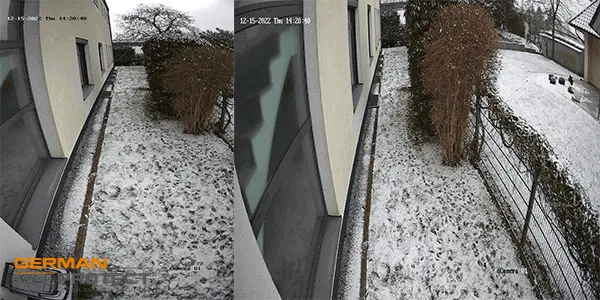
In general, fields of view that are too large are rarely GDPR-compliant, especially in private settings, because the excessively wide viewing angle of the surveillance camera usually also captures neighboring properties or public areas such as roads or sidewalks in the surveillance image.
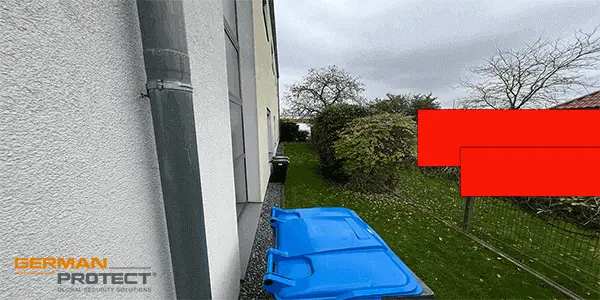
Consequently, these areas (see Figure 6) must be made unrecognizable in the video image (privacy masked), otherwise authorities may impose heavy fines.
From this perspective, for the layperson, the question of “which viewing angle is the right one” is often rocket science.
Calculating the optimal viewing angle of an IP camera is application-specific and depends on the conditions on site.
In our professional online shop for video surveillance, you will find a wide range of surveillance cameras with different viewing angles. No one can tell you which of them is best suited for your video application without knowing the conditions on site.
Don't be misled by self-proclaimed “experts” online who claim that “the wider the viewing angle of a surveillance camera, the more image and the better.”
Before buying a surveillance camera, take a little more time and rely on expertise backed by solid knowledge.
Our recommendation to end customers, as specialists in video surveillance, is: before buying a surveillance camera, have qualified specialists advise you thoroughly. Call us, we are happy to help.


