For a surveillance camera to make the most of its technological capabilities, it must be mounted correctly.
Correct installation of a surveillance camera basically depends on two main factors:
a) Complete mechanical mounting with the associated accessories recommended by the manufacturer for the respective application.
b) Observing the relevant technical factors of video surveillance that are fundamentally important for the efficient functioning of the surveillance camera.
Complete mechanical mounting with the associated accessories recommended by the manufacturer for the respective application.
Especially for surveillance cameras used for outdoor use and labeled by the manufacturer as outdoor cameras, the use of the recommended accessories plays a significant role in the long-term functionality of the IP camera, depending on the type of mounting.
In principle, the following rule applies in professional video surveillance technology:
A surveillance camera used for outdoor use must be mounted so that it remains waterproof at all times, regardless of the mounting location and weather conditions. The difference between mounting the surveillance camera on the facade, where it is unprotected from rain, and mounting it under the roof gutter, where it is protected from rain, can be enormous.
The upper surveillance camera in the illustration, which is mounted directly on the facade (see Figure 1), is a professional installation with the right accessories. With this type of mounting, you must consider not only direct rain falling on the IP camera, but even more importantly the rainwater running down the facade behind the camera. That is why the surveillance camera was mounted on the facade with a flush-mount junction box, which keeps it waterproof in all weather.
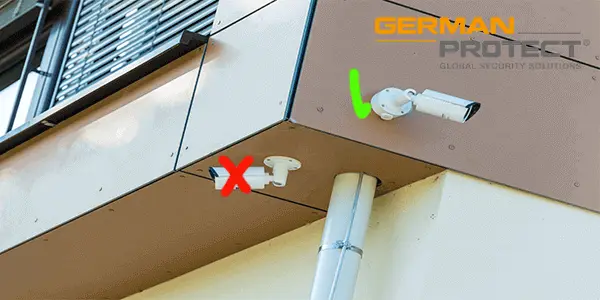
The lower surveillance camera, mounted under the overhang without a flush-mount junction box, might be assumed to be correctly installed.
At first glance, the IP camera appears to be protected from water running straight down by the overhang.
Wrong!
Despite the protection provided by the overhang, the surveillance camera is far from adequately protected against the moisture generated during rain. Sooner or later, this IP camera will condense moisture on the inside, which will ultimately cause the lens or the protective cover to fog up (see Figure 2).
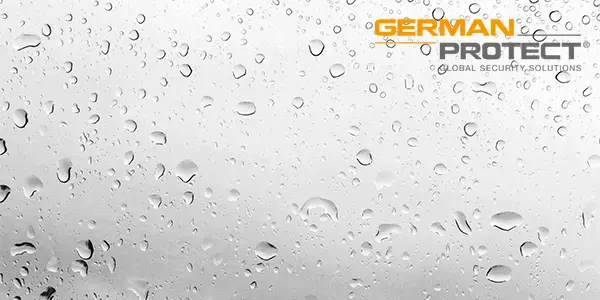
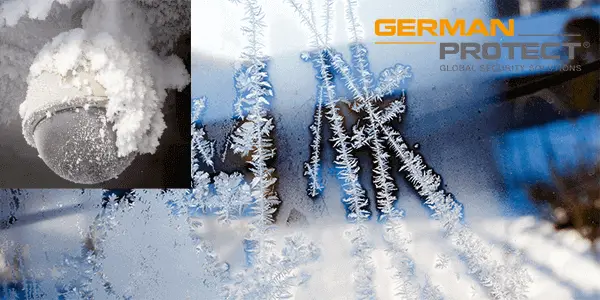
As a result, the surveillance camera can neither detect anything nor focus the image. In winter, the moisture that has penetrated the surveillance camera often causes the protective cover to freeze over (see Figure 3)
In general, when mounting a surveillance camera for outdoor use, it is essential to make sure that all screws are tightened securely and that all seals on the camera are present and correctly fitted.
Surveillance cameras that are mounted on poles in particular should be protected by using suitable accessories. Because of pole mounting, IP cameras are constantly exposed to wind, rain and snow from all sides, which places additional strain on the surveillance camera.
In addition, loose or hanging cables (see Figure 4) running to and from the surveillance camera should be avoided during installation. These not only give an intruder a convenient way to disable the surveillance camera without much effort, but can also be damaged by the weather and thus interrupt the video surveillance.
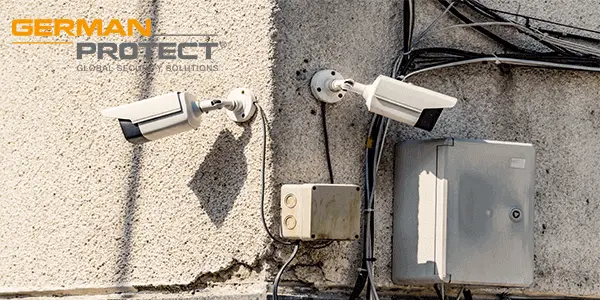
Such "installations" not only look unprofessional and disfigure the facade, but also signal to the intruder that the video surveillance is not to be taken seriously. A moderately professional burglar is hardly deterred from his plans by such video surveillance.
Observing relevant factors of technical video surveillance that are fundamentally important for the efficient functioning of the surveillance camera.
Before mounting a surveillance camera, the mounting location should be chosen carefully, taking important factors such as data protection into account.
It is important to clarify several relevant points in advance for the correct functioning of the surveillance camera.
1. For which application areas is the surveillance camera being mounted?
The term "application area" is used in professional video surveillance to define the specific tasks of a surveillance camera.
Is it a general surveillance view, also called an overview image, where you simply want to see activity on the property?
In this case, the surveillance camera can be mounted a little higher without any problem.
If the surveillance camera is used as a security system with alarm functions for surveillance areas under 30 meters in length, we recommend not exceeding a maximum mounting height (depending on the camera type) of 3.50 meters.
If the IP camera has facial recognition functions and is intended to automatically trigger door or barrier openings upon recognition, we recommend not exceeding a maximum height of 2.50 meters. The tilt angle of the surveillance camera plays a significant role for accurate facial recognition (see Figure 5 - Source: Axis Communications).
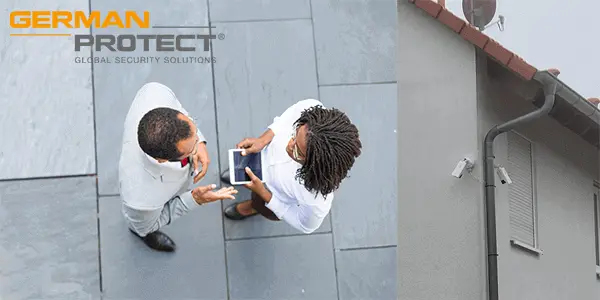
The rule here is: the higher the surveillance camera is mounted, the steeper the tilt angle within the first 10 meters in front of the camera.
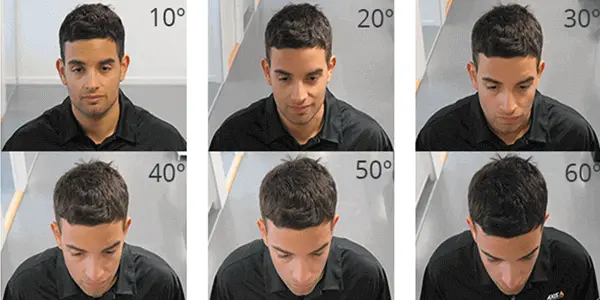
An angle that is too steep causes a so-called bird's-eye view (see Figure 6), which makes personal identification almost impossible. Depending on the application area, bird's-eye views should generally be avoided in professional video surveillance. Exceptions are surveillance applications such as overview images.
2. What tasks should the surveillance camera perform?
Before planning a video surveillance system, we recommend that our customers consider an important point: a video surveillance system is neither a television broadcast nor video footage shot with a mobile phone.
This statement sounds odd, but it often holds true.
A professional video surveillance system must always be able to monitor efficiently and continuously, regardless of the time of day and weather conditions.
Accordingly, the surveillance images do not need to look attractive like a television broadcast; they need to be efficient so that the surveillance camera, as a security system, can perform the tasks required of it.
We often hear statements like "my mobile phone takes a better picture than the surveillance camera," which can certainly be true at times.
However, a good surveillance camera can deliver a good image continuously, day and night, whereas a phone only does so at times.
The problem often lies in incorrect mounting and settings of the surveillance camera.
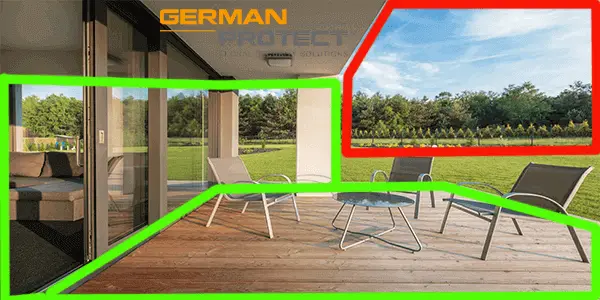
The most common problem is that the camera has been mounted too high.
As a result, the IP camera captures too large an image area with many irrelevant details, such as trees, sky, etc.
These areas are completely irrelevant to the actual monitoring area and the surveillance tasks of the surveillance camera. (see Figure 7)
Of course, for a layperson, such a large surveillance image, following the motto "the bigger, the better," and realized with just a single IP camera, seems simply excellent.
This view is not correct!
The more irrelevant elements that have nothing to do with the actual surveillance task overlay a surveillance image, the harder the IP camera has to work and the higher the error rate.
Due to multiple scenarios in an oversized surveillance image, where bushes, trees or birds simultaneously generate movement, a conventional surveillance camera eventually no longer knows exactly what to do.
As a result, the IP camera is simply overwhelmed with important tasks such as homogeneous focusing of several image areas. Consequently, it only chooses one area, which is often irrelevant for video surveillance.
The area that actually matters is suddenly no longer prioritized.
Especially at night, such scenarios can become very problematic for video surveillance that is meant to function as a security system and therefore contribute to protection.
In addition, video analytics, especially with inexpensive surveillance cameras, cannot cope with frequent movement in the image and generate false alarms.
Of course, there are IP cameras suitable for video surveillance that can handle such multiple scenarios. However, these are priced rather in the upper segment, starting at 500 euros.
That said, dear friends of video surveillance, we recommend setting the image area of the surveillance camera to the area that is important and should be monitored.
Unnecessary elements such as sky, trees and image areas that are too far away, where the surveillance camera cannot display the image in enough detail for a review anyway, should be avoided as far as possible.
Figure 8 shows an example of an incorrectly mounted surveillance camera.
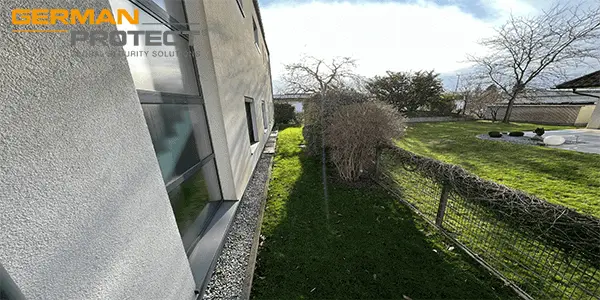
At the same time, Figure 9 shows how the same IP camera should be mounted correctly for efficient video surveillance.
For questions about correctly mounting a surveillance camera for your applications, our video surveillance experts are happy to help.
Give us a call!