

Choosing a surveillance camera for outdoor use depends technically on the task the camera is needed for, but also on where it will be installed.
To achieve reliable video surveillance for outdoor use over the long term, it is essential to use only
outdoor cameras for this purpose.
This recommendation also applies when the surveillance camera is mounted under a roof overhang and seems to be protected from direct rain. The moisture that arises during rain places considerable strain on the electronics and optics of a surveillance camera that is designed for indoor use and therefore for constant climatic conditions.
This leads to a temporary or even complete failure of the camera and thus of the video surveillance.
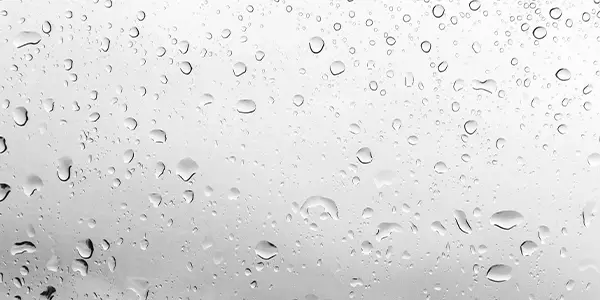
Even though the electronic components of the surveillance camera can cope with the moisture for a while, the lens often fogs up, which puts the optics out of operation.
The surveillance camera still sends an image, but one in which nothing more can be recognized (Figure 1).
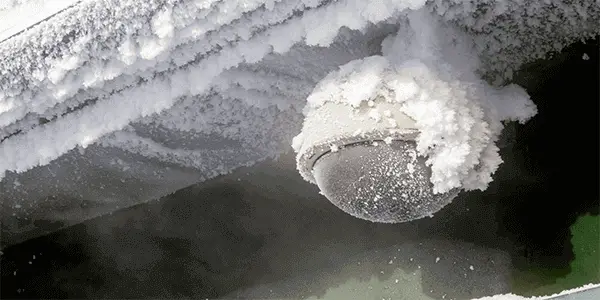
In winter, this problem mostly causes the surveillance camera to freeze (see Figure 2).

Suitable surveillance cameras for outdoor use are explicitly labeled by the manufacturer as “Outdoor Camera” or “for outdoor use.”
But what is the difference between an indoor and an outdoor camera that could be so significant?
Compared with indoor cameras, outdoor cameras have many additional mechanical features that are specifically optimized for use outdoors.
For example, an outdoor camera has several rubber seals (see Figure 3), which protect it against the ingress of moisture.
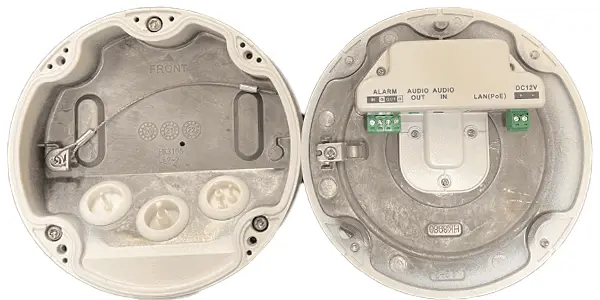
High-quality outdoor cameras from reputable manufacturers are even equipped with a water drainage device, which allows condensation to drain from the junction box of the surveillance camera.
In addition, surveillance cameras for outdoor use are also protected against dust by such seals and by the use of various materials.
The degree to which a surveillance camera is protected against weather influences for outdoor use is indicated by the manufacturer through its IP protection rating (IP – International Protection).
You can view a table explaining the different IP protection ratings here in our glossary.
For use outdoors, surveillance cameras with an IP protection rating of IP65 or higher are generally recommended.
Especially for areas of application such as coastal or mountainous regions, where harsh weather conditions (see Figure 4) regularly occur due to storms, only surveillance cameras with an IP protection rating of at least IP67 or IP68 up to IP69 should be used.
This contributes significantly to the longevity of the surveillance camera and thus to consistently reliable, functioning video surveillance.
In addition to the IP rating, other equipment features, such as the electronic auxiliary components, should also be considered.
Auxiliary components in a surveillance camera include, for example, heaters, window heaters, wipers, or cooling.
In addition to the IP rating, such components can contribute significantly to the flawless functionality of the surveillance camera for outdoor use.
As a general rule, we do not recommend battery-powered surveillance cameras for outdoor use, especially in winter, if you want to implement permanent video surveillance.
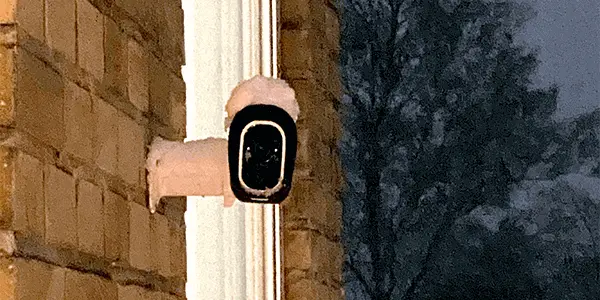
Especially in winter (see Figure 5), when temperatures are low, batteries often drain unpredictably fast and therefore do not provide reliable video surveillance.
A surveillance camera that can be recharged via a solar panel is also only conditionally recommended in Germany due to the limited number of sunshine hours.
However, for temporary, partial surveillance applications, battery-powered cameras can indeed offer added value, depending on their features.
Another technically relevant feature that makes a good surveillance camera for outdoor use is efficient night vision.
Most break-ins occur at night. Accordingly, a clear surveillance image that allows the perpetrators to be identified is fundamentally important.
To enable the surveillance camera to deliver sharp, clear images (see Figure 6) even in complete darkness, it requires infrared or white light.
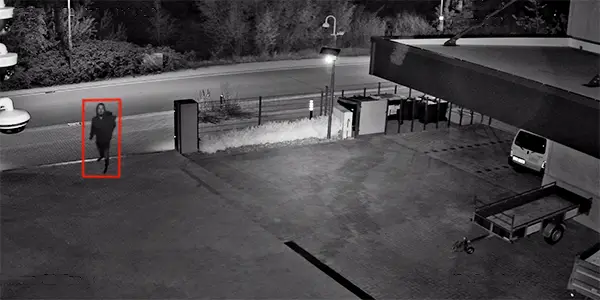
For this reason, most outdoor cameras are usually equipped with infrared illuminators, white light spotlights, or both.
The exception is thermal imaging cameras or bispectral cameras, which do not need spotlights because of their thermal image.
Surveillance cameras without night vision capability are not recommended for outdoor use, unless they are mounted in a weatherproof housing (see Figure 7), such as a box camera, which allows them to be equipped with night vision.
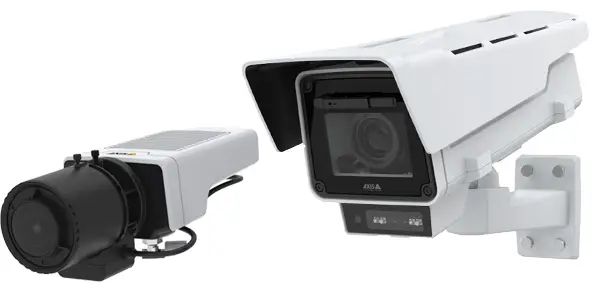
In general, it is important to consider the range of the infrared or white light illumination of the outdoor camera for the respective application.
For example, if the application involves a surveillance area of 50 meters, the surveillance camera should accordingly be equipped with infrared illuminators of suitable range.
Standard outdoor cameras are usually equipped with a range of 15 to a maximum of 20 meters.
Especially for surveillance cameras equipped with AI-based analysis, optimal illumination of the surveillance area plays a decisive role. At night, the camera can only analyze what it can see. The earlier an intruder is detected by the surveillance camera, the faster it can trigger an alarm.
When it comes to AI-based motion analysis, this feature plays a fundamental role, especially for outdoor use, in preventing false alarms.
Especially outdoors, where there is a lot of movement, for example from trees or shrubs, in our opinion the outdoor camera should be equipped with efficient motion analysis or alarm functions.
AI (Artificial Intelligence) ) based motion analysis that can distinguish between people, vehicles and animals (see Figure 8) is very efficient. Alarm functions such as line crossing detection also make a significant contribution to a precisely functioning video surveillance system.
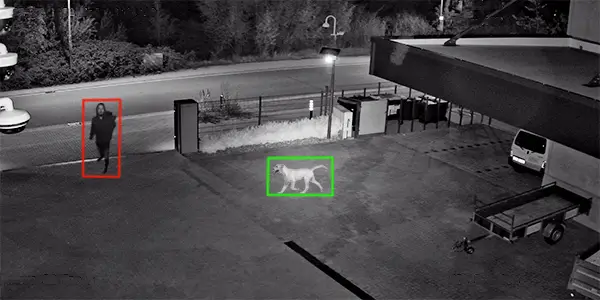
Outdoor cameras equipped with such advanced technological capabilities are naturally priced higher than conventional surveillance cameras.
However, a surveillance camera that constantly produces false alarms is completely useless for achieving well-functioning video surveillance.
Unfortunately, many end customers do not consider this important feature when buying an outdoor camera, which often ultimately leads to a double purchase. Modern surveillance cameras offer a whole range of features that turn an ordinary outdoor camera into a permanently precise guardian.
Our Expert Tip! Before buying an outdoor camera, a few important key details should be clearly defined in advance.
Information such as the size and length of the surveillance area as well as the tasks of the surveillance camera must be taken into account.
This information determines the technical requirements of the outdoor camera.
If the camera has the functions required for the intended application, nothing stands in the way of effective video surveillance.
Simply buying an outdoor camera just because it is cheap, without considering why it is cheap, usually leads nowhere.
If any doubts arise during the planning phase about choosing the right outdoor camera, we always recommend seeking advice.
Our certified video surveillance technicians are happy to help.


