

Surveillance cameras for private properties: What should you pay attention to?
More and more people are deciding to install a surveillance camera for their home. A surveillance camera for private use offers several advantages:
- Protection against crimes such as burglaries and thefts, as well as against vandalism
- The ability to detect and recognize visitors at an early stage
- In the event of a crime: securing evidence to hand over to the police
- An increased sense of security for the residents.
Considerations before buying a surveillance camera for private use
Choosing the right surveillance camera for your home and installing it requires some advance planning.
For example, the lighting conditions need to be checked. Where is the sun, and how does it move across the property? This is important in connection with backlit recordings. Strong backlighting can significantly impair recordings if the camera is positioned incorrectly or the lens is unsuitable.
Is there a power outlet available at the intended camera positions? Is a data connection available? If both questions can be answered with "yes," it may be worthwhile to install wired cameras or purchase appropriate surveillance kits. Otherwise, wireless radio cameras can also be used.
What about people who regularly enter the property? They should be informed about the placement of the surveillance cameras. This applies in any case to video surveillance on private property as well: you must provide notice of it. It is best to use suitable signs that also include further information, such as the party responsible for the video surveillance.
By the way, audio recording through video surveillance is not permitted. After all, you cannot ensure that you only record sounds from your own property.
Pay particular attention to these camera features:
- Light sensitivity: Should the camera be used only during the day, or also at night or in poor lighting conditions?
- Camera resolution: Note: A higher resolution such as 4K often comes with lower light sensitivity.
- Fixed camera or camera with tilt, pan, and zoom function?
- Camera design such as dome, bullet or mini camera
- Special camera functions desired, such as person tracking or facial recognition?
- Wired, battery or solar operation: Depending on whether a power connection is available, these alternatives may or may not be suitable.
- Wired cameras or wireless cameras? Both options have advantages and disadvantages. While wired cameras are cheaper to operate because they do not require batteries, wireless cameras are easier to install. For security reasons, using cameras over Wi-Fi is not recommended, because in some cases they can be hacked fairly easily.
Caution when adjusting the camera
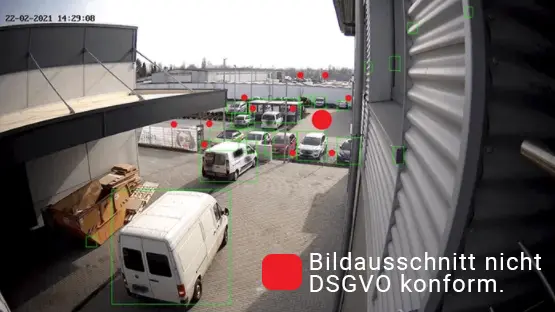
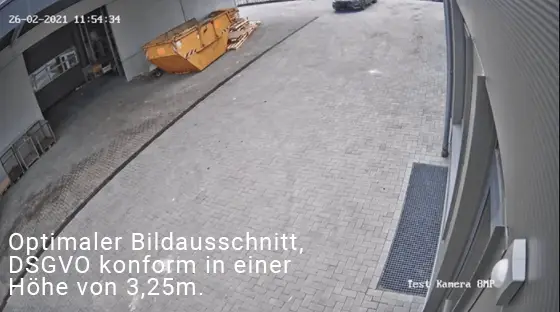
While it is generally permitted to monitor your private property with video surveillance, this does not apply to public areas such as the street or the sidewalk in front of the house. If your surveillance camera is set up so that it also captures public areas, this can lead to problems, even if you use the camera or recorder to ensure that the relevant areas are blacked out or pixelated. The same applies to neighbors' properties.
Using suitable recording equipment
The best images from a surveillance camera are useless if they are not recorded. For evidence purposes, but also to be able to analyze the images, the images supplied by the cameras should be secured using suitable recording equipment.
Delete recordings showing uninvolved persons immediately
You must delete recordings from your surveillance cameras as soon as possible if they show uninvolved persons. An exception applies if the recordings are to be used as evidence to solve a criminal offense.
Surveillance cameras in multi-family buildings
Disputes over video surveillance in multi-family buildings occur again and again. For example, it is generally not permitted for a landlord to monitor the building entrance or the hallway in order to check who enters or leaves the building.
Video surveillance may likewise not be used to check for unauthorized subletting. Such recordings also cannot be used as evidence.
Landlords should speak with their tenants and inform them before installing surveillance cameras. In addition, the cameras must be indicated as such during operation. Secretly installing such cameras is by no means permitted, because it violates the rights of the tenants.
What to check before you decide to install a surveillance camera
Setting up a surveillance camera for private use, or for monitoring a private property, also involves a number of requirements. As already described, you may only capture your own property, not your neighbors' properties or public space.
Before you install one or more surveillance cameras, consider whether this measure is really the right and appropriate one. You should also take all precautions needed to operate your video surveillance in a legally compliant way.
Are there alternatives to video surveillance?
In some cases, it may be enough to protect a property with better lighting. A fence can also provide additional security. Motion detectors, an alarm system or locking systems are further security alternatives.
Are the surveillance cameras unproblematic in their orientation?
If you have decided to install surveillance cameras, make sure to monitor only your own building and property, not neighboring properties or public areas such as the street in front of the house. Masking critical areas with the camera or with suitable recording systems can indeed be advantageous in terms of data protection, but you should make sure in advance that the surveillance cameras do not give people outside your property the impression that they could be being monitored.
Is the technology used appropriate for the requirements?
Surveillance cameras come in many different designs. They range from fixed cameras with a fixed focal length to bullet and dome cameras that are able to capture target persons and follow them within the image frame.
If you only want to monitor your front door, for example, to capture visitors as they arrive, a simple model is certainly sufficient.
The simpler the technology, the less conspicuous it is. This can help build trust among neighbors.
Surveillance Cameras for Private Use: FAQs
Am I allowed to mount a surveillance camera on my single-family home?
Yes, this is permitted, because a surveillance camera can be used to take precautions against crimes such as theft. Especially after a crime has already occurred, the use of a surveillance camera offers the possibility of protecting against repeat offenses.
Is a surveillance camera for private use allowed to pan?
What matters is that the surveillance camera does not also capture the neighboring property or public areas. With a permanently installed camera, it is easier to prove these conditions than with a panning camera. With a panning camera, there is always the possibility of changing the image area by panning and thus also making impermissible recordings. In the interest of neighbors' trust, a permanently installed surveillance camera is therefore recommended for private properties.
Am I allowed to use a dummy camera on my private property?
Just like a surveillance camera, the use of a dummy camera on private property is permitted. However, here too, it is not allowed to point it at the neighboring property or at public areas. Although no one is actually being recorded, the feeling of being monitored created by the dummy alone is enough for such an alignment to be impermissible.
We also advise against using dummy cameras, because although they can have a certain deterrent effect, in the event of a crime they cannot provide footage that could be used to solve it.


