

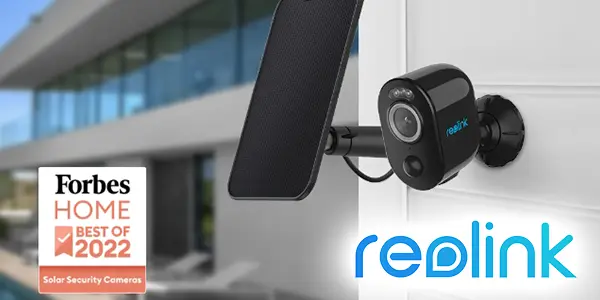
Operating a wireless surveillance camera powered by solar energy can be advantageous, especially in remote areas. Using the example of our partner Reolink, we show how it works. The brand Reolink is known for a wide range of wireless surveillance cameras with very high quality and design.
Operating Solar-Powered Outdoor Surveillance Cameras: What You Need
To operate a surveillance camera outdoors with solar power, you will need the following components:
- a wireless outdoor surveillance camera
- Solar panels (or a solar panel kit) for generating electricity
- a battery pack or batteries (rechargeable battery / car battery) for storing the solar energy
- a solar charge controller or solar regulator, a DC converter or an inverter
- suitable cables to connect the components.
Solar-Powered Outdoor Surveillance Cameras: What to Keep in Mind
When installing a solar-powered outdoor surveillance camera, several factors must be taken into account. These concern the power supply in particular, namely the solar panels and the batteries.
Factor 1: Power Supply Voltage of the Solar Surveillance Camera
It is important that the supply voltage of the battery/solar power kit matches the voltage required by the surveillance cameras. If the correct voltage is not provided, the solar surveillance camera will either not work or may even be damaged or destroyed.
In general, wireless surveillance cameras for outdoor use operate on either 12V or 24V power. For example, a 12V wireless surveillance camera cannot be operated with a 24V battery or power source.
If you want to operate a mains-powered outdoor surveillance camera with a direct current (DC) solar battery, you need a device that converts DC into alternating current (AC) or vice versa. An inverter converts a given DC input voltage into a different AC output voltage (either higher or lower).
Factor 2: Battery Backup for Solar-Powered Wireless Surveillance Cameras
The independent power supply you receive from the solar panels must be sufficient to keep the surveillance cameras running long enough, even when the sun is not shining or when it is cloudy or rainy.
The power consumption of surveillance cameras or IP security systems varies. This applies in particular to cameras with features such as infrared night vision or a pan/tilt function, which may require more power.
Therefore, make sure that your solar panels or solar power kits for surveillance cameras generate sufficient power.
Also make sure that the solar batteries can charge quickly and can store enough energy for continuous monitoring and recording.
Factor 3: Consider the Effects of Environmental Influences and Weather
Solar-powered outdoor surveillance cameras or batteries placed outdoors will inevitably be exposed to various environmental influences, including humidity, dust and temperature fluctuations.
Be sure to choose waterproof outdoor surveillance cameras and protect solar kits with sturdy housings or weatherproof boxes.
Also make sure that solar-powered infrared surveillance cameras for outdoor use are kept clean.
Factor 4: Installing a Surveillance Camera with Solar Panels
The placement and orientation of the solar panel affect power generation. Try to orient the solar panel toward the equator, i.e., toward the south, and avoid shadows to maximize sun exposure. The best results are achieved when the solar panel faces south and has an optimal tilt angle.
Before switching from AC power to solar power, make sure the Wi-Fi connection of your wireless outdoor surveillance cameras is configured to make it easier to later connect the solar-powered Wi-Fi camera to your home network.
The battery pack or rechargeable battery should be fully charged before switching to solar power.
Factor 5: Costs for Self-Installed Solar-Powered Surveillance Cameras
Although using solar energy to power surveillance cameras is environmentally friendly and often efficient, the initial costs of setting up a solar-powered security system may be somewhat higher. The price of a solar power supply for a video surveillance system can range from 50 to several thousand euros, depending on requirements. However, it should not be forgotten that the benefits of such systems justify the initial investment: besides saving on electricity costs and operating in an environmentally friendly way, the great flexibility of using solar energy to operate surveillance cameras is a key advantage.
Alternative to Solar-Powered Wireless Surveillance Cameras
Solar-powered surveillance cameras are often chosen for applications where no other power supply is available. Besides using solar power, however, there are other alternatives. For example, battery-powered wireless surveillance cameras such as the Argus 3 Pro from Reolink, which also feature a motion sensor and an SD card, have proven highly effective for monitoring areas without a power supply.
Users can also use the rechargeable, battery-powered surveillance cameras in areas without a power outlet. Examples include garages, driveways, basements, carports or remote properties.
Conclusion
Solar energy as an alternative power source is currently receiving a lot of attention, and rightly so. It can also be used to power surveillance cameras, enabling operation in locations where laying cables would be too expensive or too complicated.
Do you have questions about solar-powered surveillance cameras and the necessary accessories? Then feel free to contact us. Our security experts at German Protect look forward to hearing from you.


