

Power over Ethernet (PoE) is a standard that enables the power supply of devices in a network via Ethernet cables. PoE is particularly suitable for devices with low power requirements, such as surveillance cameras. This offers the advantage that additional cabling for the power supply can be omitted.
The Components of a PoE System
PoE relies on the interaction of various components. A basic distinction is made between power consumers (PD, Powered Devices) and power suppliers (PSE, Power Sourcing Equipment).
- PD: This includes, for example, surveillance cameras or other consumers such as VoIP phones. Many of these devices today support power supply via an Ethernet connection.
- PSE: There are various options here. Starting with the Power Injector, also called a PoE adapter, which provides power via PoE, through the PoE Switch, up to PoE network video recorders, the range extends.
For PDs and the feeding of power, a further distinction can be made between so-called endspan devices, such as switches, and midspan devices. The latter are located between the switch and the end device. Usually, PoE injectors or hubs are used as midspan devices.
PoE switches can lead to a less complex network infrastructure, for example by eliminating the need for additional network components such as PoE injectors.
With PoE, only one cable connection is required from the PSE to the PD. This allows data transmission and power supply to be realized with a single cable. The maximum cable length is 100 meters. At least a Cat 5 cable should be used. For higher power consumption of a network client, a Cat 7 cable may also be useful due to possible heat generation.
What to Consider in PoE Systems
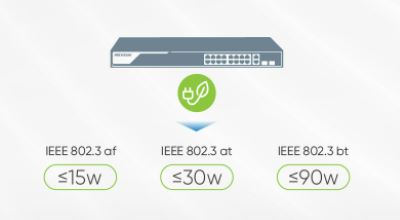
Keep in mind that the overall capacity must be right in a PoE system. If you use several surveillance cameras, for example, the PSE must be able to provide the corresponding total power. If you use, for example, a PoE switch with four ports according to PoE 802.3at with 25.5 watts per port, the switch must be able to provide at least 122 watts in total.
Therefore, before purchasing, check whether the power provided by the PSE per port and in total matches the power consumption of the PDs.
By the way, if a non-PoE device is connected to a PoE switch, no damage to the device is to be feared, because a PoE switch first sends a low test voltage to the device to check its PoE capability. If the device is unsuitable, no power is sent to it afterwards.
Conclusion
PoE offers the ability to handle the transmission of data and power in a network, each via a single cable. This saves installation effort and increases flexibility during mounting.
It is important that the power provided in the system, the cabling, and the power consumption of the clients in the network are matched to each other. Existing standards can be used as a guide for this.
At Germanprotect, we are happy to advise you on assembling the components and answer your questions. The best way to reach us is today.


