

The quality of a surveillance camera's night vision is of fundamental importance for efficient and reliable video surveillance.

While the tried-and-true infrared illuminators continue to be technologically refined and remain an essential component of professional video surveillance, their prominence is increasingly being undermined by white light illuminators (see Figure 1), particularly in the private sector.
Both technologies have advantages and disadvantages
Using infrared (IR) light, infrared illuminators have the advantage of a greater illumination range at a distance.
In video surveillance, infrared illuminators are divided into two emission wavelengths: 850nM (nanometers) and 940nM.
The most powerful (see Figure 2) are infrared illuminators with an infrared light emission of 850nM (nanometers).
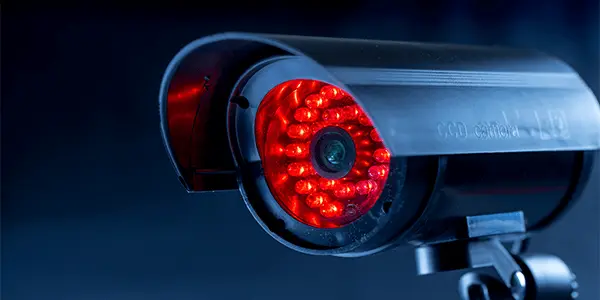
The 850nM IR light is not visible to the human eye; only the LED illuminators on the surveillance camera may be perceived as red dots.
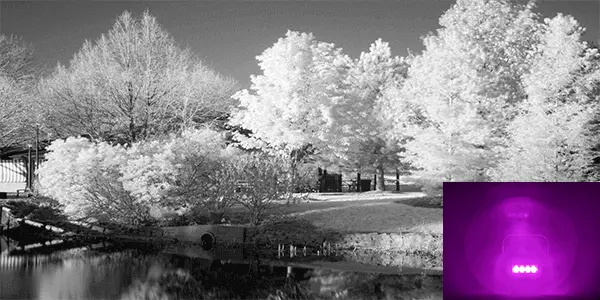
With 940nM infrared illuminators, not only is the infrared light invisible to the human eye, but so is the infrared LED on the surveillance camera. As a result, the surveillance camera is completely invisible in total darkness.
However, 940nM infrared illuminators have a significantly shorter range than 850nM infrared illuminators and are therefore more often used for close-range applications.
Thanks to rapid technological development, modern surveillance cameras today are equipped with only two or at most four powerful infrared illuminators.
Surveillance cameras like those of the past, with infrared LEDs arranged all around the lens (see Figure 3), have belonged to the past for years.
In this sense, efficiency comes from quality rather than quantity.
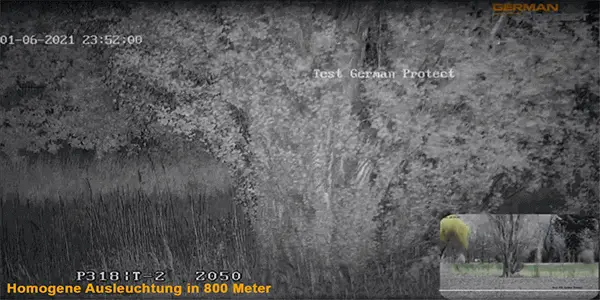
Accordingly, a surveillance camera with an integrated infrared illuminator can today easily deliver crystal-clear surveillance images at distances of up to 800 meters (see Figure 4) without additional IR illuminators.
However, since the video surveillance market is flooded with countless "cheap manufacturers," this statement applies only to established and renowned surveillance camera manufacturers.
Accordingly, when it comes to range, the infrared illuminator is far superior to the white light illuminator.
A disadvantage of infrared illuminators is that as soon as the surveillance camera switches to night mode and the infrared LEDs are activated, it immediately produces a black-and-white surveillance image.
White light illuminators, on the other hand, allow the surveillance camera to continue delivering color images even in night mode. (see Figure 4.1)

Although the range of the lighting is far shorter than that of infrared illuminators, the color images make it very efficient for applications up to 30 meters.
In the event of a break-in, for example, details such as the color of a pair of trousers or a jacket (see Figure 5) are very relevant, so that an accurate description of the perpetrator can be given to the police with the help of video surveillance.

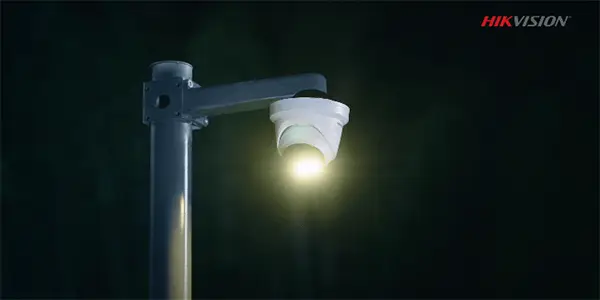
Another positive feature of a surveillance camera with a white light illuminator is the immediate signal (see Figure 6) directed at the intruder: “Warning, I am watching,” which may make him reconsider his plan.
The downside, however, could be the glaring light, which can be disruptive to the neighborhood, for example.
Security experts are still debating whether this type of signaling is actually beneficial for professional video surveillance.
In our view, a Hikvision camera equipped with a white light illuminator can certainly contribute effectively to deterrence for certain video surveillance applications.
It is important that the surveillance camera also has other key features for video surveillance, such as a suitable image sensor, good resolution, or a lens matched to the white light illuminator.
White light alone is not enough
This problem is often encountered specifically with surveillance cameras in the lower price segments.
For some time now, numerous budget providers on the internet have been aggressively trying to lure, in particular, end customers with supposedly outstanding technical features at extremely attractive prices, advertising “toy cameras” as “the security solution” for home security.
Due to their technically inferior equipment, whether in terms of motion detection or the short range of the motion detector, such “toy cameras” only switch on the white light when the perpetrator is standing right in front of them.
In addition, it very often happens with cheap surveillance cameras that the white light LEDs for close range are technically unsuitable. Especially for surveillance areas between 5 and 8 meters in front of the surveillance camera, the white light is often so strong that the perpetrator is completely overexposed (see Figure 7) and can hardly be recognized in the surveillance footage.
Such results are very problematic and disappointing for security-relevant components such as a surveillance camera, which should actually reliably contribute to self-protection.

In our view as a provider of professional video surveillance, combining infrared light for long range and white light for close range in a single surveillance camera can achieve far more efficient surveillance performance.
However, the technical expertise needed to realize this synergy is usually possessed only by well-known surveillance camera manufacturers.
As a certified provider of video surveillance, we regularly test “affordable” surveillance cameras that are highly praised online by self-proclaimed specialists.
The results are usually not even sufficient for basic video surveillance.
In our professional online shop for video surveillance, you will find, alongside renowned brand manufacturers, a large selection of surveillance cameras that meet such technical requirements.
Do you have open questions and need advice?
Give us a call, and our technicians will answer all your questions expertly and professionally.


