

Hikvision ColorVu
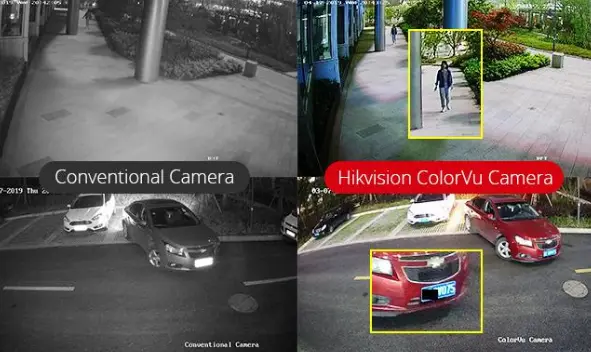
While classic surveillance cameras often deliver only blurry black-and-white footage in poor lighting conditions, cameras featuring Hikvision ColorVu technology can capture sharp color images even in almost complete darkness.
A large share of break-ins occur in darkness. Classic surveillance cameras have a problem with this, because in poor lighting conditions they usually deliver only blurry images without color. The use of LED lighting can improve the quality of the footage, but the images remain black and white. Recognizing details such as facial features or distinguishing colors of vehicles is difficult or entirely impossible under these conditions. The result: the collection of evidence is limited.
Hikvision, one of the leading providers of high-quality surveillance cameras, offers with its ColorVu technology an innovation that enables sharp color images around the clock, even in almost complete darkness.
This is achieved through improved lenses with an F1.0 aperture and high-performance sensors. Combined with an additional light source for use in extreme darkness, these components can deliver sharp and colored images in all situations.
Another component of cameras with Hikvision ColorVu is a new type of 3D digital noise reduction (DNR). An algorithm improves image clarity, while a soft, warm supplementary light enables color images even in environments with complete darkness.
Advantages of Hikvision ColorVu
ColorVu delivers true-to-life color information and precise color rendering, especially in poor lighting conditions. This allows more and more accurate details to be displayed.
The viewing experience is further enhanced by optimal brightness distribution. Specially developed lenses and sensors ensure realistic image processing.
In this way, clear and detailed footage can be captured even in poor lighting conditions, which would not be possible with a conventional surveillance camera.
Application Areas of Cameras with Hikvision ColorVu
Surveillance cameras with Hikvision ColorVu technology are ideal wherever conventional surveillance cameras reach their limits due to poor lighting conditions. This can affect residential buildings such as single-family and multi-family homes, apartments, but also commercial buildings, warehouses and properties. In locations with poorly lit areas such as stairwells, narrow paths or garage entrances, ColorVu cameras offer optimized surveillance options. This helps reduce risks for residents as well as employees.
For use in open areas and particularly large spaces, there are also suitable ColorVu cameras - for example with 4K resolution – for airports, stadiums, parking lots or ports, i.e., wherever clear and high-resolution footage is essential.
Hikvision lists the following four examples of concrete application scenarios for ColorVu:
- Security for outdoor use, especially streets and parks. Lighting conditions here can be particularly challenging.
- Improved monitoring of fence systems around warehouses and logistics areas. Here, cameras with ColorVu can help significantly shorten response times in the event of an intrusion.
- Protection of valuables at small businesses. Cameras with ColorVu improve the chances of securing clear evidence in the event of a break-in or theft and thereby recovering the valuables.
- Building entrances: These are sometimes unlit or only poorly lit, so cameras with ColorVu can contribute to better monitoring through sharper and color images.
Which surveillance cameras offer Hikvision ColorVu?
There is a wide range of surveillance cameras that feature Hikvision ColorVu. Above all, selected cameras from the Hikvision Acusense series should be mentioned here, which are able to use deep learning to isolate certain elements such as people or vehicles from the recordings.
Conclusion
For video surveillance in poorly lit locations, Hikvision ColorVu can deliver a significant improvement in recordings. In addition to greater depth of detail, color recordings can be made around the clock, which improves the quality of monitoring and optimizes options for securing evidence.


