

The resolution of a surveillance camera depends on the area of application and the tasks of the respective camera within its video surveillance system.
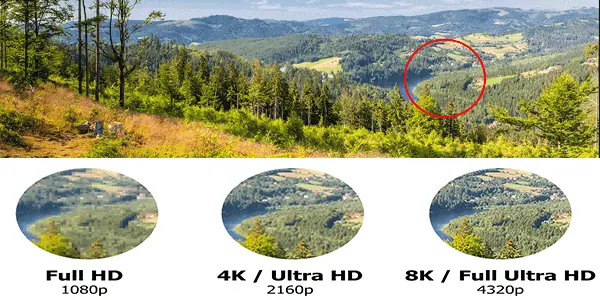
In professional video surveillance, surveillance cameras with a resolution of 4 megapixels (twice Full HD) are used most of the time. Higher resolutions, such as 4K UHD or even higher, are suitable for applications with large surveillance areas or long distances, in order to achieve better depth of field (see Figure 1).

In areas such as department store surveillance, where sharp image sequences in the video recordings are essential, the high resolution of the surveillance camera can play an important role in theft prevention (see Figure 2). Especially for investigative work using existing video recordings, the quality of the video footage plays a decisive role. To ensure a correspondingly high quality, high-resolution video footage is necessary.
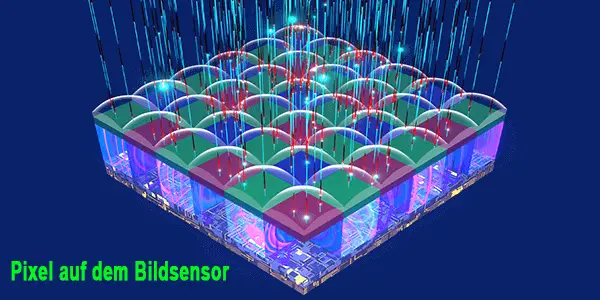
In principle, a high resolution brings many advantages for video surveillance, provided that the surveillance camera also meets the technical requirements for it. For the surveillance camera to display the high resolution sharply at night as well, when the infrared illuminators for night vision are switched on, the image sensor plays a fundamental role.
The larger the image sensor is, the larger its pixels are, which allows it to capture more light (see Figure 3). In professional video surveillance, these are referred to as light-sensitive image sensors.
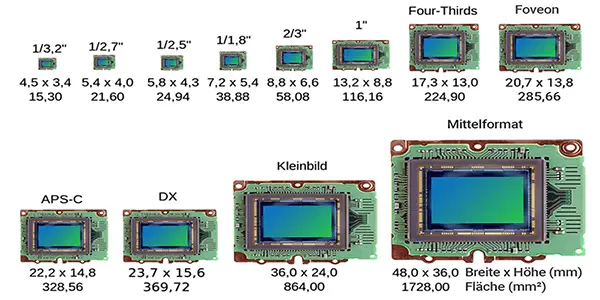
For example, to accurately display the enormous resolution of 4K UHD, which corresponds to 3840 x 2160 pixels and 4 times Full HD, the image sensor should have a size (see Figure 4) of at least 1/1.8" (inch).
With the help of the large image sensor, the surveillance camera can effortlessly produce high-resolution surveillance images even in difficult lighting conditions, without losing sharpness.

Surveillance cameras in the low price segment in particular that are equipped with high resolutions usually have an image sensor that is too small in order to save costs. Such "cheap" image sensors are often fitted with additional photodetectors on the same sensor area, which causes the pixels to shrink and capture less light.
As a result, these image sensors are hardly suitable for moving surveillance images at night, but they are cheap. They produce either surveillance images that are too dark (see Figure 5) or images covered by a haze (see Figure 6). The result is blurry images in which it is impossible to identify a person or vehicle.
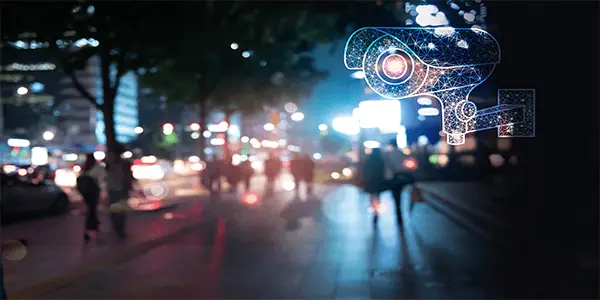
We therefore recommend efficient video surveillance based on a well-balanced resolution of 4 megapixels with a suitable image sensor rather than a high resolution with an undersized image sensor.

Moreover, especially in the private sector, where the areas to be monitored are often only a few meters across, a high resolution is of hardly any use.
On average, most private homes in Europe have a maximum width of 15 meters.
Using a high-resolution surveillance camera for such a short monitoring range does produce a beautiful image, but one that is unnecessary for video surveillance (see Figure 7).

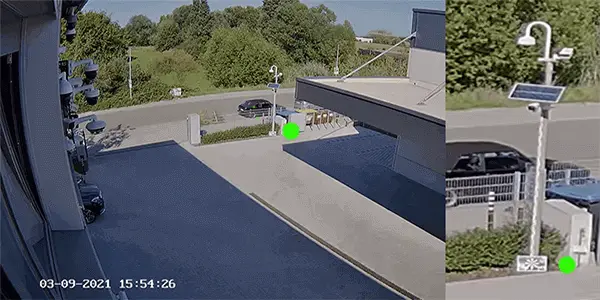
For large properties with distances of 50 meters or more (see Figure 8), an 8-megapixel 4K UHD surveillance camera can certainly bring added value. However, it depends on what you want to recognize at a distance of 50 meters.
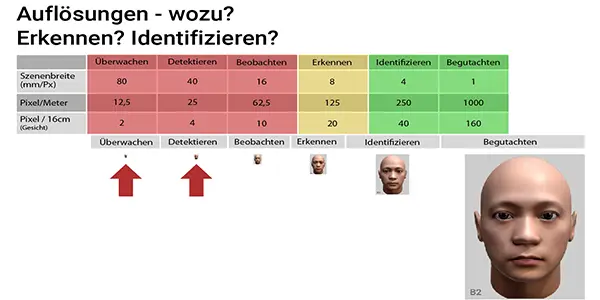
Is it solely a matter of detecting a person, or should the person possibly also be identified at that distance? (see Figure 9)
Despite the high resolution of a 4K camera at 3840x2160 (8,294,400 pixels, 4.0 x 1080p), it is not sufficient for identification at 50 meters without a zoom lens. (see Figure 10)
To implement efficient video surveillance, you first need to determine the various tasks of the surveillance system and the expectations associated with them. Based on this assessment, the surveillance cameras with the appropriate resolution are selected individually for each area of application.
Simply assuming the highest possible resolution for a complex surveillance system with several surveillance cameras is not recommended. Unnecessarily high resolution can put a strain on the network and reduce the frame rate of individual surveillance cameras.
In addition, multiple high-resolution cameras in a system, resulting from a larger number of surveillance cameras, also require a suitable NVR (network video recorder) or NAS so that the video recordings can be processed.
Hence our expert advice: high resolution, yes, when it is necessary, and no, when it is pointless and therefore inefficient.
Describe your requirements to us, and our certified video surveillance technicians will be happy to advise you.


