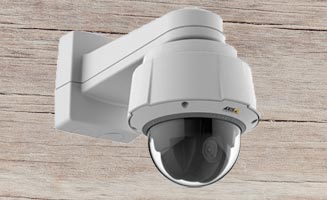
In this blog post, we would like to introduce you to the design of the PTZ or Speed Dome camera. What defines this type of camera, and for which application areas is it suitable? Find out more here about the advantages and disadvantages of PTZ surveillance cameras!
What is a PTZ Dome Camera?
Pan Tilt Zoom (PTZ for short) dome cameras, which some manufacturers also sell under the name Speed Dome, offer the ability to pan the surveillance camera by up to 360° and to tilt it. At the same time, the image section can also be zoomed, which makes this type of camera particularly flexible and offers a large, individually adjustable surveillance area.
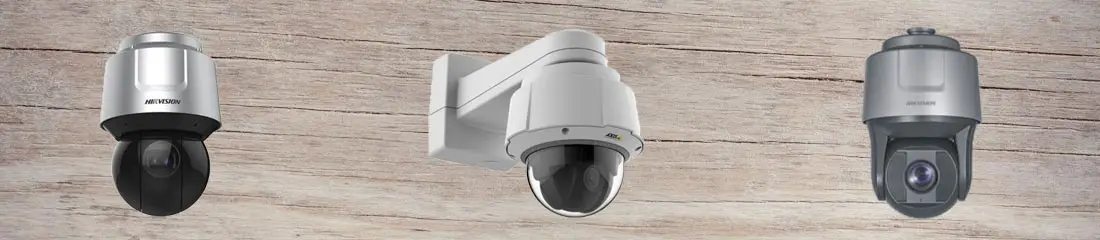
These cameras usually have a dome-like shape, which explains the name "Dome". Other PTZ cameras have a more cylindrical shape. The dome-like shape can be seen in the picture above, in the center, with the example product AXIS Q6055-C, while the cylindrical shape is shown on the right with the HIKVision DS-2DF8225IH-AELW. There are also spherical PTZ cameras, shown on the left in the picture: the HIKVision DS-2DF8A836IX-AEL.
Due to the motors that move the camera, as well as the size of the built-in lens, PTZ cameras are considerably larger in design than, for example, fixed dome cameras. If you would like to learn more about this type of camera, we have compiled further information for you under this link. In such a comparison, a PTZ dome camera is of course much more versatile and more capable in use than other models such as fixed dome or bullet cameras, thanks to its mobility.
Which advantages do PTZ dome cameras have over dome or bullet cameras?
In a comparison, the PTZ dome camera is of course much more versatile and more capable in use than a regular fixed dome camera or bullet camera, thanks to its mobility.
However, speed dome security cameras are considerably larger in design due to the motors that move the camera, as well as the size of the built-in lens. This affects where they can be installed:
• PTZ dome cameras are used to monitor large areas and wherever it is necessary to zoom, such as at construction sites or on a factory premises.
• Fixed dome cameras offer a comparatively compact design. Therefore, they are frequently used in indoor areas (e.g., at a cash register) or in private gardens.
• Bullet cameras are also fairly large and very conspicuous, which can be used as a deterrent. Compared with a fixed dome camera, more technology can be housed in the housing (e.g., infrared illuminators), which makes them well suited for outdoor use.
Another advantage of PTZ cameras is the ability to pan the camera up to 360° and tilt it up to 90°. With bullet and fixed dome cameras, the field of view is usually between 70° and 100° and is often fixed.
Compared to bullet cameras, dome cameras (both PTZ and conventional) are generally better protected against vandalism damage. This depends mainly on the housing used, but bullet cameras are harder to protect against damage due to their less compact design.
Although PTZ cameras can monitor a large area, there is one important disadvantage: panning and tilting the camera inevitably creates areas that remain unmonitored. For gap-free surveillance or high-security applications, combining fixed and moving cameras is therefore essential. Fixed cameras can monitor the area constantly and trigger an alarm if necessary, while the PTZ camera can verify, recognize and identify. For a professional and reliable security application, we recommend thermal cameras for detection and PTZ dome cameras for identification – or both, such as a dual camera that combines PTZ and thermal imaging.
What should you look for when choosing a PTZ dome camera?
Even more than with other surveillance camera models, high image resolution is important for a PTZ dome camera. Since zooming in on the image section is a key advantage of this camera type, it is of course essential that magnified scenes are also clearly recognizable. A resolution of at least 2 megapixels is recommended, and clearer images are achieved with 4K and higher resolutions. At resolutions of 4K or higher, the typically large optical zoom of this camera type also comes into its own, as no details are lost when zooming.
A high zoom factor is important. This allows even distant areas to be displayed in great detail. This is particularly useful for accurately identifying faces. However, pay attention to the type of zoom: only optical zoom, where the focal length of the camera lens is increased, delivers good results. With digital zoom, as often used in lower-priced camera models, the image pixels are merely interpolated, which reduces the resolution (and thus the sharpness) of the zoomed image.
If the security camera is to be used outdoors, make sure that good images are delivered even in poor lighting conditions. Some PTZ 360° cameras without a dome (such as the Vivotek SD9365-EHL) are equipped with extremely powerful infrared illuminators. These can illuminate up to 250 meters of the current image section (Field of View). The PTZ camera intelligently illuminates only the current image section.
Depending on the application, it may be necessary for the camera to be controlled remotely. For outdoor use, make sure the housing is certified to at least IPXX and therefore protected against rain.
Application possibilities for PTZ cameras
• Tracking: PTZ cameras can be used effectively to track people or vehicles. However, note that a single camera can of course only capture and follow one target at a time, and not all PTZ cameras have a tracking function.
• Patrol runs or approaches to fixed points: Using so-called presets (preset positions), the pan and travel ranges of the camera can be programmed and then executed automatically. This increases the area that can be monitored.
These are only two of the many applications for which PTZ video surveillance cameras are particularly well suited because of their functions and features, and where speed dome cameras offer a considerable advantage over other fixed cameras. Nevertheless, even a PTZ camera can of course only point in one direction at a time.
You will find further information on these terms in our Glossary. An overview of all available PTZ cameras can be found in our shop under PTZ 360° Cameras. In addition, over the coming weeks we will present further camera types and their advantages on our blog.
For personal advice, we are of course, as usual, also happy to help by phone or email.
We look forward to your inquiry!