Are you wondering which camera form factor is the right one for your security project? In our blog posts on the different camera types, we gradually explain the special characteristics of individual cameras and tell you about their advantages.
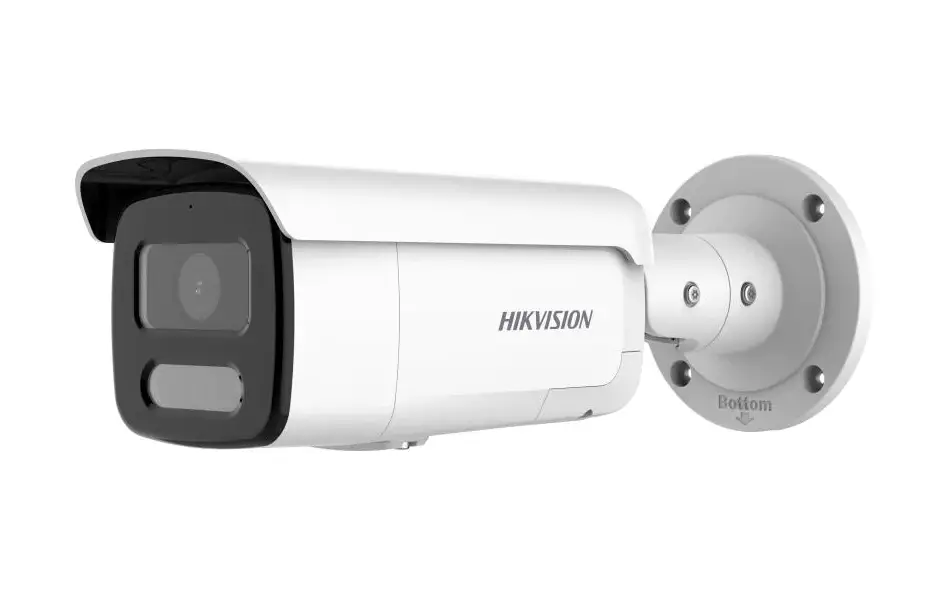
(Example image of a common bullet camera)
What Matters When Choosing the Right Bullet Camera?
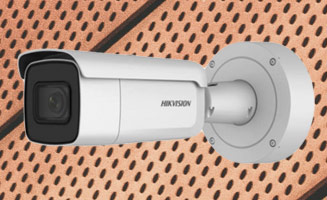
This design differs from a Fix Dome Camera, for example, in its elongated or cylindrical shape. A "classic" example is the HIKVision Kamera HK304108 shown at the top right. Apart from a few application-specific advantages, the core functions of the camera, depending on its equipment, are not very different from those of a dome camera.
However, because of its cylindrical design, a bullet camera can be noticed by an intruder from a greater distance, which is why this camera type is particularly suitable for outdoor use. A fixed dome camera, for example, is more aesthetic and smaller and is therefore often less conspicuous. The visibility of the camera can also be affected by the mounting method. The most important advantage of a bullet camera over a fixed dome camera is that its size leaves more room for technology (e.g. infrared illuminators with a longer range or thermal imaging functions). Likewise, with a bullet camera, problems with infrared reflections, which often occur with a fixed dome camera due to its dome design, are largely ruled out.
Focal Lengths and Lens Variants of the Bullet Camera
A bullet camera can be fitted with a fixed lens with a fixed focal length, but then it offers no zoom function. If the bullet camera has a fixed focal length, this affects the monitored image section, which you should be aware of when planning and purchasing a specific camera type.
Bullet cameras are also available with a varifocal lens, for example with a focal length of 2.8 to 12 mm, which accordingly has a zoom range. Please note that with a varifocal lens, the zoom range should only be used to set up the camera for each application and is not suitable for constant zooming.
With a bullet camera featuring motorized zoom (e.g. 2.8 to 12 mm), you can, under certain circumstances, use the optical zoom to enlarge and bring closer a specific area in the image. The rule here is: the more you zoom in on the image, the more you reduce the image section (FOV or Field of View). With optical zoom, the megapixels and therefore the image quality remain unchanged when zooming. Adjusting the image section with motorized zoom is more flexible and convenient, and it can be changed as needed at any time.
You can also find further information on camera types and many other technical terms from the field of security and surveillance technology in our glossary.
An overview of all available bullet cameras can be found in our shop. In the coming weeks, we will also present other camera types and their advantages on our blog, such as fix dome cameras or PTZ / speed dome cameras. Of course, we are also available for personal advice, as usual, by phone or email.
We look forward to your inquiry!