

Door intercom systems with an integrated camera add a layer of security because you can see who is standing at the door. However, not all systems serve their purpose. Before buying, it is therefore important to understand the features of video door intercom systems. This way, you can be confident that you are purchasing a product that actually provides protection.
Why a video door intercom system?
When the doorbell rings, you want to know who is standing outside before opening the door. There are plenty of cases in which unauthorized persons try to gain access to a home in order to commit illegal acts there. This applies in particular to multi-family buildings. The intruder simply rings at every unit in the hope that someone will open the door.
But residents of single-family homes also want to protect themselves and keep unauthorized persons out.
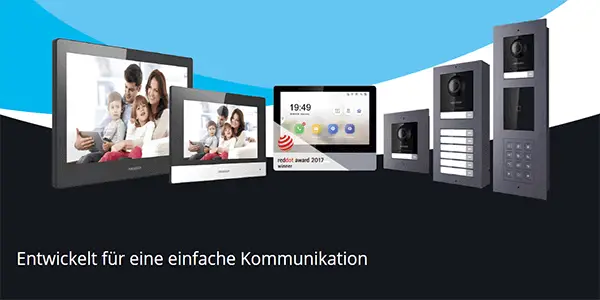
This is made possible by video door intercom systems. They combine the functions of a classic intercom with video image transmission. This allows the resident inside to see right away who is standing at the door.
However, this requires that the video door intercom system also serves its purpose and is technically capable of doing so. Therefore, a number of things should be considered before purchasing such a system.
Conventional or network-based door intercom systems?
Compared with the conventional "doorbell systems" that have been around for years, network-based door intercom systems offer many technological advantages, which increase convenience and therefore quality of life.
By connecting a door intercom system to the home router, whether via LAN cable or Wi-Fi, new communication options become available.
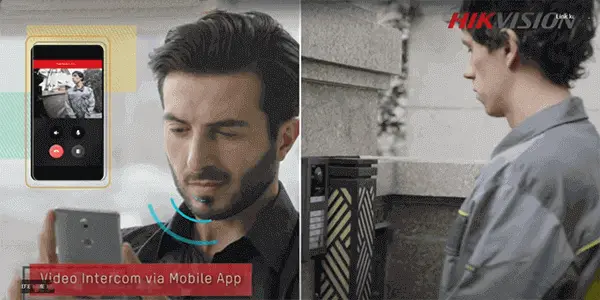
If the mail carrier rings the doorbell while you are away, the door intercom system sends the signal, including image and sound, to your phone via a push notification, for example. No matter where you are in the world, you can communicate with the mail carrier through your phone with image and sound. If you cannot answer the phone at that moment, the mail carrier can leave a message that you can retrieve and view later on your mobile device.
Therefore, network-based door intercom systems are far superior to conventional "doorbell systems", which are mostly overpriced as well.
Camera Resolution and Display Quality
The resolution, or the number of pixels the camera can produce for the image, affects image quality. The more pixels are resolved, the clearer the image generally is. For example, a camera with a Full HD resolution of 1920x1080 pixels offers more sharpness than a camera with a resolution of 640x320 pixels.
However, a good camera resolution alone is pointless if the display of the door intercom system cannot reproduce it. If the display itself has only 1280x720 pixels (HD-Ready), a Full HD camera will not help. Therefore, make sure the components always match.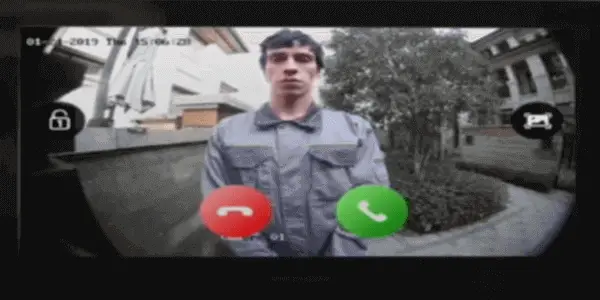
Light sensitivity
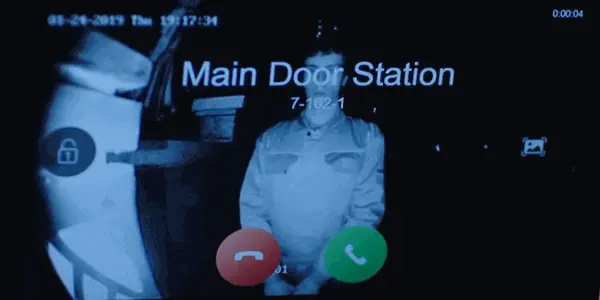
The light sensitivity of the camera in a video door intercom is especially important in situations with low light or unfavorable lighting conditions. If someone rings at the door in the evening or at night, for example, the camera should be able to deliver a clear image even without daylight. Here it can be helpful if the camera has suitable infrared illuminators or white light illuminators. Coordinate with your installer to ensure the door intercom is mounted according to the technical requirements. In combination with a motion detector on a light, the lighting conditions can be improved for less capable camera models.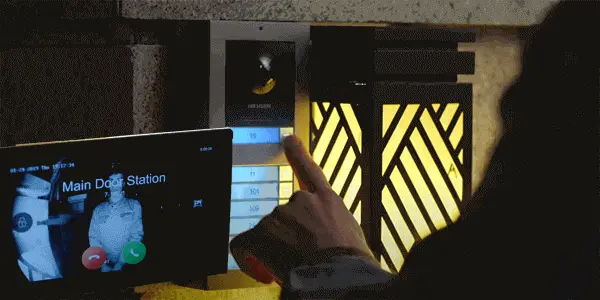
Is an additional mains power connection necessary?
Modern door intercom systems are nowadays mostly based on IP networks. Some video door intercom systems can be easily connected to the (two-wire) cabling of the door opener, which is usually already installed, and which can then be used for audio and video transmission as well as for opening the door. Other systems, however, require additional power and must therefore be connected to the mains power supply, which means extra installation effort.
Thanks to the rapid development of security technology, many well-known manufacturers such as Axis, Hikvision, 2N, Hanwha or Dahua now offer the option of not only conveniently connecting door stations to the in-house network via LAN cable, but also supplying them with power through it via PoE (Power over Ethernet).
Another alternative for connecting door stations to the home network is simply via Wi-Fi. However, despite the convenient network connection, the door station and the monitor must each be supplied with power separately on site using power supplies.
Protection against mechanical force
To protect a video door intercom system against mechanical force and vandalism, an appropriate protection class is required. Otherwise, an attacker can easily damage your camera, which can become very expensive in the long run. Regarding protection against manual force, there is a classification into IK protection classes, ranging from IK00 (no protection) to IK10 (impact from a 5 kg hammer dropped from 40 centimeters).
It is best to have your specialist dealer advise you on which IK protection class is the right one for your purposes.
Protection against moisture and dirt
Depending on the installation location of the video door intercom system, enhanced protection against moisture and dirt can also make sense. This is the case, for example, when there is no canopy and the system is exposed to precipitation. Here too, there is a division into different protection classes. The so-called IP protection rating ("International Protection Codes") is used.
The first digit indicates protection against contact or foreign objects such as dust, and the second digit stands for protection against moisture. For example, a video door intercom system with a suitable IP protection class offers complete protection against contact and dust, as well as against water jets from all directions.
Viewing angle and focal length of the lens
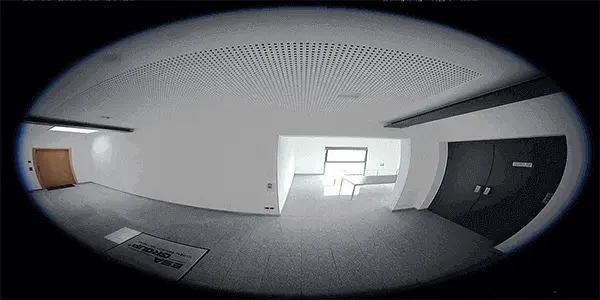
Depending on the focal length of the lens, the area that can be covered by the camera of the video door intercom differs. Modern video door intercoms from well-known manufacturers are usually equipped with a fisheye camera that offers a viewing angle of 180°, allowing the entire door area to be monitored to the left and right.
In principle, when installing a video door intercom, data protection compliance must be observed. A video door intercom should not be used for video surveillance of uninvolved persons or neighbors. This also includes public streets and paths in front of the house and apartment.
We also recommend that you have us, as specialist installers of video door intercoms, advise you on this. Our technicians are happy to provide you with a thorough and data protection-compliant consultation on a suitable video door intercom.
Observe the legal situation when recording audio and video
Some video door intercoms allow audio and video to be recorded. This information can be used to later identify the perpetrator in the event of an unauthorized intrusion. However, making recordings without the consent of the persons concerned is only permitted if the interest in the recordings justifies it – for example, if there have been multiple break-ins in the past. Therefore, it is best to find out in advance whether you are allowed to make recordings.
Conclusion
For security reasons, installing a video door intercom is definitely a worthwhile investment. However, several considerations should be made before purchase so that the system can fulfill its purpose and later disappointments or problems during operation can be avoided.


