

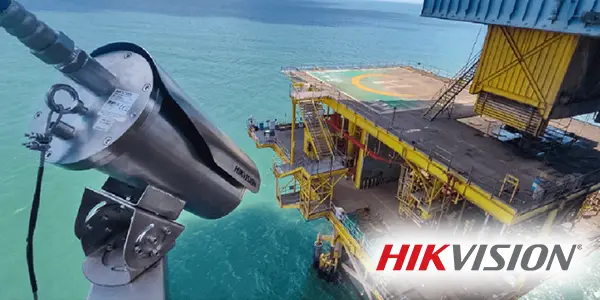
Protecting oil and gas production facilities is of great importance, as sites such as offshore oil platforms carry special safety and environmental risks. The greatest challenges include the high risk of fire and explosion posed by volatile hydrocarbons and the extreme weather conditions at sea, with salty air, strong winds and poor visibility. These conditions can impair conventional security equipment and lead to operational interruptions and security gaps.
Oil and gas facilities are attractive targets for theft, piracy and terrorist attacks, which gives the requirements for security and environmental monitoring the highest priority. Another important aspect is the obligation on companies to protect the environment, which calls for the use of suitable security technologies to minimize the impact on local ecosystems.
Technical Solutions for Monitoring Oil and Gas Platforms
To meet these challenges, oil and gas companies are increasingly relying on integrated security systems that use modern technologies such as thermal imaging cameras, explosion-proof devices and deep learning algorithms. Explosion-proof cameras, often housed in stainless steel enclosures, prevent sparks or heat from coming into contact with flammable gases. They are designed to meet international corrosion protection standards and to withstand the prevailing conditions at sea.
Thermal imaging cameras play a decisive role in the early detection of overheating, fires and gas leaks, as they can detect even the smallest temperature changes.
Deep learning algorithms improve threat detection rates by distinguishing between false alarms, such as those caused by seabirds or waves, and real threats, such as unauthorized persons, thereby improving the response times of security teams.
Security Technology in Oil Production: A Real-World Example
An example of the successful implementation of these technologies is the La Santa Maria offshore oil drilling platform in the Gulf of Mexico, a particularly sensitive ecosystem where numerous accidents have already occurred.
Advanced security solutions from Hikvision are used here, including thermal and optical bi-spectrum network bullet cameras and explosion-proof thermographic network bullet cameras. Every single Hikvision camera deployed there is designed in the best possible way to minimize the risk of sparks. Thanks to their thermal imaging functions, the cameras enable early detection of temperature anomalies. Deep learning algorithms reduce false alarms, so that security personnel can focus on real threats.
The corrosion-resistant Hikvision cameras are ideally suited to the harsh conditions at sea and thus contribute to long-term value for the company.
Do you have questions about video surveillance systems and surveillance cameras? Then feel free to contact us. Our security experts at German Protect look forward to hearing from you.


