

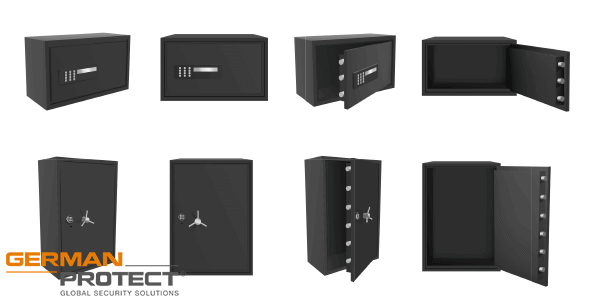
A safe must do more than protect against break-in attempts. It must also protect its contents from damage in the event of a fire.
For this reason, when selecting the right safe, it is important to check its fire protection rating and its security grade or resistance class.
The security technology range offers a wide selection of safes for various applications, from furniture safes for short-term storage of valuables to solid cabinet safes designed to permanently protect valuable documents or electronic data media.
Depending on the intended use, it is important to choose a safe with the appropriate fire protection rating as well as the appropriate security grade or resistance class.
Fire Protection of Safes
There are different national and international standards for classifying the fire protection of safes.
The most important standards and their countries of origin are:
- EN 1047-1 (Germany)
- EN 15659 (Germany)
- NT Fire 017 (Sweden)
- UL 72 (USA)
Each standard sets different requirements that a safe must meet in order to comply with that standard.
For example, EN 1047-1 requires that a safe classified as S60 DIS ("DIS" stands for "floppy disks") provide fire protection for more than 60 minutes.
For a classification of S120 DIS, at least 120 minutes are required. The temperature rise inside the safe may not exceed 30 Kelvin.
Comparable classifications also exist for the protection of paper documents.
UL 72, by contrast, requires fire protection of at least 30 to at least 240 minutes, depending on the classification.
Different tests are carried out depending on the standard, and they can differ according to various criteria, for example:
- Duration of flame exposure / heating of the safes
- Whether a cooling phase is part of the test or not
- Test with or without fire blast
- Test with or without drop test
Security Classes and Resistance Grades of Safes
To be best protected against break-in attempts, a safe must be assigned to a sufficient security class.
This classification depends on various criteria, such as:
- Fire protection / fire seal present?
- Single-wall, double-wall or multi-wall safe?
- Filling material between the safe walls?
The most important resistance grades for safes are EN 1143-1 and EN 14450. For example, security level N (0) under the EN-1143-1 standard specifies that both the body and the door must be multi-walled and that a fire seal running around the edge must be present. Security level I, by contrast, additionally requires a special door filling. In the higher security level V, the entire filling must consist of special concrete.
The EN-14450 standard requires, at security level S1, at least a double-walled door, a single-walled body and a locking mechanism. At security level S2, a double-walled body must also be present.
By comparison, the requirements for safes under EN-1143-1 are higher than under EN 14450.
For completeness, the VDMA 24992 standard should also be mentioned, which has security levels A and B.
Which fire protection and resistance class do you need for your safe?
When choosing the right resistance class for your safe, you should first ask yourself a few questions:
- How long will the valuables be stored? Only temporarily or permanently?
- How great is the risk of fire?
- What type of valuables are to be stored (documents, electronic data media, jewelry, etc.)
- What level of resistance should the safe offer against break-ins?
- Size / capacity of the safe
- Protection against humidity / moisture
- Should the safe be portable?
- Would additional protection through an alarm system make sense?
- Should the safe room be equipped with video surveillance to prevent unauthorized access?
In our online shop you will find an adequate selection of products from renowned manufacturers such as Atlas Tresore or Honeywell.
Our security technology expert team would be happy to advise you on selecting your safe.


