

Crime in the retail sector is on the rise. In the United Kingdom alone, retailers' losses from theft in the past year amounted to more than 1.1 billion euros. Losses have thus almost doubled since 2016. This trend can also be seen elsewhere, for example in Australia and New Zealand, where theft losses in retail have totaled more than 1.8 billion euros.
What options are there to protect against losses, safeguard the business and increase profitability?
There are a number of solutions that can help prevent losses. These range from networked surveillance solutions that can provide visual information about relevant incidents and thefts, to data analytics that provide insights into store operations, to audio technologies that enhance deterrence. These technologies are designed to detect suspicious activity, enable a rapid response and prevent future incidents.
Change in Retail Through AI and Machine Learning
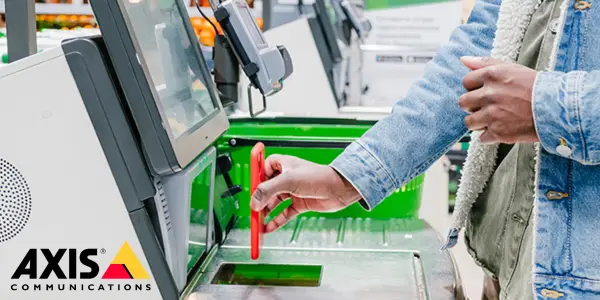
In recent years, retail has undergone a remarkable transformation. Faced with growing staff shortages and skilled labor shortages, as well as the need for improved operational efficiency and productivity, the retail sector is now investing more heavily in automation and AI-based technologies. As a result, self-checkout systems, such as scan-and-go checkouts, and other self-service options are becoming more common. Some stores have gone one step further and eliminated checkouts altogether.
Indeed, research shows that the market for "unmanned" stores will see considerable growth in the coming years. After being estimated at 62.2 million euros in 2019, it is expected to rise to 1.5 billion euros by 2027. This new retail model is here to stay. However, while this increase in in-store automation reduces the workload of staff, it also places new demands on loss prevention as well as on the security and protection of inventory. Without appropriate solutions, unmanned stores and self-checkout systems can have a significant impact on retail losses.
Video Surveillance for Loss Prevention
Intelligent video surveillance systems are essential for cushioning potential losses. In modern retail, AI-based surveillance cameras and sensors give retailers insight into what is happening on site. This makes it possible to identify risks and detect hidden patterns that people might overlook. This speeds up analysis. In addition, these intelligent solutions help prevent theft and fraud by detecting suspicious activity. Security teams can use real-time data to quickly identify deviations or suspicious activity, allowing them to act more effectively and efficiently. Real-time information enables a faster response to threats, faster investigation of incidents and more effective security measures.
Intelligent technology can provide support beyond merely detecting suspicious activity. By learning from past incidents, such as repeated thefts, AI can recognize patterns and even identify potential offenders. This enables retailers not only to prevent future crimes but also to hold those responsible accountable.
As with any data collection and all analyses, it is important to consider the ethical concerns regarding data protection and possible misuse of the technology, and to do so before implementation.
Combating Retail Crime with Integrated Network Solutions
Integrated network solutions (including cameras such as an Axis camera, audio, sensors, access controls, video management systems and analytics) are indispensable in retail for preventing losses. Because these solutions can be linked to every point-of-sale (POS) transaction, it is possible, for example, to visually examine unusual cancellations, refunds or exchanges. Product returns are also recorded on video.
There are a number of use cases in which you can use integrated network solutions and video surveillance to detect and prevent suspicious activity in high-risk areas:
- Missing or incorrect scans at self-checkout: Video analytics can detect an unscanned product and prompt the buyer to scan it again. A notification can be sent to sales staff.
- Cart theft: If a customer attempts to leave the store with a full shopping cart without paying, video analytics and audio alerts can be used to guide them back to the checkout.
- Transaction without a customer present: By adding a sensor to the cash register that detects when the cash drawer is opened, it can be checked in conjunction with a camera whether a customer is present. If the cash drawer is opened and the camera determines that no customer is present, a notification can be sent to management.
- Monitoring of valuable goods: If a cover or cabinet door is wirelessly connected to a surveillance camera and is opened, sensors can cause the camera to zoom in on the cabinet. When an employee swipes a card over a reader that opens the cabinet, the time and identity are recorded. These two scenarios enable traceability of access and provide visible evidence.
- Loitering: The integration of audio functions and analytics enables action to be taken in response to suspicious activity. For example, cameras can be used to detect whether a shopper stays in an area for a long time, so that a notification can then be sent to staff. At the same time, a message can be sent to the waiting shopper that help is on the way.
Monitoring Deliveries
Shrinkage can also occur away from the sales floor. This particularly affects the receipt of deliveries. To counter this, authorized deliveries can be verified via intercoms, QR codes or license plate recognition. Access can be controlled remotely. In addition, portable or permanently installed cameras can be used to visually confirm that the correct number of ordered goods is being loaded and unloaded. Analytics can identify vehicles on the premises. Once a vehicle of interest has been detected, edge-based analytics can automatically send a notification to the responsible staff.
Do you have questions about network-based loss prevention in retail through video surveillance? Then feel free to contact us. Our security experts at German Protect look forward to hearing from you.


