

Thanks to the rapid development of modern video surveillance, intelligent surveillance cameras offer effective protection against burglars. Compared with a conventional alarm system, the surveillance camera can warn in time, before the intruder reaches the building and begins carrying out their plan.
The most important points at a glance:
What does perimeter surveillance mean?
How effective is perimeter protection with a surveillance camera for securing my premises?
How do I set up perimeter protection with a surveillance camera?
What does perimeter surveillance mean?
The term "Perimeter" comes from Greek and means "around."
In the field of security technology, the term "perimeter surveillance" describes the ability of an IP camera, through various setting options in its programming, to specifically monitor different critical zones on a site. The alarm zones on the site can be precisely defined in the settings of the IP camera using geometric drawings. If movement occurs in a predefined area, the surveillance camera immediately informs the owner or the NSL emergency and service control center and notifies them of the registered movement. Modern surveillance cameras suitable for professional video surveillance can distinguish the type of movement, whether it is a person, an animal or a vehicle, and alert accordingly.
How effective is perimeter protection with a surveillance camera for securing my premises?
Due to the usually too wide field of view, as well as the high resolution of IP cameras, oversized surveillance images often result, which are only rarely relevant for video surveillance. The idea of covering a huge area with just one surveillance camera and thereby creating a general overview of the situation is correct in principle, but not effective for reliable video surveillance. The image from the IP camera provides unnecessary information due to the large field of view, such as sky or distant corners, which is not only irrelevant for video surveillance but also limits the accuracy of the monitoring in its functionality. Thus, the IP camera cannot guarantee reliable alarm triggering, which weakens the entire security concept. This problem changes as soon as the precise perimeters where the IP camera should raise an alarm are defined in the settings. The surveillance camera still provides a broad overview of the situation, but can reliably trigger an alarm specifically when predefined areas are breached.
From a security perspective, perimeter protection using video surveillance is certainly an effective method of protection that has demonstrably helped significantly reduce break-ins. Thanks to advances in video technology, comprehensive protection of a site using several surveillance cameras with different monitoring capabilities is very effective. For example, thermal imaging cameras, which can detect an intruder from a great distance, can be combined with PTZ 360° cameras, which identify the intruder and track them across the site. This combination of different surveillance cameras increases the level of protection and, accordingly, the effectiveness of the security system. Based on precisely predefined areas that each IP camera is to monitor, every camera is given a correspondingly precise task within the surveillance chain, which significantly improves the quality of video surveillance by greatly reducing false alarms.
Of course, this type of video surveillance can sometimes present the operator with certain knowledge hurdles due to its complexity. However, these quickly lose their difficulty once the functionality of perimeter surveillance and its setting options are understood.
How do I set up perimeter protection with a surveillance camera?
From a practical standpoint, setting up perimeter surveillance based on predefined areas is the same for almost all manufacturers.
The difference mostly lies in the manufacturer's software, where the respective setting options for programming the surveillance zones are located.
Our video shows, for example, how alarm zones can be defined on a Hikvision camera.
You can find another video on setting options for perimeter surveillance using a PTZ 360° camera here.
(Interested in regular video content on security and surveillance technology? Then follow the German Protect YouTube channel to be notified of new videos and enjoy exciting video content.)
Basically, the following relevant video surveillance criteria should be observed to correctly set up perimeter surveillance:
- When drawing the alarm zones geometrically, avoid sky sections in the image area of the surveillance camera as much as possible. Exceptions are surveillance applications of airspace.
- On a heavily frequented site, avoid defining more than 3 areas with one surveillance camera. With a high volume of alarms, this only causes confusion. For such scenarios, we recommend using a second surveillance camera.
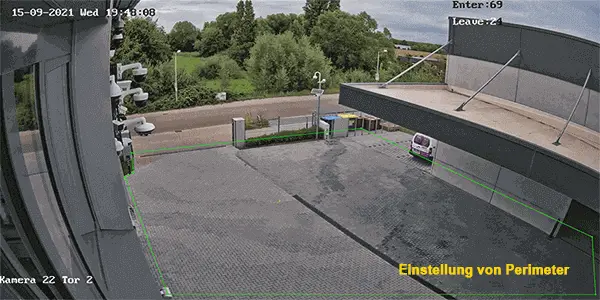
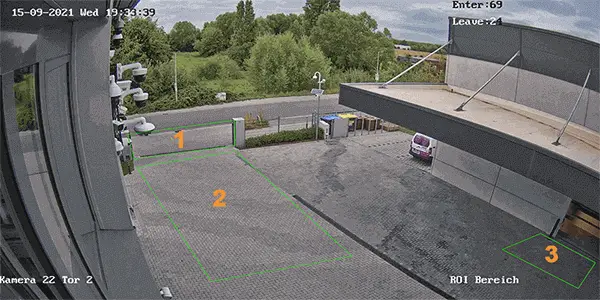
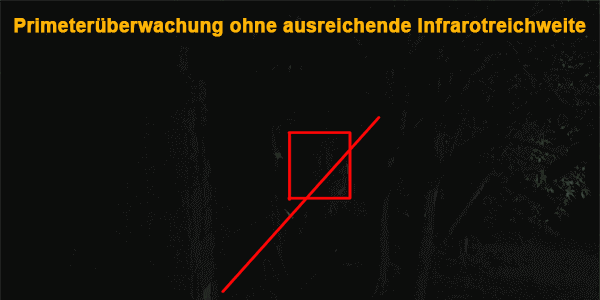
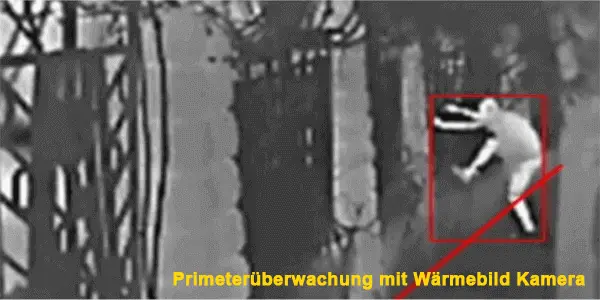
- Only define surveillance areas that can also be clearly viewed by the surveillance camera at night. Take the infrared range of the IP camera or the infrared illuminator into account. To implement perimeter surveillance efficiently at distances of more than 50 meters, we recommend using thermal imaging cameras or bispectral cameras.
Help and advice on selecting a suitable surveillance camera for your perimeter surveillance is available at:
+49 6232 1002425. Our video surveillance expert team is happy to assist you.


