

Dahua EN54 Camera: Detecting Fires Early with AI and Thermal Imaging
A new era of early fire detection with verification begins.
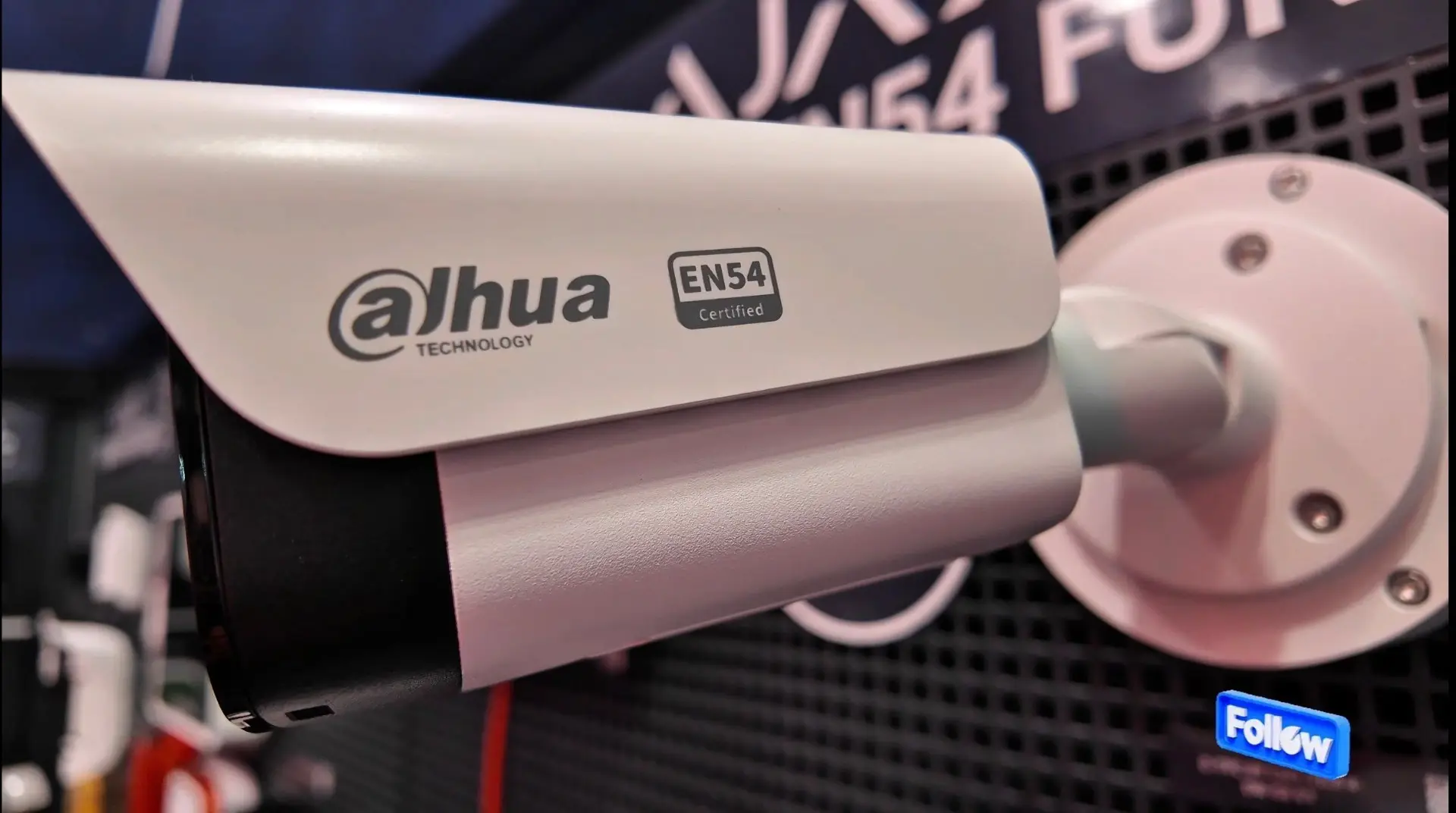
At the Security Trade Fair 2026 in Essen, Dahua Technology presented the bispectral surveillance camera TPC-BF1241-TB3F4-DW-S8-V1 with EN54 certification for fire protection, thermal imaging technology and artificial intelligence.
As part of our “Surveillance Camera Test 2026” series, we at German Protect will test this new EN54 Dahua camera TPC-BF1241-TB3F4-DW-S8-V1 under real-world conditions in detail.
Early Fire Detection with Thermal Imaging and Artificial Intelligence
Fires in industrial plants, warehouses, production facilities and critical infrastructure can cause damage in the millions within a very short time.
Particularly dangerous are fires that initially develop unnoticed and are only detected once smoke or open flames are already visible.
Conventional fire alarm systems can reach their limits, especially in large halls, extensive outdoor areas and hard-to-access building areas.
At the Security Trade Fair 2026 in Essen, Dahua Technology presented the TPC-BF1241-TB3F4-DW-S8-V1, a new bispectral surveillance camera for professional early fire detection.
You can find this Dahua camera in our German Protect online shop under article number DA284957.
The special feature of this Dahua camera lies in the combination of thermal detection, optical video surveillance, intelligent analysis and EN54 fire protection certification.
Thermal anomalies can be detected early and then verified using an optical video image.
For industrial companies, operators of critical infrastructure, security control centers and fire safety managers, this opens up new possibilities for the early detection and assessment of fire hazards.
Two Image Sensors for Thermal Detection and Optical Verification
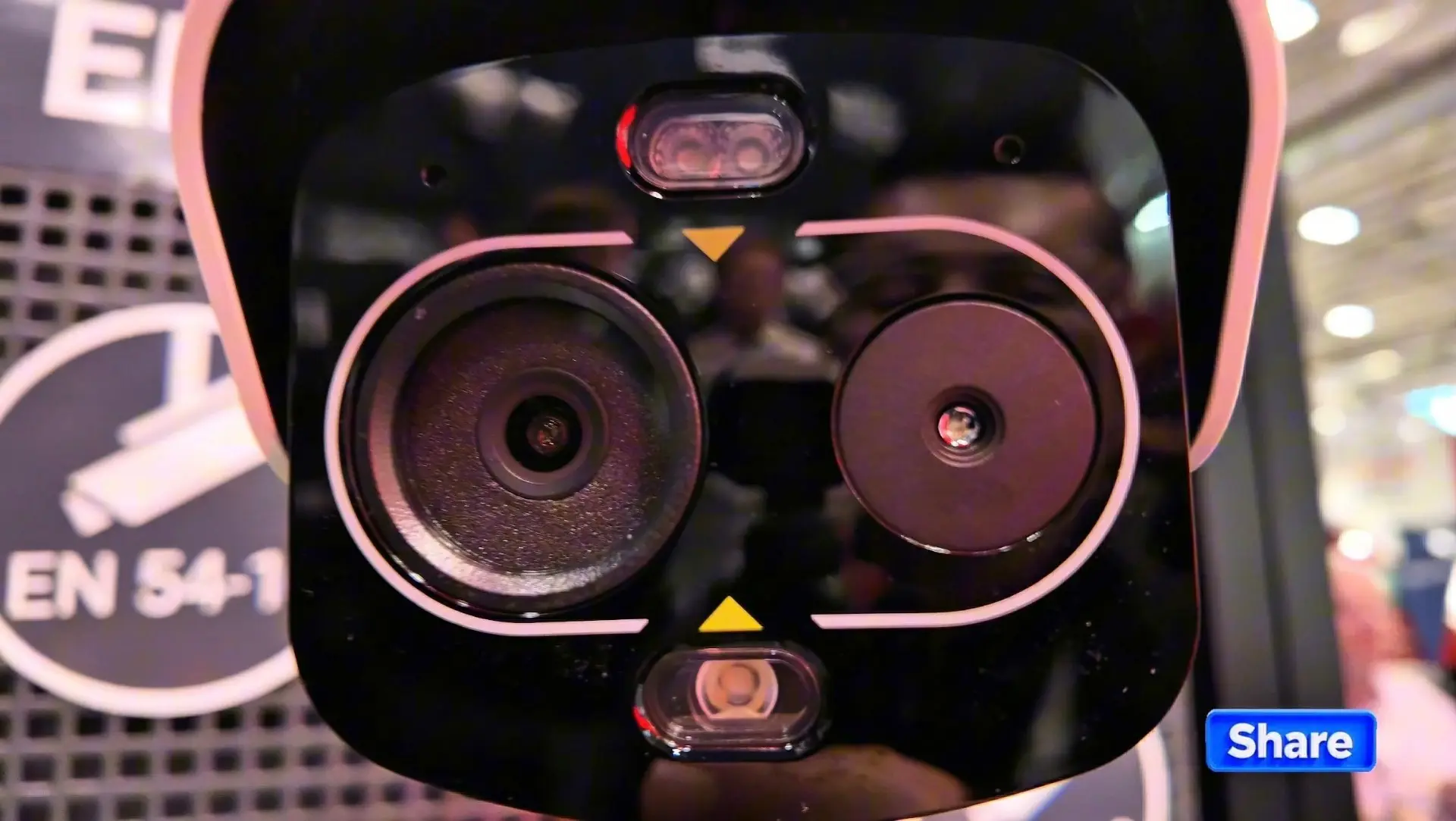
The Dahua TPC-BF1241-TB3F4-DW-S8-V1 combines two different image sensor technologies in one housing.
Optical image sensor with 4 megapixels and 1/1.8 inch
The optical image sensor has a resolution of 4 megapixels and a sensor size of 1/1.8 inch.
The large-format image sensor provides good conditions for detailed image display. Actual image quality also depends on the lens, the lighting conditions and the image processing.
The optical surveillance camera serves primarily for visual verification.
If a thermal anomaly is detected, the optical image can be used to assess the situation.
For example, it can be checked whether an elevated temperature is caused by a normal production process, a technical system or a possible fire.
Thermal Image Sensor with Temperature Measuring Range from -20 to +650 °C
The second image sensor operates in the thermal range (thermal imaging) and captures temperature information.
The specified temperature measuring range extends from minus 20 to plus 650 degrees Celsius.
This makes it possible to detect thermal anomalies and possible fire sources before visible flames or larger amounts of smoke may develop.
Defined surveillance areas can be continuously checked for unusual temperature developments.
Thermal detection works independently of visible ambient light. This allows the thermal imaging camera to be used even in darkness.
Measuring distances, visual obstructions, surface properties and environmental conditions must be taken into account during planning.
By combining both image sensors, thermal events can be detected and verified using the optical image.
Xianghan Large Scale AI Model: Artificial Intelligence Against False Alarms
A special feature of the Dahua surveillance camera TPC-BF1241-TB3F4-DW-S8-V1 is the Xianghan Large Scale AI Model.
The artificial intelligence is designed to reliably detect relevant events and reduce the number of unnecessary alarms.
This is a demanding task, especially in industrial facilities.
Hot machinery, production processes, reflective surfaces and changing thermal conditions can cause temperature changes that do not necessarily indicate a fire.
Intelligent video analysis must therefore distinguish normal operating states from possible hazardous situations.
The Xianghan Large Scale AI Model is designed to improve detection quality and significantly reduce false alarms.
This is especially important for operators of large industrial facilities and critical infrastructure. False alarms cause costs, interrupt operations and tie up security personnel.
We will examine in our practical test how reliably the new AI works under real-world conditions.
EN 54 certification for professional fire protection
The Dahua TPC-BF1241-TB3F4-DW-S8-V1 surveillance camera has certification for fire protection according to EN 54.
The European EN 54 standard series sets requirements for various components of fire alarm systems and fire alarm systems.
For professional security projects, this certification is particularly relevant when fire detection and alarm signaling are to be integrated into existing security concepts.
When planning the project, it must be considered which functions are covered by the specific EN 54 certificate.
Suitability for a specific fire alarm system or for an application required by building regulations must be checked on a project-specific basis.
Notre-Dame fire disaster: could thermal imaging technology have detected the fire earlier?
The devastating fire at the Notre-Dame Cathedral in Paris on April 15, 2019 shows the dramatic consequences a fire can have in a historic roof structure.
Large parts of the centuries-old roof truss were destroyed. The crossing spire collapsed, and one of Europe's most important cultural monuments was severely damaged.
Especially in historic buildings, early fire detection is particularly important.
Old roof structures often consist of large amounts of combustible material. Concealed areas, extensive timber structures and hard-to-reach parts of buildings make fire protection monitoring difficult.
Under suitable installation conditions, a modern bispectral thermal imaging camera such as the Dahua TPC-BF1241-TB3F4-DW-S8-V1 could potentially have detected a critical temperature rise early, before the fire spread over a large area.
A prerequisite would have been that the affected area is within the field of view of the thermal imaging camera.
Additional optical verification could have allowed security personnel to assess the situation more quickly and initiate appropriate measures.
Whether the Notre-Dame fire would actually have been detected earlier or its extent prevented with such technology cannot be determined with certainty in hindsight.
Decisive factors would have been the positioning of the thermal imaging cameras, a clear view of the point of origin, the sensitivity of detection and the subsequent alarm.
The Notre-Dame fire clearly shows how important modern thermal imaging cameras can be for preventive fire protection.
In addition to industrial facilities and critical infrastructure, historic buildings, churches, museums, libraries and other valuable cultural assets are also suitable for professional thermal early fire detection.
In fire protection, a few minutes can determine whether an incipient fire can be contained or develops into a disaster.
IP68 and IK10: Protection for demanding operating conditions
In addition to technical performance, the durability of the surveillance camera plays an important role.
According to the product specifications presented, the Dahua TPC-BF1241-TB3F4-DW-S8-V1 has IP68 protection rating and IK10 impact resistance classification.
IP68 stands for a high level of protection against dust and water under the specified test conditions.
IK10 describes a high mechanical impact resistance of the housing and offers protection against considerable external stress.
These properties are particularly interesting for applications in industrial facilities, logistics centers and exposed outdoor-use locations.
The robust construction allows the thermal imaging camera to be used even under demanding environmental conditions, provided the manufacturer's respective operating limits are observed.
Early fire detection for industry, commercial businesses and critical infrastructure
The combination of thermal imaging camera, optical video surveillance and intelligent analysis offers a range of application possibilities.
Industry and production facilities
In production facilities, overheated machines, electrical systems and technical defects can cause considerable fire risks.
Continuous thermal monitoring of defined areas can help detect unusual temperature developments early.
Warehouses and logistics centers
Large storage areas place special demands on early fire detection.
High fire loads, varied stored goods and extensive building structures can make detection more difficult.
Thermal monitoring systems can be a useful addition to existing fire protection measures.
Critical infrastructure (KRITIS)
In critical infrastructure, fires can have far-reaching effects on supply security.
Particularly relevant are energy supply facilities, substations, telecommunications infrastructure, technical operating rooms and other facilities relevant to supply.
Early detection of fire hazards can help limit operational disruptions and consequential damage.
Recycling facilities and outdoor storage
Recycling plants, waste disposal facilities and large material storage sites are often exposed to particular fire risks.
Thermal anomalies can arise, for example, from material heating, technical defects or incipient smoldering fires.
Continuous thermal monitoring can help detect possible hazards early.
Historic buildings and cultural assets
Churches, museums, libraries and listed buildings place special demands on fire protection.
Valuable building fabric, historic roof structures and hard-to-reach areas require individually developed security concepts.
Thermal early fire detection can be used here as a supplementary protective measure, provided the structural and technical requirements are met.
Early fire detection alone is not enough: alarm response is decisive
Early fire detection is only effective if an appropriate response follows a detected event.
Professional early fire detection must therefore be part of a comprehensive security concept.
This includes reliable event detection, alarm processing, visual verification and forwarding to the responsible parties.
A thermal surveillance camera can detect a fire event. However, the subsequent alarm notification must be planned so that the required measures can be initiated without unnecessary delay.
Depending on the security concept, this may include forwarding the alarm to a security control center or to a fire alarm system designed for this purpose.
Optical verification provides additional information about the affected area and the possible development of the event.
German Protect tests the Dahua camera TPC-BF1241-TB3F4-DW-S8-V1 in the 2026 Surveillance Camera Test
As a permanently certified Dahua Technology partner, ESA GmbH German Protect has been working with professional video surveillance, thermal imaging cameras and intelligent security systems for many years.
As part of our test series "Surveillance Camera Test 2026," we will thoroughly test the new Dahua TPC-BF1241-TB3F4-DW-S8-V1 under real-world conditions.
The surveillance camera is being provided to us directly by Dahua Technology for this purpose.
We will examine how reliably the thermal early fire detection works and what advantages the combination with optical verification offers.
The focus is on the following questions:
-
How early are thermal anomalies and fire events detected?
-
How reliably does the Xianghan Large Scale AI Model work?
-
How does the Dahua surveillance camera perform with different heat sources?
-
How well can detected events be verified optically?
-
What options does the system offer for integration into existing security concepts?
Our evaluation is based on practical tests and traceable results.
For us, what matters is not only the performance data a manufacturer provides, but what results a surveillance camera actually delivers under real operating conditions.
German Protect Conclusion: New Possibilities for Professional Early Fire Detection
With the Dahua TPC-BF1241-TB3F4-DW-S8-V1, Dahua Technology presents an interesting development in the field of intelligent early fire detection.
The combination of a thermal image sensor, an optical surveillance camera with 4 megapixel resolution and a 1/1.8 inch image sensor, the Xianghan Large Scale AI Model and certification for fire protection according to EN 54 offers potential for demanding security applications.
The ability to verify thermally detected hazards with an additional optical image is particularly relevant.
The fire disaster at Notre-Dame illustrates how important it is to detect fire events as early as possible.
Modern thermal surveillance systems can help detect hazards in time and initiate suitable countermeasures.
We will examine in our "Surveillance Camera Test 2026" whether the new Dahua technology also convinces under difficult practical conditions.
Are you planning professional early fire detection for industry, commercial buildings, historic buildings or critical infrastructure?
Contact ESA GmbH German Protect, your certified Dahua Technology partner for professional video surveillance, thermal imaging cameras and intelligent security solutions.
We advise you on security analysis, planning and implementation of professional video surveillance and thermal early fire detection.
ESA GmbH German Protect. Added value for the world of security.


